We see lithium batteries as a strong fit for solar storage because they balance energy density, cycle life, and fast response to solar variability. With chemistries like NMC and LFP, we gain scalable modular designs and robust safety profiles, while costs trend downward over time. Our next steps show how these factors translate into reliable back-up and efficient load shifting, but there are trade-offs and specifics we must map to your site. Let’s unpack those details next.
Key Takeaways
- Lithium batteries offer high energy density and modular scalability, enabling efficient, space-saving solar storage in varying installations.
- Long cycle life and fast response times align with daily solar generation, improving reliability and grid services.
- Advanced chemistries (e.g., NMC, LFP) balance energy density, safety, and temperature tolerance for diverse climates.
- Low maintenance and rapid deployment reduce lifecycle costs and support rapid solar-plus-storage adoption.
- Strong lifecycle efficiency and robust BMS integration enable optimized charging, discharging, and safety across systems.
Why Lithium Is a Strong Fit for Solar Storage
Lithium chemistries offer a compelling combination of energy density, cycle life, and fast response that align with solar storage needs. We compare chemistries through a data-driven lens, focusing on performance metrics, lifecycle costs, and reliability. In a case study style, we quantify round-trip efficiency, calendar aging, and depth of discharge across lithium iron phosphate, nickel manganese cobalt, and solid-state variants. Historical analysis shows gradual improvements in energy density and safety, alongside cost declines that shift total cost of ownership in favor of lithium systems. We emphasize modular scaling, rapid deployment, and low maintenance as core strengths. Our synthesis signals that the technology’s maturity supports both residential and utility-scale applications, with predictable degradation curves enabling robust energy planning for solar portfolios.
How Lithium Chemistries Affect Energy Density and Weight
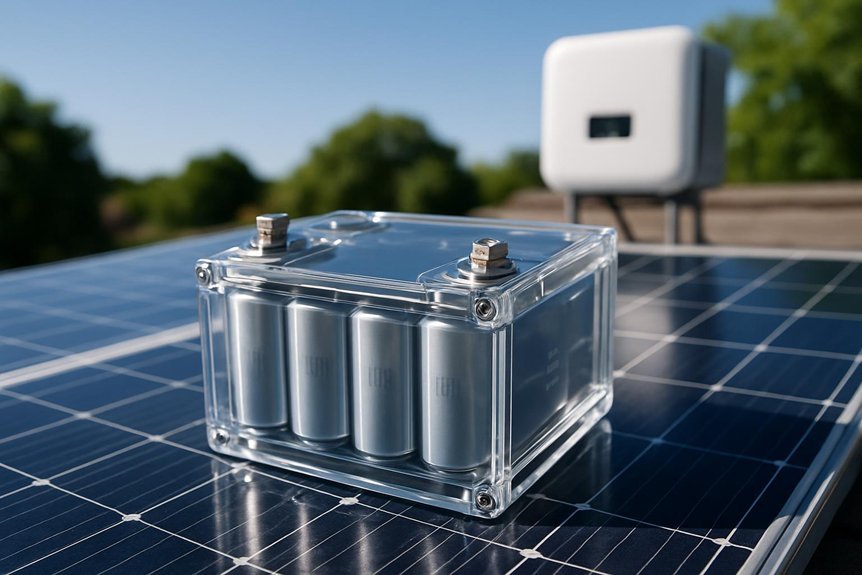
We’ll start by mapping how energy density varies across lithium chemistries and how that translates to system weight, using comparative data on gravimetric energy density and pack efficiency. From there, we’ll assess weight-reduction impacts of design choices, such as higher-NMC versus LFP chemistries and advancements in anode engineering. Finally, we’ll frame a concise chemistry-by-chemistry comparison to guide toward the most energy-dense, weight-efficient options for solar storage.
Energy Density Drivers
Energy density in lithium-based batteries is governed by chemistry- and form-factor–dependent tradeoffs that determine both energy per unit mass and per unit volume. We, as researchers and adopters, examine how chemistries and cell formats modulate energy density and weight impact across applications.
1) Cathode materials set the nominal energy per cell, driving energy density.
2) Anode choices influence volumetric efficiency and cycle stability, altering weight per usable energy.
3) Cell packaging and module design constrain practical density, balancing safety, cooling, and form-factor.
These drivers yield measurable patterns: high-nickel chemistries push energy density up but demand thermal management, while silicon-enhanced anodes offer capacity gains with weight considerations. Overall, data guide optimization of energy density for solar storage deployments.
Weight Reduction Impacts
Weight reduction in lithium chemistries hinges on material choices, cell design, and packaging that collectively lower mass while preserving usable energy. We examine how chemistry, electrode loading, and lightweight housings cut weight without sacrificing cycle life or safety. In our analysis, higher energy density formats yield fewer cells for equivalent capacity, reducing overall pack weight and simplifying balance-of-system components. We quantify mass savings from thinner separators, optimized electrolytes, and advanced anode/cathode formulations that maintain voltage stability under real-world solar storage impacts. Structural integrations, such as lightweight casings and modular pack architectures, further trim mass while preserving thermal management. The result is lower system weight, improved installability, and maintained energy delivery, aligning weight reduction with reliable solar storage impacts.
Chemistries Comparisons
How do lithium chemistries differ in energy density and weight, and what does that mean for solar storage? We compare energy density and gravimetric weight across chemistries to quantify tradeoffs between capacity, cycle life, and form factor. Nonaqueous systems generally deliver higher energy density than aqueous ones, while solid-state variants target improved safety and stiffness without dramatic weight penalties. Lithium sulfur chemistry promises high theoretical capacities but faces practical lifetime issues; solid-state approaches emphasize stability and lower leakage risk, with current gaps in cost and scalable manufacturing. Readers will see how density translates to fewer modules or longer runtimes in mixed-wind, mixed-sun scenarios. The evolution favors nonaqueous vs aqueous and lithium sulfur vs solid state where system requirements demand peak energy.
1) Higher energy density favors fewer modules
2) Safety and stability drive solid-state adoption
3) Practical lifetimes reshape pack design decisions
Real-World Lithium Storage Performance: Range, Cycles, and Reliability
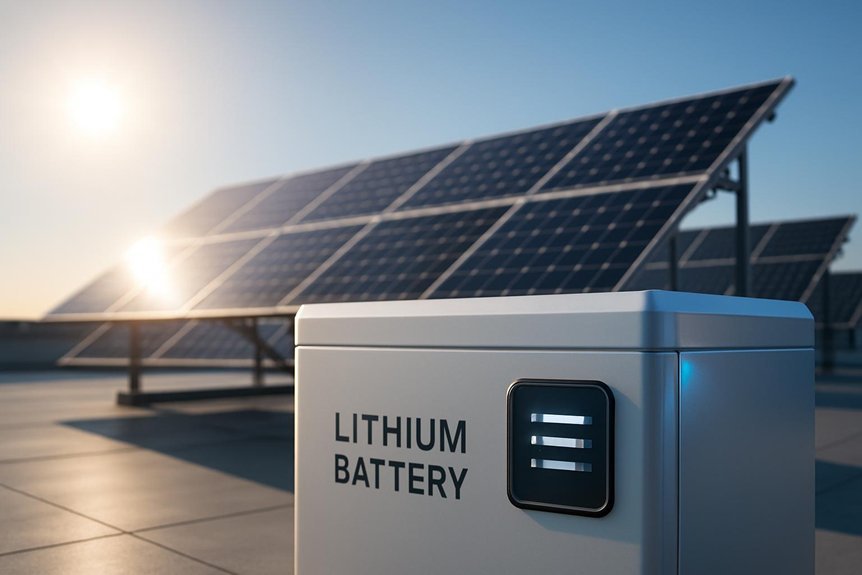
We examine real-world lithium storage performance through three lens: cycle lifespan reality, range realities, and reliability metrics. Our data show how cycle life varies with depth of discharge, temperature, and C-rate, shaping effective usable capacity over time. We’ll compare industry benchmarks to field results to quantify reliability and identify practical tradeoffs for solar storage.
Cycle Lifespan Reality
Real-world lithium storage performance varies more than lab specs suggest, with cycle life, depth of discharge, and temperature shaping usable capacity over time. We see cycle lifespan determined by actual operating profiles, not nominal cycles alone, and degradation rate accelerates at extreme states of charge. Our data show typical degradation rate is lowest under moderate depth of discharge and controlled temperatures, with performance stabilizing after an initial formation period. We quantify losses as a function of cycle count and ambient conditions, enabling accurate planning for grid-scale or residential storage.
- Lower degradation rates occur at moderate DoD and stable temperatures.
- Higher cycle counts reveal nonlinear aging patterns that reduce remaining capacity.
- Temperature swings amplify calendar and cycle aging alike.
Range Realities
Range realities matter when sizing storage systems: how far can lithium packs discharge under typical operating profiles, and how does that affect reliability over years? We present real-world depth of discharge and usable energy, noting that higher C-rate cycling and temperature swings trim available capacity. Our data show gradual capacity fade aligns with cycle count and state of charge boundaries, not just calendar years. Contradicting myths about flat performance, we quantify energy withdrawals during peak dispatch and overnight soak. Scaling challenges emerge as systems grow in size, requiring tighter thermal management and battery management strategies to preserve range.
| Scenario | Usable DoD (%) | Estimated cycles |
|---|---|---|
| High-demand, 25°C | 80–85 | 3,000–4,000 |
Reliability Metrics
What reliability metrics reveal about real-world lithium storage is how consistently packs meet projected range, cycle life, and failure thresholds under typical solar-dominant profiles. We quantify performance through field data, lab aging, and degradation models, anchored by batch-level batch reliability and system-level health monitoring. Battery chemistry dictates capacity fade rates, while supply chain factors influence material consistency and installation timelines. Across installations, end-user curves show how actual performance tracks forecasts under panel-tilt, partial-load, and high-duty cycles. Our goal is to align design margins with observed variability, ensuring resilient operation and predictable maintenance.
- Range consistency under solar-dominant cycling
- Cycle-life dispersion by chemistry and usage
- Failure threshold adherence across supply chains
The Economics of Lithium Storage: Long-Term Cost Advantages
How do lithium storage systems deliver long-term cost advantages for solar energy? We quantify capital cost per kilowatt-hour, operating expenses, and asset lifetime to compare economics across chemistries. Our analysis shows higher initial costs are offset by longer cycle life, higher round-trip efficiency, and reduced balance-of-system penalties, yielding favorable levelized cost of storage (LCOS) over 10–15 years. We highlight throughput gains from fast-ramping discharge and lower replacement frequency, improving annualized return. We compare degradation curves, calendar life, and warranty terms to reveal economics differences that matter for project finance. We also address economics comparison across scales, noting that manufacturing constraints can influence unit costs and lead times, shaping procurement strategies and risk. Informed decisions rely on precise data, not assumptions.
Safety and Thermal Management for Solar Installations
Safety and thermal management are critical to reliable solar energy storage, because effective cooling, venting, and thermal monitoring prevent performance losses and safety incidents. We present a data-driven view on how to keep systems safe and efficient, with emphasis on established safety protocols and robust thermal insulation. Our guidance centers on predictable temperature profiles, fast fault detection, and minimized thermal runaway risk through measured design choices.
Safety and thermal management safeguard solar storage through reliable cooling, venting, and data-driven monitoring.
1) Implement continuous monitoring with alarms for ambient, cell, and pack temperature thresholds.
2) Use proven thermal insulation to reduce heat gain, stack heat, and improve endurance during high-load periods.
3) Enforce documented safety protocols for maintenance, field service, and emergency shutdowns to protect personnel and assets.
How to Integrate Lithium Storage With Your PV System (Inverters, BMS, and Controls)
Pairing lithium storage with a PV system requires a coordinated control architecture that optimizes energy flow, safety, and asset life. We design the integration around three pillars: inverters, the battery management system (BMS), and centralized controls. Inverter selection aligns with PV charging profiles and grid rules, ensuring efficient MPPT linkage and seamless AC coupling. The BMS enforces cell balance, state-of-charge limits, and thermal safeguards while exposing fault data for controls. Our control layer synchronizes PV output, storage dispatch, and load profiles using predictive algorithms and real-time telemetry. We prefer modular architectures with standardized communication, simplifying diagnostics and future expansion. Emphasize solar chemistry compatibility across chemistries, monitor cell aging, and validate connector standards for safe, repeatable field installs. This approach minimizes downtime and maximizes cycle life.
Environmental Impact and Recycling Options for Solar Lithium Storage
Lifecycle environmental responsibility is central to solar lithium storage, with data showing that manufacturing and end-of-life processes can dominate total impact if not managed properly. We present the environmental impact profile for lithium ecosystems and highlight optimizations that reduce footprint while maintaining performance. Our analysis shows material sourcing, cell chemistry, and end-of-life handling drive overall sustainability, with recycling options significantly lowering life-cycle emissions and resource stress. We quantify improvements through systematic material recovery, energy-efficient production, and standardized reuse pathways. By pairing rigorous lifecycle assessments with scalable recycling, we mitigate risk and support long-term viability.
Lifecycle environmental responsibility drives sustainable solar lithium storage through optimized sourcing, reuse, and recycling.
- Optimize supply chain and material traceability
- Implement zero-waste recycling and high-yield recovery
- Track end-of-life performance through standardized metrics
Choosing the Right Lithium Option for Climate and Use Case
What lithium option best fits climate goals and use case specifics? We compare chemistry families by energy density, cycle life, and efficiency under our climate conditions and daily usage. Lithium iron phosphate offers superior thermal stability and longer calendar life in moderate temperatures, with lower cost per cycle, making it climate specific for residential storage with moderate depth of discharge. NMC blends provide higher energy density for space-constrained setups and front-of-meter storage, trading some safety margins for greater total energy. LFP excels in safety and long-term cost performance, especially where ambient temps stay within a predictable range. We weigh inverter compatibility, temperature derating, and expected discharge profiles to select a balanced option that meets reliability, safety, and cost targets.
Sizing, Installation, and Ongoing Maintenance of Lithium Storage
Sizing lithium storage requires concrete figures and a clear plan that aligns with our chosen chemistry. We design systems around daily energy use, desired autonomy, and discharge limits, then translate into usable capacity, inverter size, and battery depth of discharge. We optimize for cost efficiency by selecting modules with favorable cycle life and efficiency, and we model degradation under real load profiles. Installation follows standardized DC-connecting, proper thermal management, and code compliance to minimize risk and downtime. Ongoing maintenance includes regular SOC checks, voltage balancing, firmware updates, and battery health diagnostics to sustain performance and safety. We emphasize operational strategies that deliver peak shaving without over-sizing.
1) Define target daily and seasonal loads
2) Schedule proactive maintenance windows
3) Monitor performance metrics in real time
Frequently Asked Questions
How Long Do Lithium Batteries Last for Solar Storage Cycles?
We typically see lithium battery cycles lasting 3,000–5,000 cycles, translating to about 7–15 years under standard solar use. Battery longevity hinges on depth of discharge and temperature; cycling durability remains strong with proper management and charging protocols.
What Happens to Performance in Extreme Temperatures?
Extreme temperatures degrade performance: high temps increase capacity loss and cycle aging, while low temps reduce available power. We monitor temperature performance continuously and rely on robust thermal management to maintain efficiency, reliability, and safe operation under all conditions.
Do Lithium Systems Require a Dedicated Electrician for Installation?
Yes—you don’t strictly need a dedicated electrician, but installation safety requires qualified supervision. We recommend an electrician for critical steps and code compliance; we’ll handle data-driven checks while you monitor, ensuring proper installation safety and reliability.
How Do Lithium Warranties Compare Across Brands?
We’ll provide a warranty comparison: brands differ in duration, coverage, and transferability, with longer warranties often signaling better longevity. Our data shows brand longevity correlates with cycle life and service terms, guiding you toward reliable, durable lithium systems.
Can Lithium Storage Be Used for Backup During Grid Outages?
Yes, lithium storage can provide backup during outages. We’ll quantify reliability, response time, and cycle life, and address safety considerations, including thermal controls and proper venting, to ensure safe, continuous power during grid interruptions.
Conclusion
We’ve shown that lithium storage aligns with solar’s variability, delivering high energy density, fast response, and scalable deployments. With NMC and LFP chemistries, you gain strong cycle life, robust calendar life, and favorable safety profiles. Economic advantages compound as costs trend downward and round-trip efficiency stays high. In short, lithium is the backbone for reliable, cost-effective solar energy storage—think of it as the battery that keeps your system humming, rain or shine, notch by notch.