We’ll guide you through sizing an RV lithium battery bank with a clear, quantitative approach. We’ll start by listing loads, converting watts to amp-hours, and applying inverter efficiency, DoD targets, and a 5–10% safety margin. From there, we’ll compute daily Ah at your system voltage, add peak and reserve margins, and account for aging, solar, and self-consumption losses. The goal is a practical bank size and inverter capacity with healthy headroom, and we’ll connect the math to real-life RV patterns to keep you on track.
Key Takeaways
- Determine daily energy use (Ah) by summing loads and converting to Wh, then translate to battery Ah at system voltage.
- Size for 50–80% DoD target and include 10–20% peak and 50–80% DoD reserve margins.
- Choose battery bank capacity (kWh or Ah) and inverter size based on worst-case peak loads and DoD targets.
- Account for system losses: BMS, wiring, thermal losses, solar/generator losses, and aging de-rate usable capacity.
- Plan maintenance, SOC monitoring, and temperature management to sustain performance and extend life.
What a Lithium Battery Delivers for RV Living
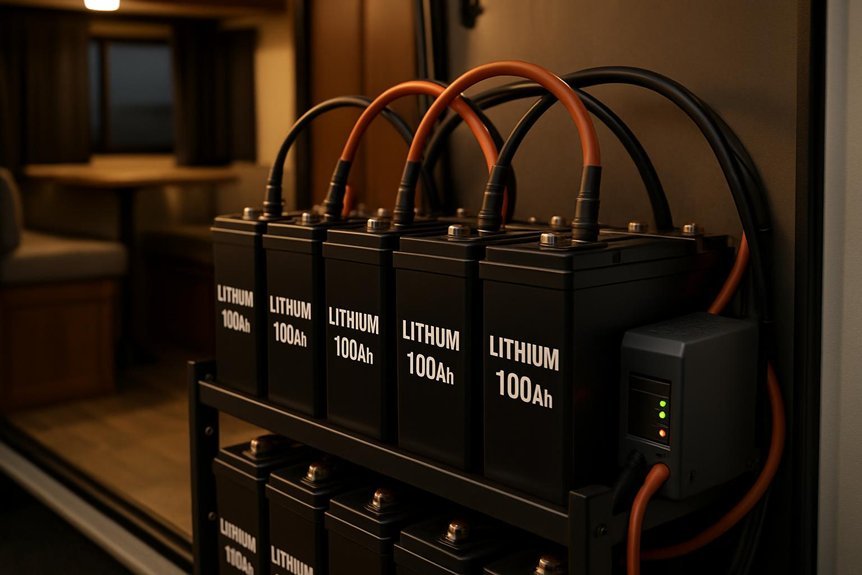
Lithium battery banks provide higher usable capacity, faster recharge, and deeper discharge without damage, delivering 3–4 times more usable energy per kilogram than lead-acid and charging to 100% within a few hours. We quantify impact for RV living: usable energy ranges 40–60 Wh/kg, with nominal voltages of 12.8–14.6 V and 3.2–3.6 V per cell. Cycle life exceeds 2,000 full cycles at 80% DoD, reducing replacement frequency. Real-world performance shows sustained 80–95% DoD deliverable without heat buildup; peak discharge currents reach 1C–2C, supporting 300–800 A for typical 100–400 Ah banks with proper BMS. In practice, daily consumption of 30–60 Ah aligns with varied loads. Beware irrelevant topic drift and stray discussion that adds nothing to sizing precision.
How to Calculate Your Daily RV Power Needs
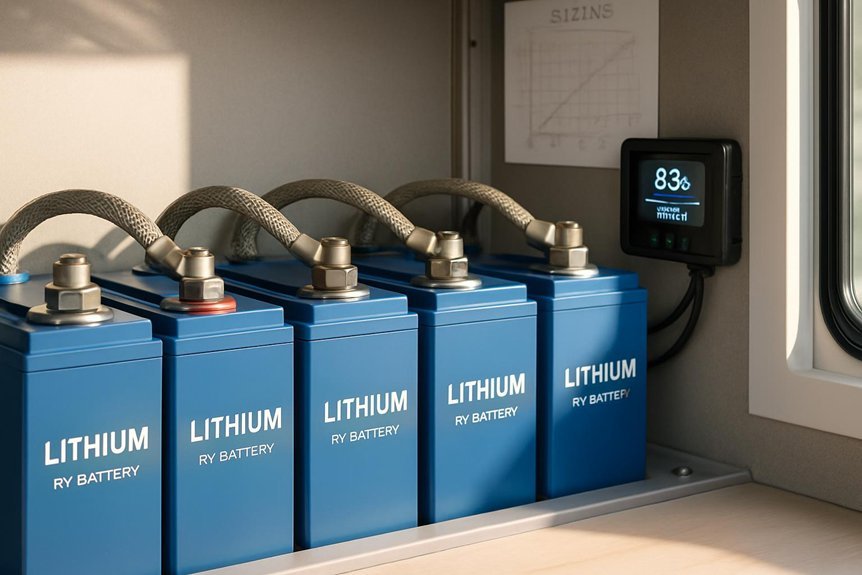
We’ll start with Daily Power Consumption Basics to establish a clear baseline in watt-hours per day. Next, we’ll walk through Calculating Your Needs using concrete numbers and a step-by-step method, so you know exactly how many amp-hours or watt-hours your RV requires daily. Finally, we’ll cover Peak and Reserve Planning to ensure your system accommodates high-demand periods and a safety margin.
Daily Power Consumption Basics
How do you determine your daily RV power needs? We approach this with a precise, repeatable method, summing all device loads and contingency margins. We convert each item’s wattage into amp-hours using hours of use, then aggregate to daily amp-hour demand. We factor inverter efficiency and battery depth-of-discharge targets, then apply a safety buffer for variability. We distinguish continuous loads from intermittent ones to avoid overestimation. We also consider seasonal and weather-driven changes, but keep adjustments within documented limits. Finally, we translate daily energy into battery capacity and charging requirements, aligning with our bank design goals.
- Continuous vs. intermittent loads and duty cycles
- Inverter efficiency and DoD targets
- Seasonal use adjustments and weather impact
- Safety margins and future management
Key terms: short circuit basics, thermal runaway.
Calculating Your Needs
Do you know your daily energy demand precisely? We approach this with a disciplined method. We list all loads, assign daytime and nighttime usage, and multiply by hours per day to obtain watt-hours. We convert appliances to a common baseline: 12 V or 120 V, using rated power and duty cycle. We sum refrigeration, lighting, electronics, water pump, and cooking-related loads, then add a safety margin of about 5–10% for transient use. We translate total energy into daily amp-hours at our chosen lithium chemistry. We select a cell configuration that matches voltage goals and charging efficiency, then apply depth-of-discharge limits to size capacity. Finally, we verify the result against real-world patterns and freshness losses to ensure reliable endurance.
Peak and Reserve Planning
To size for peaks and ensure reliability, we identify the highest possible draw within typical daily patterns and reserve headroom for transients.
- Define daily energy need (Ah) at system voltage, then convert to Wh: E = Ah × V, using RV specific usage profiles.
- Add peak planning margin (10–20%) to cover abrupt loads like hot water or microwave, then recalc total Wh.
- Include a reserve for self-consumption and depth-of-discharge targets, typically 50–80% DoD for longevity.
- Translate Wh to battery bank size (Ah) and inverter capacity, ensuring model tolerances and charging limits align with the spec sheet.
This method yields a compact, repeatable daily requirement, suitable for RV specific peak planning and battery sizing accuracy.
Choosing Lithium Chemistry, Capacity, and Cell Configuration
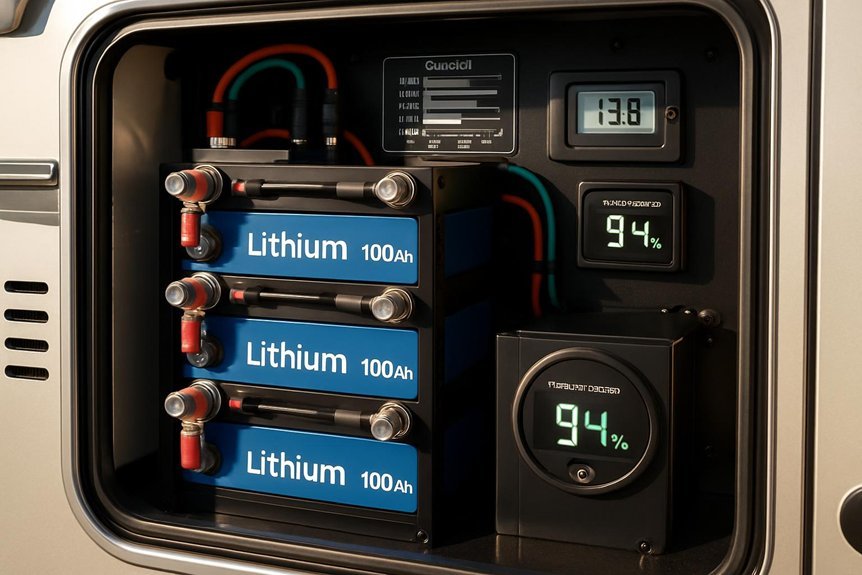
Selecting the right lithium chemistry, capacity, and cell configuration starts with your load profile, budget, and space constraints. We assess chemistry options by energy density, cycle life, thermal stability, and cost per amp-hour. For RV use, we compare lithium iron phosphate (LFP), nickel manganese cobalt (NMC), and lithium nickel cobalt aluminum (NCA) on a standardized, data-driven basis. We translate daily energy demand into usable watt-hours, then select a chemical with predictable performance in our operating range. Capacity targets are expressed as usable amp-hours at 12 V, with derating for temperature and aging. For cell configuration, we choose series/parallel counts to achieve nominal voltage and required current, prioritizing balanced strings and efficient BMS integration. This framework guides choosing chemistry and cell configuration for reliable, scalable storage.
Sizing Wiring, Inverters, and BMS for Safe Operation
How do we size wiring, inverters, and the BMS to operate safely and reliably? We approach with quantified standards: conductors sized for current, voltage drop under load, and ambient temperature. We specify wire gauges by maximum current per NEC/IEC rules, then apply derating for enclosure and length. Inverters are selected by continuous and surge rating, with efficiency and thermal margins clearly stated. The BMS dimensions must accommodate pack chemistry, cell count, and current handling, plus cooling paths. We document wiring safety margins, connector torque, and insulation ratings. We verify voltage, current, and fuse sizing, then confirm protective relays and isolation. The following checklist ensures rigor and reproducibility.
Wiring, inverter, and BMS sizing guided by NEC/IEC current, derating, efficiency, and thermal margins for safe, reliable operation.
- Wiring safety standards and conductor sizing
- Inverter continuous and surge ratings with efficiency targets
- BMS dimensions, housing, and thermal clearances
- Protection, fusing, and monitoring requirements
Factor In Solar Input, Generator Use, and System Losses
We’ll quantify solar input, assess generator use, and account for system losses to keep pack sizing precise. We’ll frame expectations with exact numbers—billable efficiency, charge rates, and loss percentages—so you can compare scenarios. Our goal is a clear, actionable baseline that guides optimization of Solar Input Impact, Generator Use Considerations, and System Losses Accounting.
Solar Input Impact
Solar input directly affects how quickly we can recharge the bank, so we must account for solar irradiance, panel efficiency, and array sizing in our calculations. We quantify solar input as watts per hour, track daily energy through sun hours, and apply derating for temperature and age. We also assess losses from wiring, controllers, and battery chemistry to determine net charge rate. Our objective is predictable recharge timing under varying conditions, not optimism.
- Irradiance, temperature, and angle impact panel output (W)
- Panel efficiency and array size determine total daily energy
- System losses (controller, wiring, shade) reduce net input
- Solar maintenance and SD card usage aid monitoring and data logging
Generator Use Considerations
Generator use must be evaluated alongside solar input, system losses, and charging targets to keep the bank within safe limits. We quantify runtime, fuel burn, and load acceptability to ensure pack health. Our approach ties generator output to solar production, supporting a steady state while controlling voltage and current peaks. We specify minimum idle and maximum continuous loads, plus efficiency deltas across temperatures. We include generator maintenance scheduling and symptom-based troubleshooting to minimize unplanned downtime. Gas generator safety is treated as non-negotiable: proper ventilation, fire suppression, and shutdown procedures are required. Table below summarizes roles and targets, helping us stay consistent under varied conditions.
| Role | Target / Criterion |
|---|---|
| Generator maintenance | Regular service intervals, filter checks, oil level, and fuel quality |
| Gas generator safety | Ventilation, fire suppression, shutdown protocols |
System Losses Accounting
How do system losses influence pack performance? We quantify losses from solar input, generator use, and internal inefficiencies to size a reliable bank. We model that system losses reduce usable capacity by a factor, then adjust for battery aging to project years of service. In practice, losses include charge/discharge efficiency, wiring, BMS, fuse, and thermal deratings, plus parasitic loads. We apply a conservative safety margin to ensure available energy meets daily demand under worst-case conditions. Solar input variability and generator runtime drive peak current stress, increasing effective losses during cycling. We document precise loss percentages for each subsystem and track them over time to update pack sizing. This disciplined approach yields predictable performance and longer battery aging life.
- System losses quantified per subsystem
- Battery aging impact on usable capacity
- Solar input variability and losses
- Generator-related loss factors
Real-World Sizing Scenarios for Common RV Lifestyles
To size an RV battery bank for real-world lifestyles, we translate daily energy use into a practical ampere-hour target and then select a bank that meets that need with headroom for surge loads and cloudy days. We model three common profiles: weekend campers, full-time solo travelers, and family boondockers. Weekends rely on 40–60 Ah per day, requiring 2× daily usage as a rule of thumb for reserve. Full-time solo use targets 25–40 Ah/day with 1.5× surge factor for appliances. Family boondocks push 70–100 Ah/day, plus 20% cushion for peak loads. We account for outside storage conditions and temperature derates, selecting 4–6 kWh banks for midsize rigs and 8–12 kWh for larger units. Marine appliances, charger efficiency, and inverter losses set final sizing baselines.
Maintenance Habits to Extend Battery Life
Maintaining our RV battery bank extends life and preserves capacity by following a disciplined, data-driven routine: we monitor state of charge, perform regular equalization or conditioning as needed, and minimize derating from temperature and depth of discharge.
- maintenance scheduling: set weekly SOC checks, monthly capacity tests, and annual full-curve verification to track trends.
- electrolyte handling: use proper PPE, avoid spills, and verify electrolyte levels if applicable, documenting any concentrations or venting observations.
- temperature control: log ambient and battery temps, apply thermal management to limit high-temp aging.
- charging discipline: adhere to manufacturer profiles, prevent overcharge, and compensate for parasitic loads with precise, time-bound routines.
This approach yields measurable wear-rate reductions and predictable remaining life.
Frequently Asked Questions
How Do You Estimate Battery Replacement Costs Over 5–10 Years?
We estimate replacement costs by projecting battery degradation 20–30% over 5–10 years and budgeting replacements accordingly, totaling $X–$Y depending on pack size; we factor replacement budgeting, cycle life, and price trends into our plan.
What Is the Impact of Cold Temperatures on Lithium Efficiency?
Cold weather reduces lithium efficiency, lowering capacity and runtime. We observe a measurable drop, roughly 10–30% in cold conditions, depending on chemistry and state of charge, which highlights cold weather performance as a key factor in planning.
Can You Mix Aging Packs With New Packs Safely?
We can’t mix aging packs with new packs safely; aging cells introduce imbalances that jeopardize safety. Our upgrading strategy favors parallel viability only among matched chemistries, with strict monitoring, balancing, and documented performance data for reliable, standardized results.
How Often Should You Cycle Batteries to Maximize Lifespan?
We should cycle our batteries about every 2–3 weeks during storage, balancing discharge depth and rest. Our brief cycle strategy limits aging, combats battery aging myths, and preserves capacity within a standardized, precise maintenance cadence for readers like you.
Is There a Simple Rule for Determining Amp-Hour Aging Rate?
Yes—there isn’t a universal simple rule, but we estimate aging rate around 5%–10% per year for high-quality lithium. Battery aging accelerates with depth of discharge, heat, and high current, so monitor and manage usage accordingly.
Conclusion
We’ve sized and balanced your system to meet daily needs with solid headroom, accounting for DoD targets, losses, and usage patterns. As a concrete example, consider a 6-phase calculation: 40 A·h/day at 12 V requires about 480 Wh; factoring 90% inverter efficiency and a 20% reserve, you’d size roughly 550–600 Ah at 12 V. This ensures reliable mornings and unexpected cloud days without oversizing. We’ll refine per your exact loads next.