With severe weather causing more grid failures each year, ensuring reliable backup power is now a homeowner’s essential task. We’re looking at top-rated batteries that promise uninterrupted power through a storm, but the sheer range of options can be intimidating. Let’s uncover the critical differences between high-capacity home units and portable generators to determine which truly meets our needs for resilience and value.
Key Takeaways
- LiFePO4 chemistry offers superior safety, stability, and a lifespan exceeding 10 years for reliable storm backup.
- Scalable modular systems from 10kWh to 240kWh ensure power for essential appliances through extended outages.
- High continuous outputs up to 5kW and pure sine wave inverters safely run major appliances and electronics.
- Robust Battery Management Systems (BMS) provide comprehensive protection against overcharge, short circuits, and overheating.
- Fast hybrid recharging from solar and AC sources quickly restores power between storm events.
VEVOR 48V 100Ah LiFePO4 Rack Battery with Bluetooth
The VEVOR 48V 100Ah LiFePO4 Rack Battery is a top choice for homeowners needing reliable backup power or building an off-grid solar system. Its A-grade LiFePO4 cells deliver a robust 5.12kWh of energy and promise up to 6,000 cycles. We get a 100A BMS with all the essential protections, and we can monitor its critical parameters through the LCD or a Bluetooth app. Its server rack design is made for growth, supporting stacks of eight and parallel connections for a system up to 81.92kWh. That scalability makes it versatile for home backup, RVs, or mobile power needs.
Best For: Homeowners seeking scalable backup power or off-grid solar energy storage, as well as RV and mobile power applications.
Pros:
- High-capacity A-grade LiFePO4 cells offering 5.12kWh and a 6,000-cycle lifespan.
- Includes a 100A BMS with comprehensive protections and dual monitoring via LCD and Bluetooth app.
- Highly scalable server-rack design supports stacking and parallel connections for systems up to 81.92kWh.
Cons:
- Maximum continuous current of 100A (1C discharge) may limit high-power applications.
- Scalability to full potential requires purchasing additional units, increasing overall cost.
- Lacks mention of warranty specifics or customer support details.
MARBERO Portable Power Station 88Wh Solar Generator
Seeking reliable portable power for camping, emergencies, or backup needs? Let’s examine the compact MARBERO 88Wh station. We appreciate its 3.2-pound design with an ergonomic handle and its versatile output, featuring an 80W AC outlet plus multiple USB and DC ports to charge our devices concurrently. It efficiently supports solar charging for true off-grid use. The integrated BMS and durable build give us confidence in its safety during outages. While its capacity suits phones, lights, or a mini-fridge, we find its eight ports and built-in LED flashlight incredibly practical for keeping essential gear powered through any situation.
Best For: Campers, travelers, and households needing a compact, versatile emergency backup for charging small electronics and powering low-wattage appliances.
Pros:
- Extremely portable, lightweight design with eight versatile output ports for charging multiple devices simultaneously.
- Supports efficient solar panel charging, making it ideal for true off-grid use.
- Built-in BMS and durable construction ensure safety and reliability, plus a practical integrated LED flashlight.
Cons:
- Limited 88Wh capacity and 80W continuous AC output restrict it to smaller devices, not high-power appliances.
- Relatively long 2-hour charge time from 0-80% may be inconvenient for some emergency scenarios.
- While compact, its power may be insufficient for prolonged outages or heavy-duty equipment.
LiFePO4 Lithium Battery 100Ah RV Solar Marine Backup
Need a reliable power source for RVs, boats, or home backup? This 12V 100Ah LiFePO4 lithium battery provides it. It’s 70% lighter than old lead-acid models, making installation a breeze as a drop-in replacement. Its smart BMS protects against overcharge, discharge, and short circuits, while the stable chemistry guarantees safety. You’ll get over 8,000 cycles and a 10+ year lifespan, maintaining full voltage even under heavy loads. It recharges three times faster, works from -4°F to 140°F, and can connect up to four units for larger systems. It’s our go-to for durable, maintenance-free power.
Best For: RV owners, boaters, and homeowners seeking a lightweight, long-lasting, and maintenance-free deep-cycle battery for solar, marine, or backup power systems.
Pros:
- Exceptionally long lifespan (8,000+ cycles) and maintenance-free operation.
- Lightweight, compact drop-in replacement with comprehensive BMS safety protections.
- Fast recharge, wide operating temperature range, and scalable for larger systems.
Cons:
- Higher upfront cost compared to traditional lead-acid batteries.
- Cannot be charged below 32°F (0°C) due to low-temperature cut-off.
- Limited to connecting a maximum of four units for system expansion.
Portable 1800W Power Station LiFePO4 Battery Backup
Home emergencies demand reliable power, and this portable station delivers. Its 1384Wh LiFePO4 battery provides a stable 1800W pure sine wave output with a 3600W surge. It quickly charges from the wall in about 1.3 hours and supports solar input. We can run refrigerators, medical devices, and tools while charging phones via its many ports. The 20ms UPS function keeps critical gear like computers running without interruption. With over 3500 cycles, its durable, automotive-grade cells are protected by an intelligent BMS for long-term safety and up to a decade of reliable service.
Best For: Homeowners, remote workers, and outdoor enthusiasts needing reliable, high-capacity backup power for emergencies, essential appliances, and off-grid use.
Pros:
- Exceptionally fast recharging (1.3 hours to full) and high power output (1800W AC / 3600W surge).
- Comprehensive safety and longevity from LiFePO4 battery chemistry, 3500+ cycles, and intelligent BMS protection.
- Versatile connectivity with UPS functionality (20ms switchover) for keeping critical devices and medical equipment running seamlessly.
Cons:
- The 1384Wh capacity, while substantial, may be insufficient for running high-wattage appliances like ovens for extended periods.
- Lacks specific details on solar panel compatibility (e.g., maximum input voltage/current).
- No mention of weight or physical portability, which can be a concern with high-capacity stations.
ECO-WORTHY Home Power Station Backup 10240Wh LiFePO4
We’ll recommend this ECO-WORTHY power station if your priority is an expandable backup power system. Starting with 10,240Wh, you can expand its capacity to 163.84kWh by connecting more batteries. Its 5000W inverter handles major appliances, and you can parallel additional inverters to reach a 30kW output. This UL-certified, safety-tested unit includes a 3-in-1 inverter with fast charging. You’ll monitor the system via Bluetooth or WiFi. Its substantial capacity and professional-grade expandability suit a permanent home backup installation, supported by a 3-year warranty for long-term storm resilience.
Best For: Homeowners seeking a permanently installed, highly expandable backup power system for long-term storm resilience and emergency use.
Pros:
- Extremely expandable capacity (up to 163.84kWh) and power output (up to 30kW) via parallel connections.
- UL-certified with safety-tested components (UL1973, UL1741) for reliable operation.
- Integrated 3-in-1 inverter with fast charging and remote monitoring via Bluetooth/WiFi app.
Cons:
- Heavy system (approx. 224 lbs), making it less portable and requiring permanent installation planning.
- High initial capacity may exceed (and cost more than) the needs of users with minimal backup requirements.
- Expandability to maximum specs requires purchasing many additional, costly batteries and inverters.
Solar Battery LiFePO4 Home Backup Storage 51.2V
Designed for household energy security, this LiFePO4 battery provides reliable 16kWh backup storage. We build it with durable Grade A cells for over 6,000 cycles and a 15+ year lifespan. Its modular design lets you expand capacity up to 240kWh by linking units, powering most appliances. A 100A BMS offers robust protection from overcharging or overheating. We’ve included Bluetooth for real-time monitoring from your phone. For peace of mind, it comes with a 10-year warranty and lifetime support. Due to its size, it ships by sea, with delivery taking 35-65 days, ensuring it reaches you securely packed and ready to install.
Best For: Homeowners seeking a scalable, long-life solar backup system for emergency power and reducing electricity bills.
Pros:
- Exceptionally long lifespan of 15+ years and 6,000+ cycles using durable Grade A cells.
- Highly scalable from 16kWh to 240kWh by paralleling units to power most household appliances.
- Comprehensive safety features including a 100A BMS and real-time Bluetooth monitoring.
Cons:
- Long shipping timeframe of 35-65 days due to sea freight.
- Large physical dimensions (approx. 27″L x 15″W x 35″H) require significant wall space.
- Maximum output is limited by the 5,000W AC inverter per unit in a parallel configuration.
Jackery HomePower 3000 Portable Power Station with Solar Panels
This portable powerhouse gives anyone needing serious off-grid backup a 3072Wh capacity for essentials like refrigerators and medical devices. It features a UL-certified UPS for a seamless 20ms switch, keeping critical devices running. Its versatile 3600W output powers numerous appliances through multiple ports, including an RV outlet. We appreciate the fast 1.7-hour recharge via hybrid AC/DC. Paired with its included solar panels, it can recharge in nine hours. Its durable LFP battery lasts for 4,000 cycles. Remarkably, it’s 47% smaller and 43% lighter than similar models, making this 59.5-pound unit a truly mobile solution.
Best For: Homeowners seeking reliable, long-lasting backup power for essential appliances and medical devices during extended outages.
Pros:
- Seamless 20ms UPS switch ensures uninterrupted power for critical devices like security cameras and medical refrigerators.
- Fast recharging in 1.7 hours via hybrid AC/DC, plus included solar panels for off-grid use.
- Compact and lightweight design (59.5 lbs) makes it 47% smaller and 43% lighter than comparable 3kWh models.
Cons:
- At 59.5 pounds, it may still be heavy for some users to move frequently.
- Solar recharge time of 9 hours for 80% charge could be slower in cloudy conditions.
- High upfront cost likely limits accessibility for budget-conscious buyers.
LIBRIDS Portable Power Station C600 with 640Wh LiFePO4 Battery
If you’re camping or need backup power, this LIBRIDS station is our best pick because it switches to battery in 10ms during an outage. It’s built around a 640Wh LiFePO₄ battery rated for over 4,000 cycles, giving you years of reliable, safe power. You’ll get a 600W continuous pure sine wave inverter, with a 1200W surge, perfect for sensitive electronics. It can power up to 8 devices simultaneously and recharges fully in just 1.5 hours. The durable metal design and a solid 5-year warranty make it a dependable, long-term companion for any adventure or emergency.
Best For: Campers, outdoor enthusiasts, and those seeking reliable home backup power for sensitive electronics during outages.
Pros:
- Ultra-fast recharge (1.5 hours) and 10ms automatic UPS switchover for critical devices.
- Durable LiFePO₄ battery with 4000+ cycles and a 5-year warranty for long-term value.
- Powerful 600W pure sine wave output (1200W surge) can run up to 8 devices simultaneously.
Cons:
- Indoor use only; not designed for use in wet or exposed outdoor conditions.
- 600W continuous power may be insufficient for some high-wattage appliances.
- Heavier metal construction adds durability but reduces portability compared to plastic units.
48V 314Ah Lifepo4 Lithium Battery with BMS and LCD
For homeowners seeking resilient solar storage, our 48V 314Ah LiFePO4 battery delivers 16.07 kWh of reliable power, since it’s built with a 200A BMS and Grade A cells for safety across 8,000 cycles. We equip it with a bright LCD and Bluetooth/Wi-Fi connectivity for easy monitoring. It connects in parallel with up to 14 others, scaling your backup capacity substantially. Integration is simple, with standard communication ports for major inverters like Victron and Growatt. Heavy-duty wheels and built-in handles guarantee you can move this high-capacity unit into place without hassle.
Best For: Homeowners seeking resilient, expandable solar storage with high capacity and professional integration features.
Pros:
- High capacity (16.07 kWh) and long-life Grade A cells rated for up to 8,000 cycles.
- Easily scalable via parallel connection of up to 15 units and compatible with major inverter brands.
- Comprehensive monitoring via LCD, mobile app, and PC software, plus easy installation with wheels and handles.
Cons:
- The substantial capacity and features likely come with a high upfront cost.
- May be physically large and heavy, potentially complicating installation in tight spaces despite wheels/handles.
- Requires compatible inverters and some technical knowledge for optimal integration and use of communication ports.
ECO-WORTHY 1200W 24V Lithium Solar System Off-Grid Kit
The ECO-WORTHY 1200W kit delivers daily power ideal for off-grid use. It generates 5.52 KWH daily to run household essentials like air conditioners and refrigerators. Its six high-efficiency panels produce 33% more energy than traditional ones. We get 7.168 KWH of storage from durable lithium batteries that offer over 6000 cycles. The system’s MPPT charge controller and pure sine wave inverter guarantee efficient, clean power conversion, with Bluetooth for remote monitoring. Backed by 25 years of service, this complete 24V system provides reliable, long-term energy independence for our cabin or RV.
Best For: homeowners or travelers seeking reliable off-grid power for cabins, RVs, and trailers to run essential 110V appliances.
Pros:
- Delivers substantial daily power (5.52 KWH) with high-efficiency panels generating 33% more energy than traditional ones.
- Features a large 7.168 KWH lithium battery bank with over 6000 deep cycles for long-term durability and storage.
- Includes high-efficiency MPPT charge controller and pure sine wave inverter, with Bluetooth monitoring and strong 25-year after-sales support.
Cons:
- Requires significant installation space for six large panels (each approx. 58.9″ x 26.2″).
- Daily power generation is dependent on receiving four hours of full sunlight, which may be inconsistent.
- The 24V system operating voltage may require specific compatibility checks for some applications or existing equipment.
Factors to Consider When Choosing Solar Charged Lithium Battery Backup Systems
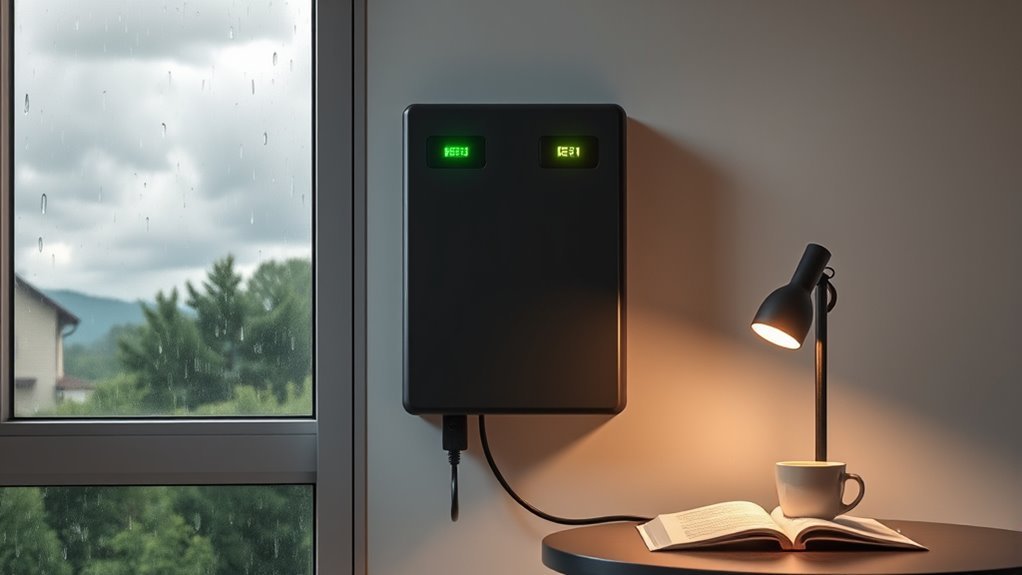
We need to pick the right solar battery by first calculating our energy capacity requirements. We’ll also want to contemplate its scalability, cycle life, and key safety features. Finally, we should check the monitoring options to keep track of our system’s performance.
Energy Capacity Requirements
Kicking off our look at energy capacity requirements, let’s start by calculating our total daily watt-hour consumption for essential devices, including both continuous and surge power needs. This figure, our energy budget, tells us the usable capacity our battery system must deliver for one full day without recharge. We can’t just look at nameplate watts; we need to multiply each appliance’s power draw by its expected runtime. Remember, a device’s surge power is vital for starting motors but doesn’t directly impact daily energy totals. Once we determine our daily needs, we can match them to a battery’s usable capacity, which is its total rating adjusted for its recommended depth of discharge. A high cycle life rating then shows how many years of daily use can be expected.
Scalability And Expandability
After determining our energy budget, let’s explore how to size a system that can grow with our needs. We should prioritize batteries designed for scalability, where we can parallel multiple units to increase amp-hour capacity. Some systems allow connecting between four and sixteen modules, reaching total capacities over 240 kWh. This modularity is key. Look for designs with standardized communication interfaces, enabling seamless integration with additional batteries and inverters. We can also consider physical expansion; some units support vertical stacking to optimize space. Remember, adding batteries in series increases system voltage, while parallel connections directly boost our usable energy storage. Choosing a scalable foundation means our backup power can evolve alongside our household demands.
Cycle Life And Durability
Because we plan to rely on our system daily, we need to evaluate how many charge-discharge cycles a battery can endure, as this determines its lifespan and overall value. We’ll see ratings from146 4,000 to over 15,000 cycles. These figures are tied to depth of discharge; a battery might offer 8,000 cycles at 80% discharge but 15,000 at 60%. High-grade lithium iron phosphate (LiFePO4) cells excel here, often rated for over 6,000 cycles at 80% depth, promising a decade or more of daily use. Their inherent thermal stability and a protective Battery Management System work together to guarantee this durability, safeguarding against the stressors that degrade capacity over time.
Safety And Protection Features
Having established a system’s longevity, its physical safety and built-in protections are equally critical for our daily reliance. An exhaustive Battery Management System (BMS) is our primary defense. It must guard against overcharging, deep discharge, overcurrent, short circuits, and overheating to prevent internal cell damage. We also prioritize the inherently stable lithium iron phosphate (LiFePO4) chemistry for its superior thermal stability. Look for systems with automatic low-temperature charging cut-offs, usually around 32°F, to avoid cold-weather damage. Independent safety certifications like UL 1973 for batteries provide verified peace of mind. Additionally, a pure sine wave inverter output is essential; it protects our sensitive electronics from “dirty” power that can cause harm.
Monitoring And Connectivity Options
A system’s intelligence in managing our power is only as good as our window into its performance. We need robust connectivity options. Many systems offer Bluetooth or Wi-Fi for remote, real-time monitoring via a mobile app, allowing us to check cell voltage and state of charge anywhere. For professional integration, interfaces like RS485 or CAN enable closed-loop control with our inverters. An integrated LCD display provides immediate on-device status without any connection. Some also support PC software for deeper data analysis. Vital, advanced battery management systems communicate protection status across these interfaces, which is essential for centralized monitoring in a scalable, multi-unit home backup setup. This transparency is key for system health and our peace of mind.
Charging Speed And Efficiency
While transparency is key for peace of mind, how quickly and effectively a system recharges is just as critical for restoring our backup power. We must look for features like bidirectional inverter fast-charging, which can fully recharge a high-capacity system in about 1.3 hours. The solar recharge speed depends heavily on panel wattage, but advanced MPPT charge controllers, with up to 99% tracking efficiency, maximize that solar input. Some systems support hybrid recharging from both AC and DC sources, slashing total charge times. Understanding the C-rate helps too; a 0.5C rating means a full charge in roughly two hours. Ultimately, faster charging efficiency gets our system ready for the next outage much sooner.
Frequently Asked Questions
Will the Warranty Cover Storm Damage?
We’ll need to check our specific policy. Most warranties cover manufacturing defects, but they often exclude “acts of God” like storms, so direct storm damage typically won’t be covered.
Can the Battery Be Safely Charged While in Use?
We’ve got you covered. Our batteries can be safely charged while powering your essentials; their integrated systems manage simultaneous charge and discharge. We’d suggest checking your specific model’s manual for ideal performance guidelines.
Does the Battery Performance Decline in Extreme Cold?
Yes, it can, as extreme cold reduces our battery’s available capacity. We’d recommend storing it in a temperature-controlled space to maintain peak performance when you need it most during a winter outage.
How Should I Dispose of an Old Lithium Battery?
We’d take it to a certified electronics recycler or hazardous waste facility, as we shouldn’t throw lithium batteries in household trash where they could start fires. Many retailers also accept them for safe disposal.
Will Installing a Battery Affect My Home Insurance?
Many insurers now require policy updates for battery installs; let’s notify them so we’re covered. Around 90% of claims from improperly installed systems are denied, making that call essential for our home’s protection.
Conclusion
We’ve seen these systems can scale to 240kWh, but the most telling stat is the 20ms automatic switch. That’s faster than a human heartbeat, ensuring our homes don’t even blink during an outage. It shows how these batteries aren’t just storing power; they’re providing seamless, resilient protection that keeps our essential systems running exactly when we need them most.