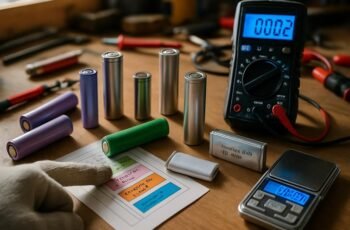
Like a compass needle that finds magnetic north, lithium batteries point us toward steadier marine power. We’ll walk you through how higher energy density, lighter weight, and sophisticated BMS translate to real onboard gains, from propulsion efficiency to extended cycles. With fast charging, robust thermal management, and safer operation at sea, the tradeoffs matter as much as the payoff. Stay with us as we unpack practical implications for house banks, trolling motors, and emergency power.
Key Takeaways
- Higher energy density enables more usable capacity per mass, reducing boat weight and improving propulsion efficiency.
- Integrated marine BMS and robust cooling enhance safety, fault tolerance, and long-term reliability.
- Modular, compact packs allow flexible installation and easier system integration with deck and hull layouts.
- Fast, coordinated charging with dockside and shore power maintains performance while protecting cells.
- Longevity and lifecycle economics: longer cycle life, lower maintenance, and lower total cost of ownership.
Why Lithium Batteries Transform Marine Power: Key Benefits and Tradeoffs
Lithium batteries transform marine power by delivering higher energy density, faster charging, and longer cycle life with lighter weight and better efficiency than traditional lead-acid packs. We assess benefits and tradeoffs with a goal of reliable, practical implementation. Our focus is on lithium chemistry that enables compact, modular packs, advanced BMS protection, and predictable performance across temperature ranges. We quantify marine reliability through consistent capacity retention, reduced maintenance, and lower overall system weight. Tradeoffs include higher upfront cost, charging infrastructure needs, and careful thermal management to prevent degradation. We emphasize system design choices that maximize safety, fault tolerance, and efficiency—integrating appropriate fuses, cooling, and state monitoring. When applied thoughtfully, lithium chemistry delivers durable, scalable power suitable for modern, operations-focused boats.
Understanding Marine Battery Types and How They Compare
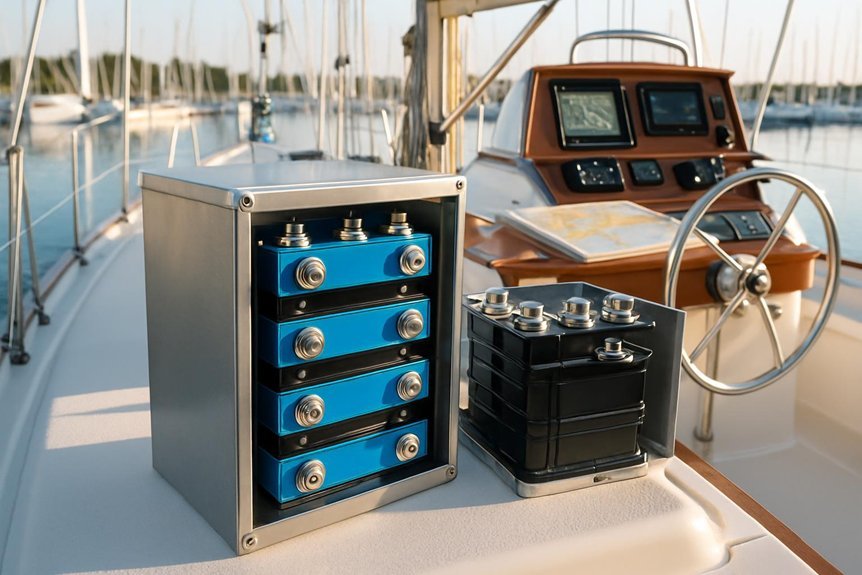
We’ll outline the main battery types used in marine applications and how they differ in chemistry, performance, and lifecycle. We’ll compare marine chemistries to highlight voltage behavior, charge efficiency, depth of discharge, and safety considerations for boats. Finally, we’ll link these factors to application suitability, so you can choose the right battery for your system and operating profile.
Battery Types Overview
To understand marine battery types, we first compare chemistry, construction, and performance targets, then map them to boat needs like weight limits, cycle life, and charge efficiency. We present a concise overview of common formats: flooded lead-acid, absorbent glass mat (AGM), and solid or lithium variants, noting practical implications for installation and maintenance. Flooded systems emphasize affordability but demand regular battery maintenance and venting considerations. AGM offers maintenance reductions and vibration resistance, yet costs and charging requirements vary by model. Solid-state and lithium chemistries improve energy density and cycle life but require compatible BMS frameworks and careful thermal management. We emphasize corrosion prevention and corrosion pathways, plus routine inspection. In sum, match chemistry to mission, prioritize safe mounting, and maintain accurate charging practices for reliable performance.
Comparing Marine Chemistries
Understanding how marine battery chemistries compare helps us pick the right fit for a boat’s needs. We evaluate lithium iron chemistry against lead-acid, nickel-based, and solid state alternatives by focusing on energy density, cycle life, weight, and charging behavior. Lithium iron offers high usable capacity and lighter weight, enabling more usable amp-hours per mass, but requires compatible BMS and proper charging profiles. Lead-acid remains rugged and inexpensive but suffers from depth-of-discharge limits and frequent maintenance. Nickel-based chemistries provide high discharge rates yet bring cost and thermal management challenges. Solid state promises safety and density gains, though practical marine-ready implementations are still evolving. In practice, we match chemistry to load, space, budget, and charging infrastructure while planning for reliable, safe operation.
Application Suitability Factors
So, which factors determine whether a marine battery type fits a boat’s load, space, and charging setup? We assess capacity, discharge rate, cycle life, and charge efficiency to match load profiles and voltage stability. We compare weight, size, and mounting options for hull integration, ensuring safe placement away from heat sources and moisture. Compatibility with the vessel’s charging system—shore, alternator, and BMS communication—drives selection. We evaluate temperature tolerance, maintenance needs, and venting requirements for each chemistry. We factor in maintenance practicality and expected lifespan, translating them into total ownership costs. Finally, we examine safety margins, fire risk, and regulatory compliance. This framework clarifies suitability for use, guiding battery maintenance planning and integration within the hull and electrical system.
How Much Capacity You Need and How Deep You Should Discharge
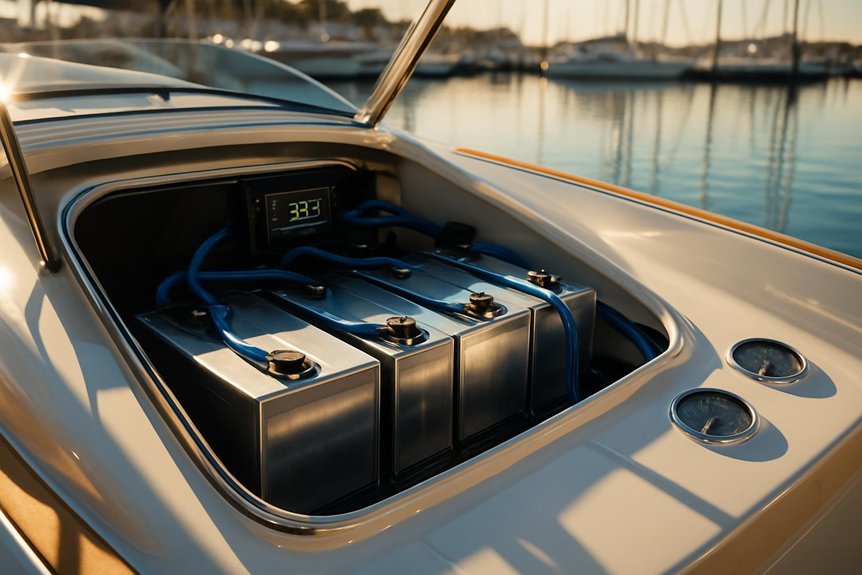
We’ll outline how to size capacity and define safe discharge, balancing energy needs with available headroom and efficiency. We’ll discuss a capacity planning approach that factors daily usage, reserve margins, and charging opportunities, along with practical safe-discharge practices to protect longevity. This establishes a clear framework for readers to tailor battery packs to their boating profile and equipment load.
Capacity Planning Guide
What capacity do you actually need, and how deeply should you discharge lithium batteries on a boat? We approach capacity planning with a practical framework: define load profiles, apply margin, and choose discharge strategies that optimize cycle life and reliability. Capacity budgeting helps balance daily use with reserve for peak demand, while respecting manufacturer guidance and safety limits. We target realistic autonomies, then translate them into usable amp-hours, factoring efficiency and inverter losses. Below is a simple rhythm table to aid intuition.
| Load | Hours | Margin |
|---|---|---|
| Essential systems | 4–6 | 15% |
| Nonessential comforts | 2–3 | 10% |
| Reserve for emergencies | — | 20% |
Safe Discharge Practices
How much capacity do you actually need, and how deeply should you discharge lithium batteries on a boat? We approach safe discharge with a conservative target: maintain usable capacity above 20% to 25% for longevity and peak reliability. Design loads around 70% to 80% DoD (depth of discharge) for daily operations; reserve peaks for essential systems. Match battery chemistry, BMS limits, and alternator or solar input to avoid deep cycling. Avoid sustained DoD beyond manufacturer guidance, and plan for worst-case loads plus contingency. Implement robust Thermal management to prevent capacity loss during high-rate discharges or ambient heat. Monitor cell temperatures, pack balance, and state-of-charge in real time, and schedule periodic profiling to keep voltage sag within spec. Safe discharge supports predictable performance and reduces cycle degradation over time.
Charge Fast, Boat Ready: Fast Charging and Onboard Downtime
Fast charging is a practical necessity in marine use, where downtime must be minimized and readiness is non-negotiable. We design our charging strategies to maximize charge speed without compromising system integrity or safety. Our approach prioritizes controlled current ramps, temperature monitoring, and balance management to protect cells and extend cycle life. Onboard, dedicated fast-charging hardware coordinates with BMS logic to prevent overcurrent, overvoltage, and thermal runaway scenarios. We optimize dockside operations by using shore power with appropriate transformer sizing and circuit protection, ensuring consistent performance under variable loads. Dockside safety remains paramount: we implement proper ventilation, cable management, and spill containment for charging stations. The result is rapid, reliable recharging that keeps our boating schedule on track.
How Weight Reduction Boosts Boat Performance
Weight reduction directly boosts boat performance by lowering hull drag and reducing the energy required for propulsion. We’ll explain how lighter systems improve hull efficiency and overall handling, while preserving function and safety. Consider these practical points:
1) Lower displacement lowers hydrodynamic resistance, increasing speed potential with the same power.
2) Reduced mass improves acceleration response and trimming, enhancing hull efficiency across conditions.
3) Lighter ballast minimizes strain on structure and drivetrain, extending component life.
4) Weight-focused design favors efficiency gains without compromising capacity or reliability.
We apply this mindset to lithium systems, targeting measurable improvements in propulsion efficiency, fuel use, and ride quality. By prioritizing weight reduction, we maximize performance margins, maintain steady power delivery, and sustain long-term operability.
Safety on the Water: Marine BMS and Temperature Tolerance
What keeps lithium-powered marine systems safe in real-world conditions? Our Marine BMS monitors cell voltages, currents, and temperatures in real time, triggering swift protection actions when thresholds are breached. We design for early fault detection, isolated faults, and safe shutoffs to prevent cascading failures at sea. Temperature monitoring is integral: closed-loop control maintains cells within an optimal band, compensating for ambient heat and charging currents. We enforce balanced charging and discharging, reducing hotspot formation and aging. System redundancies, enclosure sealing, and robust insulation minimize thermal runaway risk and moisture ingress. Battery safety relies on clear fault annunciation, remote alerts, and testable safety procedures for crews. Together, these practices ensure reliable performance, even under peak load, vibration, and temperature fluctuations inherent to marine environments.
Longevity, Costs, and Lifecycle Savings for Boats
Lithium batteries in boats offer clear long-term value beyond immediate safety gains, as durability and lifecycle costs drive total ownership. We present concrete metrics that matter at the helm and in the bill of materials:
1) Longevity costs reduce maintenance cycles and downtime, improving uptime during outings.
2) Lifecycle savings accumulate through higher charge efficiency and longer cycle life.
3) Capital cost is offset over time by fewer replacements and lower support requirements.
4) Total cost of ownership declines when battery management and warranty support are aligned with usage patterns.
We quantify reliability, anticipate wear, and compare replacement timelines, ensuring informed decisions. This approach keeps systems predictable, supports budgeting, and validates lithium as a durable, cost-aware marine choice.
Practical Applications: Trolling Motors, House Banks, and Emergencies
Practical applications on the water demand reliable power across several distinct uses: trolling motors, house banks, and emergency systems. We deploy lithium batteries for trolling motors to deliver consistent torque, rapid throttle response, and high discharge efficiency without voltage sag. For house banks, we size packs for daily load profiles, ensuring stable 12–24 V operation, long cycle life, and reduced weight compared with lead acids. In emergencies, lithium chemistry provides rapid availability, controlled shutdowns, and reliable backup power during critical moments. System design emphasizes proper BMS integration, thermal management, and robust charging strategies to maximize safety and performance. By matching capacity, voltage, and peak current to application, we achieve predictable runtime, safer charging, and dependable emergency power.
Frequently Asked Questions
How Do Lithium Batteries Handle Salt Exposure and Corrosion?
Salt exposure is mitigated by robust corrosion resistance in lithium batteries, which minimizes electrolyte attack and terminal degradation. We design with sealed enclosures and galvanic protection, guaranteeing durable performance under marine conditions and reducing maintenance needs for crews.
Can Lithium Batteries Withstand Extreme Marine Temperatures Without Performance Loss?
We can handle extreme marine temperatures, but performance hinges on proper marine thermal management. Our systems maintain stable cell temps, minimizing degradation and ensuring reliable power during extreme temperature performance. We optimize cooling, insulation, and temperature monitoring for consistency.
Do Lithium Batteries Require Specialized Charging Equipment on Boats?
Yes, we do; on boats you’ll need specialized charging equipment to protect battery health. We prioritize marine safety by using purpose-built chargers, proper battery management, and adherence to specs, ensuring safe, reliable operation across extreme conditions.
What Happens if a Lithium Battery Is Accidentally Overcharged at Sea?
Overcharge risks include venting and thermal runaway; if caught at sea, we’ll shut charger, monitor temp, and isolate the cell. We’ll vent safely, cool promptly, and replace damaged modules to prevent cascading failures.
Are There Regulatory or Insurance Implications for Lithium Marine Batteries?
Yes, there are regulatory compliance and insurance implications for lithium marine batteries. We must adhere to classifications, certifications, and reporting standards, and we should evaluate coverage limits, exclusions, and risk-based premiums to ensure proper regulatory compliance and insurance implications.
Conclusion
We’ve sailed this far with assumptions and apologies, but the truth is simple: lithium batteries aren’t magic, they’re metrics—energy density, weight, BMS rigor, and fast shore-to-bench charging. If you want predictable runs and fewer spills of coffee and amperage, adopt modular packs, thermal management, and real-time monitoring. Yes, they cost more upfront, but the lifecycle savings, safety margins, and performance practically demand we upgrade. Sailors, prepare to retire old Ni–Cd nostalgia and embrace the numbers.