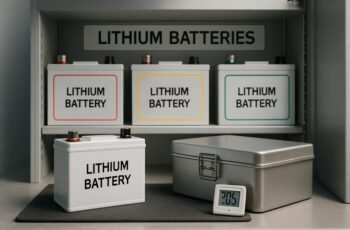
When we assess safety, we consider thermal stability, failure modes, and protection systems, then weigh how these interact with use case and management. LFP offers the strongest intrinsic thermal stability, while NMC/NCA deliver higher energy density with stricter thermal control. LCO sits between, but can be more sensitive to overcharge. We’ll outline how design, charging discipline, and robust BMS shape real‑world safety, and we’ll point to where each chemistry excels or falls short. The implications matter as conditions change.
Key Takeaways
- LFP (Lithium Iron Phosphate) offers the strongest inherent thermal stability and lowest immediate abuse risk among common Li-ion chemistries.
- LFP’s robust chemistry and protective packaging reduce thermal runaway likelihood under fault or overcharge conditions.
- NMC/NCA provide higher energy density but require stricter thermal management and fault tolerance to maintain safety.
- LCO sits between in energy density and safety, with higher risk during high-rate charging or impedance growth.
- Real-world safety depends on battery management, protective design, and robust cooling, not chemistry alone.
Define Battery Safety: Criteria That Matter
Battery safety defines the criteria that determine how reliably a lithium battery operates without causing harm or damage. We, as researchers and engineers, outline measurable parameters—thermal response, electrical abuse tolerance, mechanical integrity, chemical stability, and failure mode predictability. Our assessment relies on standard test procedures, accelerated aging data, and post-mortem analyses to quantify risk and performance. We evaluate design tradeoffs that balance energy density, power, weight, cost, and safety margins, ensuring margins align with intended use. User safety considerations guide enclosure design, fault isolation, and user-operable safeguards. We emphasize repeatability, traceability, and conservative thresholds to prevent ignition, leakage, or runaway scenarios. Clear safety criteria enable rigorous comparisons across chemistries, architectures, and packaging while informing informed, risk-aware decision-making for stakeholders.
Thermal Stability: LFP, NMC, LCO, and NCA Compared
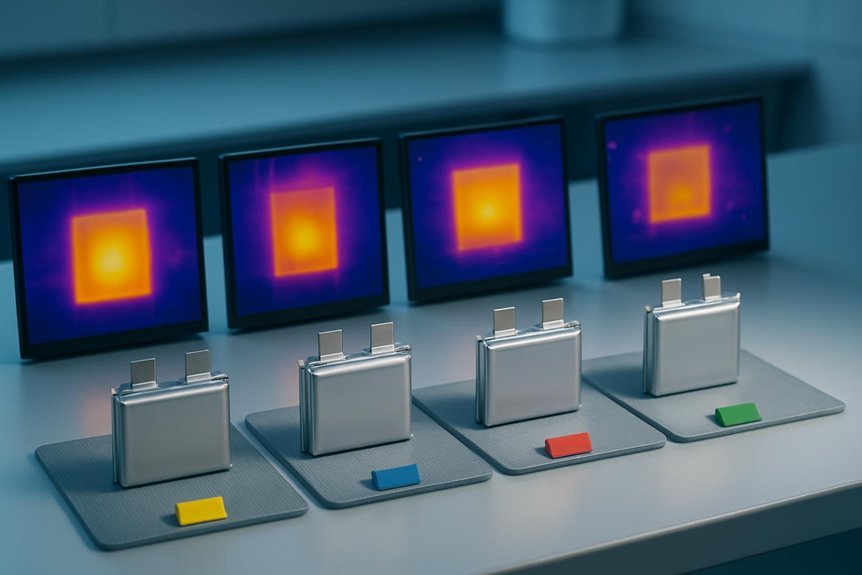
We compare the thermal stability of LFP, NMC, LCO, and NCA based on measured exothermic behavior, onset temperatures, and reaction pathways under abuse conditions. Each chemistry presents distinct safety profiles due to lattice structure, electrolyte compatibility, and thermal runaway thresholds, which we summarize with objective data rather than assumptions. In this discussion, we outline how these differences influence real-world safety considerations and guide material selection decisions for safer energy storage.
Thermal Stability Comparison
How do thermal stability characteristics differ across lithium‑ion chemistries like LFP, NMC, LCO, and NCA? We assess onset temperatures, heat generation rates, and phase stability under overcharge and abuse. LFP exhibits notably higher thermal stability, lower exothermic heat, and slower escalation, contributing to reduced risks of thermal runaway and irreversible degradation. NMC and NCA demonstrate improved energy density but higher reactivity, with more pronounced heat release under fault conditions. LCO shows the least favorable profile, with rapid temperature rise and greater propensity for exothermic reactions, elevating failure risk. Across all chemistries, protective architectures and thermal management critically influence outcomes. Our focus remains on thermally driven safety, highlighting that robust thermal runaway prevention relies on cell design, safe operating envelopes, and effective heat dissipation.
Chemistry Safety Profiles
Why do thermal stability profiles vary across lithium-ion chemistries, and how does that influence safety design? We compare LFP, NMC, LCO, and NCA to quantify intrinsic stability and failure modes. LFP offers the most robust thermal stability, slower exothermic onset, and lower risk of thermal runaway under abuse, at the cost of energy density. NMC and NCA provide higher energy density but exhibit earlier heat generation and more pronounced venting characteristics when heated or overcharged. LCO sits between LFP and nickel-rich chemistries in stability, but its voltage window concentrates risk during high-rate charging. These differences drive Key safety tradeoffs in pack design, thermal management, and fault tolerance. Charging risk assessment must account chemistry-dependent reaction kinetics, mitigation strategies, and state-of-charge boundaries to optimize safety margins.
How Batteries Fail: Common Modes and Real-World Impact
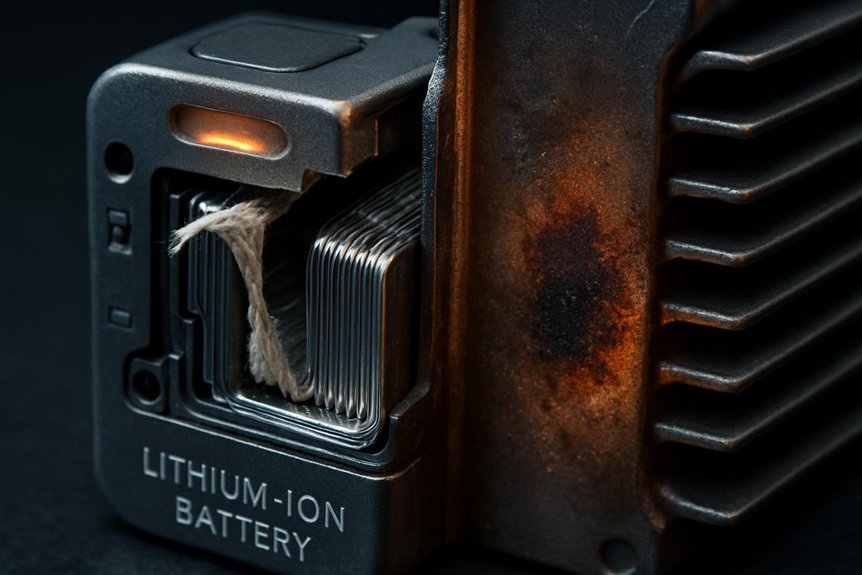
We review the primary failure modes of lithium batteries, including internal short circuits, SEI instability, electrode aging, and thermal runaway triggers. We then connect how these mechanisms translate to real-world outcomes—sudden capacity loss, reduced cycle life, field safety hazards, and performance degradation under abuse or extreme temperatures. This discussion frames the evidence base and prepares readers to compare safeguards across chemistries and designs.
Failure Modes and Effects
What are the most common failure modes of lithium batteries, and how do these failures translate to real-world impact? We identify internal short circuits, separator deformation, dendrite growth, thermal runaway, and capacity fade as primary modes. These mechanisms drive swelling, supply disruption, fire risk, and shortened life, regardless of chemistry. Our assessment relies on peer‑reviewed data and field reports, focusing on measurable effects rather than marketing claims. In addition, we address how misleading marketing and unverified claims obscure true risk profiles, potentially delaying mitigation. The table below highlights core modes, indicators, and consequences for decision makers.
| Failure Mode | Real-World Indicator | Immediate Effect | Safety Concern | Mitigation |
|—|—|—|—|—|
Real-World Battery Impacts
Real-world battery failures translate laboratory mechanisms into tangible, observable outcomes that drive safety and reliability concerns in field use. We examine how abuse, aging, and operational extremes translate to performance degradation, safety hazards, and downtime. Common modes—thermal runaway, internal shorting, separator failure, and electrolyte decomposition—present distinct, measurable signatures: rapid temperature rise, gas evolution, voltage collapse, and fire risk. By correlating lab-identified mechanisms with field data, we quantify risk and prioritize mitigations. Actionable testing focuses on accelerated life, abuse tolerance, and thermal characterization to reveal failure precursors before incidents occur. Hazard assessment integrates failure probabilities with consequences across use cases, informing design choices and maintenance schedules. Our guidance emphasizes data-driven decision-making, traceable test plans, and conservative safety margins to reduce real-world impacts.
Safety Profiles by Chemistry: LFP vs NMC vs LCO vs NCA
Given safety profiles, how do the chemistries compare in practical risk terms among LFP, NMC, LCO, and NCA? We respond with concise, evidence-based assessment. LFP cells generally exhibit higher thermal stability and stronger resistance to thermal runaway due to iron phosphate chemistry and robust lattice structure, translating to lower immediate abuse risk. NMC and NCA variants offer higher energy density but can show elevated temperatures under fast charging or high-rate abuse, increasing thermal runaway likelihood if cooling fails. LCO, while historically high energy density, tends toward greater sensitivity to overcharge and impedance growth, raising safety concerns in certain duty cycles. Across chemistries, protective packaging, thermal management, and BMS design govern real-world safety, yet chemistry-driven intrinsic stability remains a foundational risk differentiator for battery safety.
Design Choices That Reduce Safety Risks
Where do design choices most effectively reduce safety risks in lithium batteries? We focus on architecture, materials, and safeguards that interrupt failure progression. We select chemistries and electrode formulations with thermal stability and reduced propensity for gas generation. We integrate robust separators, multi-tier insulation, and venting mechanisms that respond predictably under abuse. We favor solid or quasi-solid electrolytes where feasible to limit liquid leakage, while ensuring electrochemical performance remains acceptable. We implement redundant current interrupt devices and fail-safe payload containment to preserve module integrity. We align design with safety regulation and adhere to manufacturing standards, validating through rigorous abuse testing, including thermal, mechanical, and electrical scenarios. Our emphasis is traceable, test-driven engineering that reduces hazard likelihood without compromising reliability or performance.
Safe Charging and Battery Management Practices
What constitutes safe charging and battery management practices is best grounded in disciplined control of charging parameters, monitoring, and fault response. We implement strict charge voltage, current, and temperature thresholds, plus timely termination on anomaly detection. Continuous cell balancing, state-of-charge estimation, and impedance tracking reduce overcharge and thermal runaway risk. We emphasize redundant fault signaling, automated isolation, and robust thermal management to contain incidents. Proven monitoring platforms enable drift detection, firmware integrity checks, and secure communication across the battery management system. We also consider lifecycle economics: recycling economics guides end-of-life planning, while supply chain resilience informs component provenance and spare-part availability. By design, our procedures minimize degradation, extend usable life, and sustain safe operation through proactive maintenance, audits, and rapid corrective actions.
Real-World Safety Records by Application
Real-world safety records by application show that lithium battery incidents are highly context-dependent, with frequency and severity tied to use case, environment, and management practices. We assess incident data from consumer electronics, electric vehicles, grid storage, and aerospace to identify common failure modes and containment measures. In consumer electronics, thermal runaway is mitigated by robust protection circuits and cell uniformity, yielding low, yet nonzero, event rates. Electric vehicles benefit from hierarchical BMS monitoring, rigorous pack design, and thermal management, reducing severe outcomes despite high energy densities. Grid storage emphasizes containment, ventilation, and independent fire suppression to limit cascading effects. Aerospace applications rely on rigorous qualification and fault-tolerant systems to maintain safety margins. Across domains, real world safety records reflect disciplined engineering, standardized testing, and vigilant risk management.
Which Chemistry Is Safest for Your Use Case?
Given the use case, the safest chemistry hinges on balancing energy density, thermal stability, degradation pathways, and management safeguards; no single chemistry is universally safest, but certain options reduce risk under common operating conditions. We evaluate chemistries by standardized tests: abuse resistance, cycle life, and calendar aging, then factor system controls. Lithium iron phosphate offers robust thermal stability and lower thermal runaway risk but lower energy density, benefiting stationary or low-density needs. NMC variants provide higher energy yet demand stricter battery management to prevent overcharge and heat buildup. LFP/NMC blends, solid-state concepts, and high-safety electrolytes show promise for safer charging under typical use, though costs and scale matter. For portable devices, prioritize safe charging protocols, active cooling, and rigorous battery management to align chemistry with application.
Frequently Asked Questions
How Do Transport Regulations Impact Lithium Battery Safety Choices?
Transport regulations shape our lithium battery safety choices by mandating packaging, labeling, testing, and quantity limits, ensuring safety compliance. We follow formal standards, cite data, and adapt logistics to minimize risk while maintaining efficient, compliant transport for stakeholders.
What Is the Role of Battery Management Software in Safety?
We guarantee battery management software monitors cell health, temperature, and voltage in real time, enhancing safety. It uses algorithms to detect faults, prevent overcharging, and mitigate thermal runaway, confirming robust safety software supports reliable energy storage.
Do Charging Cables Affect Overall Cell Safety Performance?
Charging cables do affect safety performance; poor-quality or undersized cables can overheat, cause voltage drops, and stress cells. We, however, verify standards, use appropriate gauges, and monitor in real time to preserve overall safety and reliability.
How Does Price Influence Safety Feature Availability?
We find price influences safety feature availability: higher pricing generally enables more robust pricing safety measures, with stricter regulation impact and advanced protection. We observe a trade-off, where affordable models may omit premium safety features to cut costs.
Can Recycled Cells Pose Different Safety Risks Than New Cells?
We answer: yes—recycled cells can pose different safety risks than new cells due to degradation, contamination, and unknown histories. We emphasize recycling safety, rigorous testing, and traceability, as reused cells require strict screening before integration into systems.
Conclusion
We can’t pick a single “safest” chemistry for every case; safety hinges on application, management, and protections. LFP offers the strongest intrinsic thermal stability, making it safer for stationary storage and high-reliability needs, while NMC/NCA deliver higher energy density with tighter thermal controls. LCO sits in between. Like a well-titted shield, robust BMS, disciplined charging, and thoughtful design reduce risk across chemistries. In every scenario, proactive controls are our strongest safety argument.