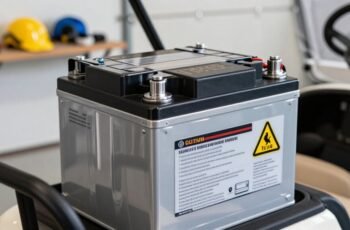
Like a quiet storm waiting to strike, safe storage of lithium batteries demands disciplined care. We must keep packs in a dedicated, nonconductive enclosure at a stable, manufacturer-recommended temperature, separated by chemistry and SOC. We’ll target roughly 40–60% SOC and monitor for swelling, leaks, or heat, with clear labeling and routine inspections. If anything looks off, procedures for handling, ventilation, and transfers come into play—and that path leads to the specifics we’ll outline next.
Key Takeaways
- Store lithium batteries in a dedicated, vented, non-conductive enclosure away from heat and flammable materials.
- Maintain ambient temperatures around 20°C and humidity below 60%, with regular temperature monitoring.
- Charge to a partial state of charge (roughly 40–60%) and avoid deep discharges; top up if storage extends beyond weeks.
- Segregate packs by chemistry and voltage, label with date and state of charge, and inspect regularly for damage.
- Use proper handling practices: disconnect leads, document deviations, and have fire suppression and spill procedures in place.
Why Safe Lithium Battery Storage Matters
Safe lithium battery storage matters because improper storage can lead to fires, thermal runaway, or degraded performance. We, as caretakers, emphasize that consistent, purpose-built environments protect both people and assets. Poor practices—exposed terminals, moisture ingress, or unsecured containers—raise risks and complicate future charging cycles. We stay vigilant about labeling, segregation, and routine inspections to prevent unnoticed degradation from voltage drift or corrosion. Even seemingly irrelevant topic items can distract from critical safeguards; we keep focus on storage integrity and environmental controls. We document conditions, monitor for temperature and humidity, and ensure qualified handling during transport or transfer. By maintaining defined storage limits and clear access, we reduce incident likelihood and preserve battery lifespan, enabling predictable performance when the next use occurs.
Ideal Storage Temperature for Lithium Cells
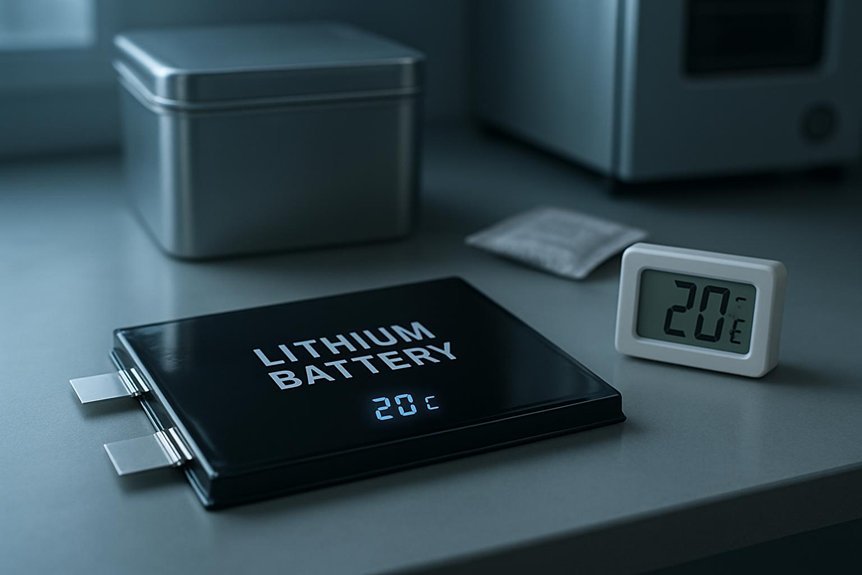
What is the ideal storage temperature for lithium cells, and why does it matter for safety and longevity? We’ll outline precise targets to minimize degradation and thermal risk, acknowledging how storage temperature interacts with battery chemistry. We recommend maintaining moderate ambient conditions, generally around 20°C to 25°C, to balance self-discharge, impedance rise, and safety margins. Avoid extremes outside the recommended range, as high temperatures accelerate chemical reactions and low temperatures can impede performance and mask faults. In practice, use a controlled environment and monitor with a thermometer. Table below illustrates emotions tied to outcomes when following these guidelines.
| Stability | Risk |
|---|---|
| Confidence in longevity | Lower risk of thermal runaway |
How to Set the Right Charge Level for Long-Term Storage
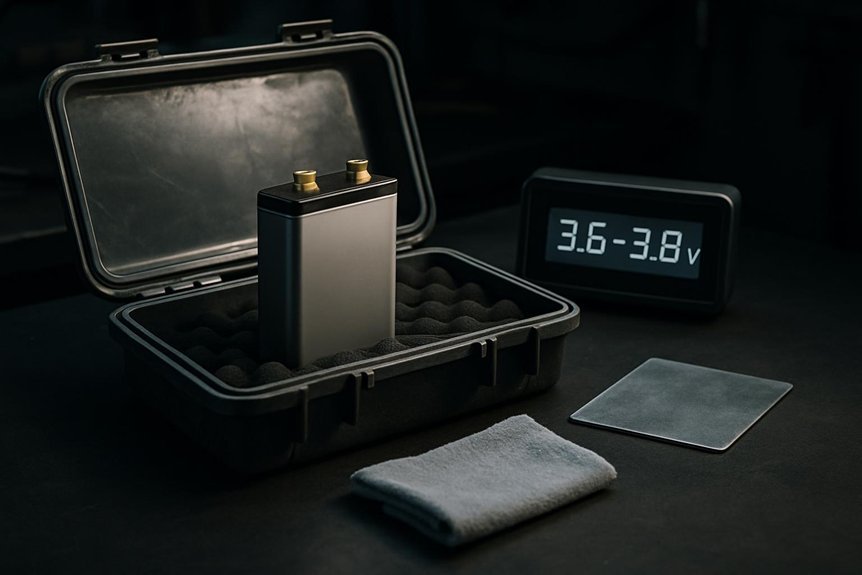
To minimize degradation and safety risks during storage, we aim to leave lithium cells at a partial state of charge rather than fully charged or completely discharged. We target a storage level around 40–60% of nominal capacity for most lithium chemistries, reflecting manufacturer guidance and cycle-life data. Avoid prolonged exposure to extremes, as both overstate and understate stresses accelerate capacity fade. We monitor state of charge with calibrated tools and confirm stability over multi-week intervals. Avoid “one-size-fits-all” assertions; note that aging and chemistry influence optimal levels. Be aware of storage myths that suggest extreme levels are harmless or universally best. Our recommended habit is to perform a periodic top-up if storage exceeds several months, maintaining a gentle, controlled charge within the target band. Consistency in charging habits preserves pack health and safety.
Safe Storage Environments: Temperature, Humidity, and Safety
We mitigate risks by controlling the storage environment: keep temperatures within a safe range, manage humidity to prevent corrosion and moisture ingress, and implement straightforward safety practices for handling and containment. We prioritize stable temperatures, with a target range specified by manufacturer guidelines, and monitor ambient and battery surface temperatures to avoid thermal shocks. Humidity control minimizes storage corrosion and reduces moisture ingress, especially in enclosed spaces. We also enforce basic safety practices: use non-slip trays, avoid sealing batteries in airtight zones, and store away from heat sources.
| Temperature | Humidity | Safety Practices |
|---|---|---|
| 15–25°C | 20–50% RH | Label, ventilation, spill procedures |
Containers and Placement for Safe Battery Storage
Containers and placement for safe battery storage require deliberate organization and separation. We group lithium cells by chemistry, voltage, and state of charge, placing high-energy packs in dedicated, labeled containers away from heat sources. Use non-conductive, flame-retardant enclosures with vented access for safety and traceability. Shelving should prevent contact between packs and metal, with staggered rows to minimize mechanical stress and facilitate airflow. Maintain a dry, cool location, and avoid moisture exposure by using sealed bins and desiccants where appropriate. We should separate charged and discharged inventories, and never stack packs haphazardly. Implement standard handling procedures, fire suppression readiness, and routine inventory checks. Proper containers and placement reduce irreversible degradation risks and support overall safety in long-term storage.
Inspecting Batteries Before Long-Term Storage
We inspect the battery’s state and condition before long-term storage to confirm it’s suitable for extended idle periods. If we detect any swelling, corrosion, or noticeable damage, we halt storage and address the issue promptly. We also verify voltages and charge levels follow the manufacturer’s guidelines to minimize risk.
Inspect Battery State
Before long-term storage, we verify the battery’s state to prevent degradation or hazards: check the charge level, inspect for physical damage, and confirm that there are no signs of leakage or swelling.
- Confirm the current state of charge meets manufacturer guidance for storage lifecycle
- Inspect casing for cracks, bulges, or deformation and note any irregularities
- Look for moisture intrusion or corrosion at terminals and connectors
- Verify that seals and vents are intact, ensuring packaging integrity and storage logistics
We document findings succinctly to support safe handling and future retrieval. If any anomaly is detected, we pause storage and implement corrective actions per protocol, avoiding risk to personnel and adjacent materials. This disciplined check reinforces safe packaging, prevents cascading hazards, and maintains proper storage logistics throughout the cycle.
Check For Damage
Have we thoroughly checked for damage before long-term storage? We inspect the battery surface for cracks, bulges, or swelling, and verify terminals are clean and intact. Any deformation or leakage indicates compromised integrity and warrants disposal or professional assessment. We test exterior insulation for tears or pinches that could expose metal contacts, which raises short-circuit risk. We verify absence of unusual heat during gentle handling and confirm there’s no audible hissing or smell. We examine connectors and packs for loose or corroded contacts, ensuring proper isolation from conductive surfaces. If damage is found, we categorize as unsafe and isolate the unit. We document findings, noting irrelevant topic or unrelated concept only as a nontechnical aside, never as justification for proceeding with storage. Safety comes first.
Debunking Common Lithium Battery Storage Myths
We’re here to clear up common lithium battery storage myths and set the record straight with practical guidance. We’ll separate myth from fact on storage temperature realities, proper charging habits, and safe handling to prevent degradation and hazards. Let’s examine what really matters so you can store batteries safely and reliably.
Myth-Busting Storage Myths
Misconceptions about lithium battery storage persist, but clearing them is essential for safety and longevity. We tackle myths directly, focusing on practical guidance and risk awareness. Our goal is rigorous, actionable knowledge that reduces incidents and preserves performance.
- Myth: storing at high temperatures is harmless. Reality: elevated temps accelerate degradation and fire risk; cool, dry conditions are preferred.
- Myth: fully charging before storage is best. Reality: partial state of charge in line with manufacturer guidelines minimizes stress.
- Myth: a simple label guarantees safety. Reality: correct enclosure, venting, and separation from metals matter equally.
- Myth: any container works for long-term storage. Reality: nonconductive, nonflammable packaging with proper insulation reduces hazards.
Together, we demystify storage myths and reinforce safe practices for reliability.
Storage Temperature Realities
Temperature matters, but not in isolation: storage decisions hinge on how temperature interacts with chemistry, aging, and safety. We present the realities so you don’t chase storage myths. Our guidance targets safe, predictable behavior across common chemistries and conditions. In practice, modest cooling slows degradation and reduces self-discharge, while excessive cold or heat accelerates aging and can stress protective packaging. We emphasize stable, moderate temperatures within manufacturer-recommended ranges, avoiding rapid cycling and thermal shocks. Documentation and limited compliance requirements shape your protocols, ensuring consistent handling, monitoring, and fault reporting. Understanding the temperature window helps prevent misinterpretation of results and supports safe long-term storage. Remember, temperature is just one piece; overall safety relies on disciplined storage, regular checks, and clear procedures.
Charging Habits Misconceptions
Charging habits often cause more confusion than danger, but clear, accurate practices prevent storage-fade and safety incidents. We address charging misconceptions that fuel storage myths and risk. Our guidance stays precise, focusing on data-backed limits and practical steps. We debunk the notion that full charges always maximize longevity; partial top-ups can be better within safe ranges. We also clarify that overnight charging isn’t inherently dangerous when using quality hardware and proper temperature control.
- Use chargers compatible with the cell chemistry and follow manufacturer specs
- Maintain storage state around 3.6–3.8V per cell for Li-ion, if not shipping at full
- Avoid deep discharges; recharge before it falls too low
- Monitor temperature and stop charging if heat spikes or swelling occurs
What to Do If a Battery Overheats, Leaks, or Swells
If a battery overheats, leaks, or swells, stop using the device immediately and move it to a non-flammable, well-ventilated area away from flammable materials. We’ll act calmly, assess, and implement safe procedures. First, disconnect power if possible without touching the device itself, then remove it from adjacent objects. Do not puncture, press, or attempt to extinguish with water; instead, use a Class D or multipurpose extinguisher only if necessary and safe. Ventilate the area to disperse fumes while awaiting emergency guidance. For overheating prevention, monitor temperature rise closely and avoid return to service until temperatures normalize. For leak containment, isolate the source, contain runoff with non-reactive materials, and dispose per local regulations. Maintain documentation for device history and safety audits.
Storing Different Battery Types: Packs, Cells, and Modules
We, as safety practitioners, outline clear storage considerations for packs, cells, and modules to minimize risk. We’ll cover packs storage guidelines, cells handling practices, and modules safety measures to ensure consistent containment, monitoring, and labeling. We’ll keep procedures concise, enforce proper segregation, and verify temperature, humidity, and charging states before any reuse or storage.
Packs Storage Guidelines
Packs should be stored in a dedicated, well-ventilated area with a stable temperature and low humidity to minimize degradation and risk. We focus on storage basics and risk assessment to guide safe practice and prevent thermal events.
- Use a dedicated enclosure, away from flammable materials, with controlled access
- Maintain a constant ambient temperature, avoiding extremes and rapid changes
- Implement passive cooling and secondary containment for leaks or venting
- Label, inventory, and segregate packs by chemistry, voltage, and age
We monitor pack integrity regularly, document deviations, and adjust storage conditions promptly. When in doubt, perform a risk assessment and consult manufacturer guidelines. Our approach emphasizes consistency, traceability, and proactive safety to protect people and property.
Cells Handling Practices
In moving from storage basics to handling practices, we must treat packs, cells, and modules as distinct entities with specific safety controls. We approach cell handling with strict protocols: inspect cells for physical damage, swelling, or corrosion before any movement, and document state of charge to minimize rapid chemical changes. Use compatible tools and PPE, and avoid improvised grips that could stress terminals. When transferring, maintain stable, non-conductive support to prevent flexing or shorting. Store cells only in purpose-built storage containers designed for lithium chemistries, with vented lids, temperature control, and clear labeling. Segregate damaged or rejected cells in isolated, secondary containment and route for safe disposal. Regularly verify container integrity, humidity, and SOC logs to sustain safe, predictable performance.
Modules Safety Measures
Modules safety measures begin with clearly defined containment and monitoring for packs, cells, and modules as distinct entities. We address each type with targeted controls to minimize risk and ensure traceability across the system. Clear storage labeling helps responders identify contents, state of charge, and hazard level at a glance. We also assess corrosion risks by limiting exposure to moisture and reactive environments, and by enforcing compatible materials in contact areas. For packs, maintain rigid housings, venting pathways, and temperature alarms. For modules, preserve isolation between units and implement continuous monitoring of seals. For cells, verify shielding and cradle support to prevent mechanical damage. Adhere to documented procedures, inspection intervals, and incident reporting to sustain a safe, compliant storage environment. Apply these practices consistently.
Practical Step-by-Step Checklist for Safe Lithium Battery Storage
What steps should we take to store lithium batteries safely, and how do we execute them reliably? We begin with a written checklist that is repeatable, auditable, and specific. Verify the battery is in a pristine, undamaged condition before storage, and remove it from any device or charger. Aim for a partial charge around 40–60% if storing for extended periods; monitor manufacturer guidance for cell chemistry. Use a fire-safe, well-ventilated container, ideally a dedicated Li-ion storage bag or metal enclosure rated for thermal events. Control ambient temperature between 5–20°C and humidity below 60%. Disconnect all leads and label the pack with date and state of charge. Inspect regularly; address swelling, corrosion, or leaks immediately to prevent irreversible degradation and reduce fire hazards. Maintain documented routines and secure access.
Frequently Asked Questions
How Long Can a Stored Lithium Battery Remain Usable?
We can typically store a lithium battery for several months to a year, depending on chemistry and state of charge, but we monitor voltage and temperature regularly for safety considerations and adjust storage duration to maximize longevity and reliability.
Can You Store a Partially Discharged Battery Safely?
Yes, you can store a partially discharged battery, but only if it’s at a partially charged level, and kept in a cool, dry place. We guarantee safe storage by monitoring voltage and avoiding extreme temperatures or moisture.
Do Storage Methods Differ for High-Drain vs. Low-Drain Packs?
We understand 70% of failures occur from improper storage, so yes: storage methods differ for high-drain vs. low-drain packs. We adjust battery chemistry considerations, monitoring states, and charging strategies accordingly to maintain safety and performance.
What Signs Indicate a Storage-Induced Capacity Loss?
We see signs of aging as capacity drops beyond expected, voltage sags under load, increased internal resistance, and heat buildup; storage misconceptions ignore temperature and state-of-charge effects, risking irreversible loss. We communicate these risks clearly to you.
Should Smart Chargers Be Left Connected During Storage?
We avoid leaving smart chargers plugged in during storage; we juxtapose quiet, steady charge against risk, and we urge caution. We rely on smart chargers only during appropriate storage durations to maintain safety and battery health.
Conclusion
We understand that safe storage isn’t guessing—it’s about controlling temperature, charge, and environment. If a popular theory claims “any shelf is fine,” we’ve seen the truth: lithium cells age unpredictably, heat can accelerate failure, and improper SOC invites swelling or leaks. By keeping packs at 40–60% SOC, ~20°C, and in a nonconductive, vented enclosure, we minimize risk. Our approach is precise, verifiable, and safety-first, ensuring reliable performance and reduced fire hazard.