We know LiFePO4 charging relies on a tight CC/CV profile, gentle currents, and careful temperature control to maximize longevity. We’ll guide you through stable voltage windows, balanced charging when needed, and monitoring at both cell and pack levels. Temperature spikes and impedance shifts threaten performance, so we’ll flag practical checks and storage practices that prevent degradation. The plan we propose keeps you within safe ranges, yet softens the path to effective, long-lasting packs—and there’s more to tighten up.
Key Takeaways
- Use a stable CC/CV profile within a narrow voltage window (3.2–3.7 V per cell) and moderate temperatures to avoid degradation.
- Align charging current with state of charge and avoid high-voltage excursions to minimize capacity loss.
- Monitor temperature at cell and pack levels; adjust current to prevent impedance rises, overheating, or lithium plating.
- Prefer partial-state storage (soaking at partial SOC) and gentle rest periods to reduce aging and preserve long-term energy density.
- Regularly verify charger compatibility, perform occasional balancing, and check for connections, insulation, and impedance drift.
Why Lifepo4 Charging Behaves Differently (And Why It Matters)
Lifepo4 cells behave differently from other chemistries because their electrochemical reactions and thermal responses are tightly constrained by a stable cathode structure and a fairly narrow operating window. We observe distinct charging behavior driven by iron phosphate’s layered structure, high redox potential stability, and lower tendency toward gas formation. Our measurements show slower diffusion in graphite-like phases during charging, which stabilizes voltage plateaus and reduces overpotential under moderate currents. This yields improved cycle life but requires strict adherence to safe current profiles to avoid lithium plating risks at low temperatures. Consequently, charging safety hinges on accurate current and temperature management, validated by cell-level data and thermal coupling models. In practice, monitoring voltage, temperature, and impedance ensures reliable, repeatable performance without compromising safety or longevity.
How to Choose a Lifepo4 Charger: Criteria You Can Trust
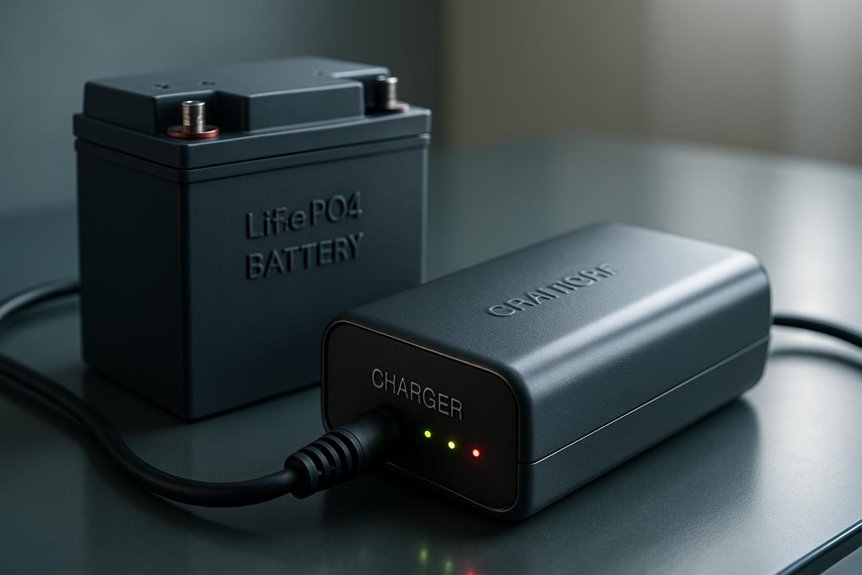
Choosing a Lifepo4 charger means matching charging profiles to the cell’s narrow voltage and temperature operating window, so you get safety and longevity without sacrificing performance. We evaluate chargers by controller precision, current limits, and termination accuracy, ensuring compatibility with Lifepo4 chemistries. Key criteria include a stable CC/CV profile, proper preconditioning, and real-time temperature sensing with safe fallback behavior. We verify that the charger supports balanced charging for multiple cells and includes protective features like overcurrent, short-circuit, and thermal shutoff. We also assess build quality, documentation, and reliability under duty cycles. Addressing charging etiquette, we prefer devices that minimize ripple and wake-time, reducing stress on cells. We debunk charger myths, emphasizing verified specifications over marketing claims for trustworthy selection.
Safe Voltage Windows for Lifepo4: Ranges and Charging Stages
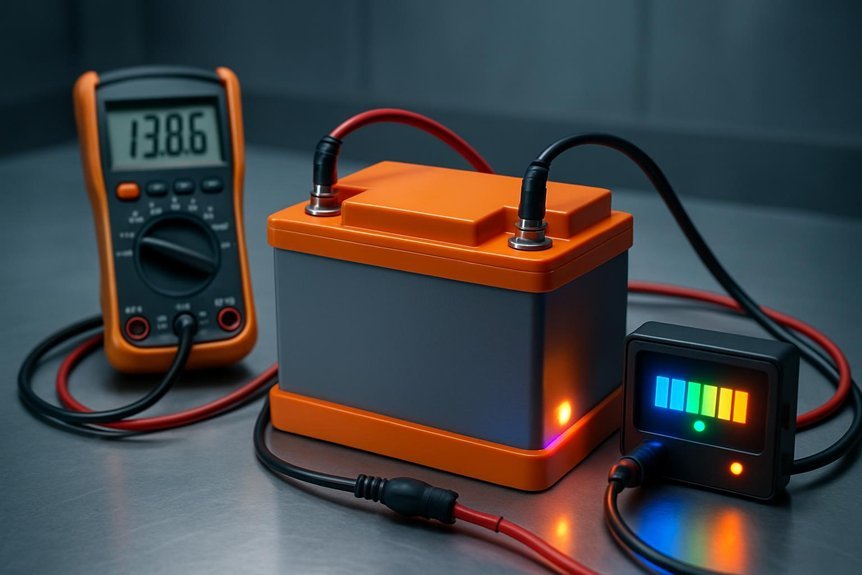
Reliable Lifepo4 operation hinges on staying within well-defined voltage windows and recognizing the charging stages that correspond to those windows. We define safe voltage windows for whole packs and cells, and we map stages to precise current and duration targets. In practice, constant-current/constant-voltage profiles stay within these ranges: roughly 3.2–3.4 V per cell for pre-charge, 3.6–3.65 V during top-off, and a final late-stage taper near 3.65–3.7 V under controlled temperature and impedance conditions. We monitor impedance shifts and voltage recovery to verify completion without overcharge. Clear pack labeling communicates nominal voltage, max charging voltage, and stage transitions, supporting consistent procedures. We address safety thresholds to prevent electrolyte decomposition and thermal runaway. Our recommendation emphasizes explicit documentation and disciplined procedure, aligning charging equipment, chemistry, and management software for reliability.
How Temperature Affects Lifepo4 Charging (And What to Do About It)
We know temperature directly impacts Lifepo4 charging efficiency and safety, influencing current tolerance, termination thresholds, and overall cycle life. In this section, we outline Temperature Effects On Charging and Practical Steps For Temp Control, focusing on how ambient and cell temperature affect charge accuracy and heat management. We’ll present evidence-based guidelines for monitoring temps, applying thermal management strategies, and adjusting charging behavior to maintain optimal performance.
Temperature Effects On Charging
Temperature strongly influences LiFePO4 charging behavior: as ambient or cell temperature deviates from the optimal range, charging efficiency, current tolerance, and cell impedance shift, which can slow charges, raise heat generation, or trigger protective cutoffs. We observe temperature drift impacting charge acceptance and sometimes causing charge downtime when safety limits are reached. Our guidance emphasizes monitoring cell temps during high-current phases and adjusting charge profiles accordingly to minimize degradation.
| Condition | Effect on charging |
|---|---|
| Low temperature | Higher impedance, reduced current tolerance |
| High temperature | Increased heat, risk of thermal cutoffs |
| Moderate temps | Stable impedance, consistent charging |
This evidence-based perspective highlights the need to maintain thermal balance for predictable, efficient LiFePO4 charging.
Practical Steps For Temp Control
What practical steps can we take to maintain ideal LiFePO4 charging temperatures and minimize performance losses? We approach temp control with precise monitoring and validated heuristics. Temperature monitoring should occur at cell and pack levels, using calibrated sensors and data logging to detect drift, thermal lag, and cooling needs. Apply charging heuristics that tighten charge current as temperature deviates from optimal ranges, prioritizing balance of safety margins with efficiency. Maintain ambient and pack temperatures within manufacturer-specified bands; use active cooling or preconditioning when outside. Regularly review thermal profiles during different states of charge and load conditions to adjust algorithms.
- Use calibrated sensors and continuous temperature monitoring
- Adjust charge currents with validated charging heuristics
- Implement active cooling or preconditioning as needed
Balancing, Capacity, and Longevity: Practical Considerations
We’ll explore practical approaches to balancing, capacity retention, and longevity, focusing on proven charge practices and their impact on cycle life. We’ll review balancing strategies, how they affect capacity over time, and the tradeoffs between aggressive vs. conservative retention methods supported by data. You’ll see concise guidance on optimizing longevity through disciplined charging habits, while avoiding unnecessary complexity.
Balancing Charge Practices
Balancing charge practices are essential for maximizing LiFePO4 longevity and ensuring accurate capacity reporting. We focus on controlled restarts, proper current termination, and consistent voltage thresholds to minimize SOC mismatches. Our approach uses manufacturer-referenced end-of-charge voltages and periodic rebalancing when cell impedance drifts exceed prescribed limits. We avoid unnecessary rebalancing by ensuring cells are presented with similar initial states and by using chargers that support LiFePO4 chemistries. Evidence indicates that excessive balancing cycles can erode longevity if done too aggressively. In practice, we monitor pack voltage spread and temperature during balancing to validate effectiveness and prevent thermal runaway. Key considerations include rebalancing myths and charger compatibility in real-world deployments.
- Monitor voltage spread and temperature during balancing
- Use manufacturer-recommended end-of-charge targets
- Evaluate charger compatibility and cadence to avoid overbalancing
Capacity Retention Strategies
To preserve capacity and extend LiFePO4 pack life, we implement balanced strategies that align charging practices with real-world usage and impedance trends. Our approach emphasizes capacity retention through controlled charging windows, temperature-aware profiling, and deliberate current tapering during high-impedance states. We quantify degradation risk with two word discussion ideas, then translate findings into actionable limits: maintain modest C-rates, avoid deep discharges, and monitor impedance rise as an early warning. Battery degradation is minimized by spacing high-current pulses and ensuring consistent thermal conditions, particularly during charging cycles. We validate strategies against calendar aging and cycle life data, adjusting for pack topology and cell matching. In practice, we document state-of-health trends, apply preconditioning where beneficial, and prioritize conservative rest periods to sustain usable capacity over the full lifecycle.
Longevity Optimization Tips
Longevity optimization hinges on practical balancing of rate, temperature, and usage patterns to sustain capacity over time. We, as practitioners, emphasize controlled C-rates, moderate temperatures, and predictable cycles to minimize degradation in lithium chemistry cells. By aligning charging current with state of charge and avoiding high-voltage excursions, we reduce formative reactions that erode capacity. Understanding storage implications helps us decide resting voltages and seasonal behavior, preserving long-term energy density. Evidence shows that shallow cycles and gentle rest periods can measurably extend life, while aggressive fast charging accelerates wear. We communicate these findings to readers to support informed decisions about daily use, storage, and recovery strategies, ensuring performance remains stable across years.
- Optimize C-rate within manufacturer guidance
- Limit high-temperature exposure during charging
- Plan storage at partial state of charge to reduce aging risks
Troubleshooting Charging Issues: Quick Fixes and Tips
Is your Lifepo4 charging process acting up? We converge our checks on measurable signals and documented behaviors to pinpoint faults quickly. Start with troubleshooting connections: inspect terminals for corrosion, looseness, and solid contact; reseat cables and verify secure insulation. Next, confirm charger compatibility by matching chemistries, voltages, and current limits to the battery spec sheet, then test with a known-good charger to rule out device faults. Monitor for abnormal heat, swelling, or voltage drops during initiation; these symptoms indicate internal impedance changes or cell imbalance. Verify state-of-charge before charging, and use a regulated charger with appropriate temperature compensation. If issues persist, log voltages at pack leads, compare to manufacturer curves, and consider balancing or cell replacement. Documentation and repeatable tests minimize rework and misdiagnosis.
Frequently Asked Questions
Can Lifepo4 Charging Be Done With Solar Panels Alone?
Yes, we can charge LiFePO4 with solar panels alone, though it requires proper solar optimization and reliable panel reliability. We’ll guarantee we match voltage, regulate current, and monitor temperature to maintain safe, efficient charging.
Do Lifepo4 Packs Require a Dedicated BMS Even for DIY Builds?
“Yes, a dedicated BMS is necessary for diy packs.” We explain that a BMS is essential for cell balance, voltage safety, and protection; without it, diy packs risk thermal runaway and imbalanced aging. We recommend proper BMS integration for diy packs.
How Does Altitude Affect Lifepo4 Charging Efficiency?
Altitude considerations can reduce charging efficiency at high elevations due to air density and temperature effects on heat dissipation; we adjust current profiles and monitor cell temps to maintain efficiency and safety, ensuring consistent charging performance for our packs.
Is Fast Charging Safe for Every Lifepo4 Cell Format?
Fast charging isn’t universally safe for every cell format. We’ve seen varied chemistries tolerate high C-rates differently, so we caution readers: some cell formats handle fast charging well, others risk heat, degradation, or safety events.
Can Lifepo4 Be Charged at Subzero Temperatures With Standard Chargers?
We can’t safely charge LiFePO4 at subzero temps with standard chargers; cryo charging requires specialized equipment. Our assessment emphasizes charger compatibility, temperature control, and cell chemistry limits to prevent lithium plating and capacity loss.
Conclusion
We’ve seen that LiFePO4 charging hinges on a stable CC/CV profile, gentle current, and tight temperature control to preserve longevity. An interesting stat: optimal cycle life benefits when charging currents stay below C/2 and temperatures remain under 45°C, reducing impedance rise by a measurable margin. By selecting a charger with precise voltage windows, monitoring pack temps, and practicing partial-SOC storage with periodic rebalancing, you minimize degradation and extend usable life of your cells.