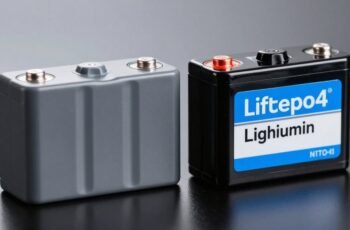
We might assume LiFePO₄ lasts longest, but Lithium Titanate (LTO) can achieve up to 30,000 cycles because its electrode structure experiences minimal strain during charging and discharging. LiFePO₄ typically delivers about 2,000–5,000 cycles, making it a strong balance of durability, safety, and cost, while NMC generally offers less cycle life. Real-world results still depend on temperature, charge limits, depth of discharge, and battery management, so the best chemistry depends on more than cycle count alone.
Key Takeaways
- Lithium titanate (LTO) generally lasts longest, delivering approximately 10,000–30,000 cycles under suitable operating conditions.
- Lithium iron phosphate (LFP) typically provides 2,000–5,000 cycles and can last longer with careful management.
- LTO’s minimal electrode expansion reduces cracking and degradation during frequent charging and discharging.
- Actual lifespan depends on temperature, depth of discharge, charging current, cell quality, and battery-management protections.
- NMC offers higher energy density, but LFP and LTO generally provide better longevity, safety, and cycle durability.
Which Lithium Battery Chemistry Lasts Longest?
Among common lithium-ion chemistries, lithium iron phosphate (LiFePO₄ or LFP) generally delivers the longest service life because its stable olivine crystal structure resists thermal stress, oxygen release, and capacity loss. In practical systems, we often see LFP batteries achieve roughly 2,000–5,000 full equivalent cycles, with well-managed installations sometimes exceeding that range. Longevity still depends on operating conditions: moderate temperatures, controlled charge voltage, limited time at full state of charge, and conservative discharge limits slow degradation. Battery-management systems also protect cells from overcharge, deep discharge, imbalance, and excessive current. We should thus treat chemistry as the foundation, not a guarantee. Cell quality, thermal design, charging practices, and duty cycle determine whether a battery approaches its rated life. For long-term reliability, LFP usually provides the strongest baseline.
How LiFePO₄, NMC, and LTO Compare
LiFePO₄, NMC, and lithium titanate (LTO) prioritize different performance characteristics rather than offering one universally superior design. We typically choose LiFePO₄ for strong thermal stability, lower material cost, and long service under moderate power demands. NMC provides higher cell-level energy density, so we can reduce pack size and weight; however, its nickel-manganese-cobalt formulation generally requires more careful thermal and charge management. LTO replaces graphite with lithium titanate at the negative electrode. This design supports excellent low-temperature performance, rapid charging, and exceptional power delivery, but its lower cell voltage reduces pack-level energy density and increases the amount of material needed for equivalent capacity. We should thus compare usable energy, operating temperature, power requirements, safety controls, cost, and packaging constraints—not chemistry in isolation—when selecting a battery.
Why LTO Batteries Lead in Cycle Life
Because LTO’s lithium-titanate anode undergoes minimal structural strain during charging and discharging, we can cycle these cells far more often than conventional graphite-based batteries. Its near-zero volume change reduces particle cracking, loss of electrical contact, and growth of unstable interfacial layers. LTO also operates at a higher anode potential, which greatly reduces lithium plating during rapid charging and low-temperature operation. That feature improves safety while preserving electrode integrity under demanding current profiles. As a result, manufacturers commonly rate LTO cells for roughly 10,000–30,000 full cycles, although actual life depends on temperature, depth of discharge, current, and pack controls. We should interpret those figures as comparative guidance, not guarantees. LTO’s exceptional durability makes it especially effective where frequent cycling, fast recharging, and long service life outweigh energy-density limitations.
Where LiFePO₄ Offers the Best Balance
LiFePO₄ offers us a strong balance between long-term cycle life and practical energy density. Its stable phosphate chemistry reduces thermal-runaway risk and supports consistent operation across demanding applications. We’ll examine how this combination of safety, stability, and durability guides battery selection.
Long-Term Cycle Life
When long-term durability matters, we should evaluate cycle life alongside usable capacity, efficiency, safety, and cost—not as an isolated specification. LiFePO₄ typically delivers the strongest overall balance because its olivine structure tolerates repeated lithium-ion insertion and removal with comparatively low structural strain. Quality cells commonly achieve several thousand full equivalent cycles before reaching roughly 80% of rated capacity, although actual results depend on temperature, charge voltage, discharge rate, depth of discharge, and manufacturing quality. Nickel-manganese-cobalt cells can offer higher energy density, yet frequent deep cycling generally accelerates capacity loss. Lithium titanate can surpass LiFePO₄ in cycle count, but its lower energy density and higher cost limit practicality. For stationary storage, recreational vehicles, and daily-use systems, LiFePO₄’s longevity reduces replacement frequency and lifetime cost, making it our most balanced long-term choice.
Safety And Stability
For systems where thermal safety and operating stability matter, we should prioritize chemistry as well as capacity and cycle life. LiFePO₄ offers the strongest overall balance because its phosphate-based cathode resists oxygen release and structural breakdown at elevated temperatures. That stability reduces the likelihood of thermal runaway compared with nickel-rich lithium-ion chemistries, including NMC and NCA, which deliver higher energy density but demand stricter thermal management. LiFePO₄ cells also tolerate repeated high-power operation and maintain relatively stable voltage across much of their discharge range. We still need appropriate battery-management systems, fusing, temperature monitoring, and mechanical protection; chemistry doesn’t eliminate installation risks. However, its lower flammability and robust thermal behavior provide a wider safety margin. For stationary storage, marine systems, and daily-use batteries, that margin often outweighs LiFePO₄’s lower energy density.
How NMC Battery Life Compares
Although NMC batteries typically deliver higher energy density and power than LiFePO₄ cells, their cycle life is often shorter because nickel-rich cathodes and higher operating voltages accelerate structural degradation. In comparable applications, quality NMC packs commonly provide roughly 1,000–2,000 full cycles, whereas LiFePO₄ packs may reach 2,000–5,000 or more. These figures aren’t universal: cell design, manufacturing quality, and operating conditions shift the outcome substantially. We should consequently compare usable lifetime, not cycle counts alone. NMC’s greater energy density can reduce pack size and weight, potentially improving system-level economics despite fewer cycles. LiFePO₄ generally retains capacity more effectively over extended cycling, making it attractive for stationary storage and high-utilization vehicles. When we prioritize compactness and power, NMC remains compelling; when longevity dominates, LiFePO₄ usually holds the advantage.
What Shortens Lithium Battery Lifespan?
Cycle-life differences between NMC and LiFePO₄ cells become more pronounced when operating conditions accelerate degradation. We shorten lithium battery life through high temperature, deep discharges, sustained full charge, excessive current, and prolonged storage at extreme states of charge. These stresses increase side reactions, resistance growth, lithium plating, and structural damage. We should distinguish chemistry from operating history: even durable cells degrade rapidly when thermal control or charge limits fail.
| Stressor | Primary damage |
|---|---|
| High temperature | Accelerated electrolyte breakdown |
| Deep discharge | Electrode instability |
| Overcharge | Plating and gas generation |
| High current | Heat and resistance growth |
We can slow aging by keeping temperatures moderate, avoiding unnecessary 100% charging, limiting extreme discharge, and using a battery-management system that balances cells and enforces voltage, current, and thermal limits. Storage also matters: moderate charge levels and cool conditions reduce calendar aging. Manufacturer limits remain the evidence-based baseline for safe operation.
Which Chemistry Fits Your Application Best?
Choosing between NMC and LiFePO₄ depends on the application’s energy, power, weight, safety, temperature, and service-life requirements. We typically select NMC when high energy density and compact packaging matter most, such as electric vehicles, drones, and portable equipment. Its higher specific energy can reduce mass, but thermal management and conservative operating limits remain essential because NMC is more thermally reactive.
We favor LiFePO₄ for stationary storage, recreational vehicles, marine systems, and high-cycle applications. Although it stores less energy per kilogram, its stronger thermal stability, lower risk of oxygen release, and longer cycle life can reduce lifetime cost. It also tolerates frequent deep cycling better. We should compare complete systems—not cells alone—using usable capacity, duty cycle, ambient temperature, charging limits, protection electronics, and replacement costs. Application data, rather than chemistry preference, should determine the final choice.
Frequently Asked Questions
Can Lithium Batteries Be Recycled After Reaching the End of Their Useful Life?
Yes, we can recycle lithium batteries after they’re depleted. Specialized facilities recover metals, plastics, and electrolytes through mechanical, hydrometallurgical, or pyrometallurgical processes, reducing waste, conserving resources, and requiring proper collection to prevent fires.
Are Lithium Batteries Safe to Use in Extreme Cold or Hot Temperatures?
Lithium batteries aren’t equally safe in extreme temperatures. We should avoid charging below freezing or above manufacturer limits, limit high-temperature exposure, and expect reduced capacity, faster degradation, protection-system shutdowns, or thermal runaway risks when overheated.
How Should Lithium Batteries Be Stored When They Are Not Being Used?
Store lithium batteries cool, dry, and partially charged—around 40–60%; self-discharge typically remains below 3% monthly. We’ll protect terminals, avoid direct sunlight, and inspect periodically, preventing moisture, short circuits, swelling, and capacity loss during storage.
What Warranty Coverage Is Typically Offered for Different Lithium Battery Chemistries?
Warranty coverage varies by chemistry and manufacturer: we typically see lithium-ion warranties around 2–5 years, LiFePO₄ 5–10 years, and lithium-titanate up to 10 years, with cycle counts, capacity retention, exclusions, and prorating defined contractually.
Can Mixing Different Lithium Battery Chemistries Damage a Battery System?
Yes, mixing lithium chemistries can damage your battery system: we’ll create mismatched voltage curves, charging limits, and thermal behavior, potentially triggering imbalance, overheating, reduced capacity, or failure. We should use compatible cells, controls, and protection.
Conclusion
When we choose a lithium battery, we’re choosing a marathon partner, not merely a power source. LTO runs the longest race, often reaching tens of thousands of cycles, but its higher cost and lower energy density limit its audience. LFP typically offers the strongest overall balance, delivering thousands of safe, durable cycles at practical cost. NMC remains compelling where compact energy matters. By matching chemistry to duty cycle, temperature, and charging habits, we’ll extend service life and value.