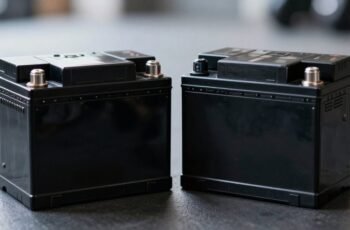
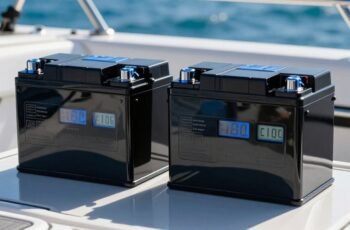
We compare LiFePO4 and AGM batteries by capacity, lifespan, efficiency, safety, and cost. LiFePO4 delivers more usable energy, faster charging, and far greater cycle life, while AGM offers a lower upfront price and simpler installation. The better choice depends on how often we cycle the battery, how much power we need, and how harsh the operating conditions are. The long-term cost difference, however, may change the decision.
Key Takeaways
- LiFePO4 batteries provide more usable capacity, typically 80–100% DoD, compared with AGM’s recommended 50% DoD.
- LiFePO4 lasts approximately 2,000–5,000 cycles, while AGM typically provides about 300–1,000 cycles.
- AGM batteries cost less initially, but LiFePO4 often delivers lower lifetime cost through longer service and better efficiency.
- LiFePO4 batteries charge faster, weigh less, and maintain steadier voltage under load than comparable AGM batteries.
- AGM tolerates cold charging better, while LiFePO4 requires BMS protection and must not be charged below freezing.
LiFePO4 vs AGM: Which Battery Wins?
If we compare LiFePO4 and AGM batteries by usable capacity, cycle life, efficiency, weight, and maintenance, LiFePO4 generally wins for frequent cycling and weight-sensitive applications, while AGM remains competitive for lower-cost, simpler installations. We’ll typically obtain more usable energy from LiFePO4 because it tolerates deeper discharge without the same capacity penalty. Its higher round-trip efficiency also reduces charging demand and operating losses. Cycle life is usually several times longer, improving total cost of ownership where the battery cycles often. AGM batteries remain attractive when initial price, straightforward installation, and established compatibility matter more than maximum performance. They’re heavier and generally require more conservative discharge limits to preserve service life. For occasional backup use, AGM can deliver adequate value; for daily cycling, portable systems, or constrained spaces, LiFePO4 usually provides the stronger technical and economic result.
How LiFePO4 and AGM Batteries Work
We’ll compare how lithium iron phosphate chemistry stores and releases energy through lithium-ion movement between electrodes. We’ll then examine how AGM batteries use lead-acid reactions with electrolyte held in fiberglass mats. This comparison clarifies why their voltage behavior, efficiency, lifespan, and charging requirements differ.
Lithium Iron Phosphate Chemistry
LiFePO4 batteries store and release energy through reversible lithium-ion movement between a lithium iron phosphate cathode and a graphite anode, while an electrolyte carries the ions and an external circuit carries electrons. During discharge, lithium leaves the cathode, travels through the electrolyte, and electrons power your load. Charging reverses this process.
| Component | Function | Result |
|---|---|---|
| Cathode | Hosts lithium ions | Stable voltage |
| Anode | Stores lithium ions | Reversible capacity |
| Electrolyte | Transports ions | Internal conduction |
| Separator | Prevents contact | Reduced short-circuit risk |
The phosphate framework strongly bonds oxygen, improving thermal and chemical stability. Its nominal cell voltage is about 3.2–3.3 volts, so we connect cells in series to reach system voltage. The chemistry also tolerates repeated cycling effectively when we maintain appropriate voltage, temperature, and current limits. A battery-management system monitors cells, balances voltage, and interrupts unsafe operating conditions.
AGM Lead-Acid Design
Unlike LiFePO4 cells, AGM batteries use lead dioxide plates as the positive electrodes, porous lead plates as the negative electrodes, and sulfuric acid immobilized in a fiberglass separator. We obtain a valve-regulated lead-acid design because the fiberglass mat holds electrolyte in place while allowing oxygen to migrate internally during charging. This recombination process limits water loss, so we don’t routinely add water. During discharge, sulfuric acid reacts with both plates, producing lead sulfate, water, and electrons that supply the external circuit. Charging reverses these reactions, but incomplete charging promotes sulfation and reduces capacity. AGM batteries tolerate vibration because the mat supports the plates, yet their chemistry remains sensitive to overcharging and heat. We consequently need accurate voltage control and adequate ventilation, even though the case is sealed under normal operation.
Compare Usable Capacity and Depth of Discharge
We’ll compare usable capacity by examining how deeply we can discharge LiFePO4 and AGM batteries without compromising performance. We’ll also assess depth-of-discharge limits and how they affect the energy available in each battery. Finally, we’ll connect discharge depth to cycle life, since repeated deep cycling influences long-term value.
Usable Capacity Comparison
When comparing usable capacity, we should consider both nominal amp-hours and the battery’s recommended depth of discharge (DoD). A 100 Ah LiFePO4 battery and a 100 Ah AGM battery have the same rated storage, but they don’t provide the same practical energy. If we calculate capacity at 80% usable discharge for LiFePO4 and 50% for AGM, the lithium battery supplies approximately 80 Ah, while AGM supplies about 50 Ah. At a 12.8-volt LiFePO4 nominal voltage, that equals roughly 1,024 Wh. A 12-volt AGM battery provides approximately 600 Wh at the same rating. We should also account for voltage-dependent equipment performance, temperature, inverter efficiency, and aging. As a result, LiFePO4 typically delivers more usable energy from an equivalent nameplate capacity, reducing battery-bank size for a given load.
Depth Of Discharge
Usable capacity depends directly on depth of discharge (DoD), the percentage of a battery’s rated capacity removed before recharging. With LiFePO4, we can typically use about 80–100% of the rated capacity, depending on the manufacturer’s limits, battery-management system, and required reserve. A 100Ah LiFePO4 battery may consequently provide approximately 80–100Ah of practical energy.
AGM batteries generally perform best with shallower discharge, commonly around 50% DoD. Although we can occasionally discharge an AGM battery further, usable energy declines because voltage drops more substantially under load and available capacity varies with discharge rate. Hence, a 100Ah AGM battery often delivers roughly 50Ah within a conservative operating range. When we compare equal nameplate capacities, LiFePO4 provides more accessible energy, while AGM requires a larger bank to supply the same usable capacity. Temperature and load also influence actual output.
Cycle Life Impact
How does depth of discharge affect long-term value? We evaluate cycle life by combining usable capacity, discharge limits, and the number of cycles each chemistry tolerates. Although AGM batteries may cost less initially, repeated deep discharges accelerate sulfation and reduce effective capacity. LiFePO4 cells typically deliver more usable energy because they support deeper discharge without comparable degradation.
- AGM: commonly 50% recommended depth of discharge for durability.
- LiFePO4: often supports 80–100% depth of discharge, depending on the manufacturer.
- AGM: approximately 300–800 cycles at moderate discharge levels.
- LiFePO4: commonly delivers 2,000–5,000 cycles under controlled conditions.
We should compare lifetime watt-hours, not only rated amp-hours. A 100-Ah LiFePO4 battery may provide about 80 Ah usable, while AGM may provide roughly 50 Ah. This difference reduces replacement frequency and improves long-term value, even when LiFePO4 costs more upfront.
LiFePO4 vs AGM Battery Lifespan
LiFePO4 batteries generally outlast AGM batteries because they tolerate far more charge-discharge cycles with less capacity loss. We’ll typically see LiFePO4 deliver 2,000–5,000 cycles, while AGM often provides 500–1,000 under comparable conditions. Calendar life also depends on temperature, storage state, depth of discharge, and maintenance. Lower operating stress generally preserves usable capacity longer.
| Battery | Typical cycles | Expected service life |
|---|---|---|
| LiFePO4 | 2,000–5,000 | 8–15 years |
| AGM | 500–1,000 | 3–7 years |
| LiFePO4 at 80% depth | Higher retention | Consistent output |
We should interpret these figures as ranges, not guarantees. A well-managed AGM can exceed its estimate, while heat or repeated deep discharges can shorten either chemistry’s life. For frequent cycling, LiFePO4 usually offers more total delivered energy before replacement. AGM remains practical where cycling is occasional and upfront simplicity matters.
Weigh Charging Speed and Efficiency
Longer service life matters most when a battery can also recharge efficiently between uses. We’ll compare how LiFePO4 and AGM batteries accept current, convert stored energy, and manage charging losses. LiFePO4 chemistry typically supports higher charge rates and reaches usable capacity faster, provided we use a compatible charger with correct voltage limits. Its charge efficiency often exceeds 95%, so less input energy becomes heat. AGM batteries generally charge more slowly, require absorption time near full charge, and may lose efficiency as charging current rises. We should also consider these operating factors:
- LiFePO4 sustains rapid charging across a broad state-of-charge range.
- AGM charging slows substantially during the absorption phase.
- LiFePO4’s battery-management system can limit unsafe current or temperature conditions.
- AGM systems need carefully regulated charging to prevent sulfation and overcharging.
Compare Weight, Size, and Installation
When space and payload are limited, we should compare both the battery’s physical footprint and the installation hardware it requires. LiFePO4 batteries typically deliver comparable usable capacity at lower mass than AGM batteries. Their higher energy density can free payload for equipment and simplify handling during installation. However, we should compare manufacturer dimensions rather than assume every LiFePO4 case is smaller. Some models use similar footprints to AGM batteries to fit standard compartments, while others require different terminal locations or mounting clearances.
Installation also differs. AGM batteries generally support straightforward replacement because their cases and terminals follow familiar form factors. LiFePO4 installations may require a compatible charger, battery-management-system connections, and secure restraint suited to the specific case. We should verify cable length, polarity, fuse placement, ventilation provisions, and mounting orientation before selecting either technology.
Understand Safety and Temperature Limits
We’ll compare LiFePO4 and AGM thermal operating limits, including charging and discharging temperature ranges. We’ll also examine protection features such as battery-management systems, thermal sensors, and pressure-relief mechanisms. These factors help us assess safe operation across changing environmental conditions.
Thermal Operating Limits
Thermal operating limits are a key safety difference between LiFePO4 and AGM batteries, because temperature affects charging, discharge performance, capacity, and service life. We should compare manufacturer ratings rather than assume identical behavior.
- LiFePO4 cells generally deliver strong performance across moderate temperatures, but charging below freezing can cause permanent damage. We should use temperature-aware charging practices.
- AGM batteries can usually accept charging in colder conditions, although low temperatures reduce chemical activity, available capacity, and charge efficiency.
- High temperatures accelerate aging in both chemistries. AGM batteries experience faster electrolyte evaporation and corrosion, while LiFePO4 cells lose service life as heat increases.
- During discharge, cold reduces voltage and capacity, particularly in AGM batteries; LiFePO4 batteries typically maintain steadier voltage until their stored energy approaches depletion.
We should install either battery within its specified temperature range, provide ventilation, and avoid placing it beside engines or other heat sources. Temperature limits don’t replace proper operating practices.
Safety Protection Features
Safety protection features differ substantially between LiFePO4 and AGM batteries. We’ll find that LiFePO4 cells require an integrated battery-management system (BMS). The BMS monitors cell voltage, pack current, and temperature, then disconnects charging or loads during overcharge, over-discharge, overcurrent, short-circuit, or thermal events. This protection helps prevent cell damage, but it doesn’t eliminate the need for correctly configured chargers and fuses. AGM batteries generally lack cell-level electronic protection. We rely on external fuses, charge controllers, and proper ventilation instead. Their sealed construction limits electrolyte leakage, yet excessive voltage can cause gassing, pressure buildup, or thermal damage. We should also observe temperature limits: LiFePO4 batteries typically prohibit charging below freezing unless they include low-temperature protection, while AGM batteries tolerate cold charging better but deliver reduced capacity and require regulated voltage.
Calculate LiFePO4 and AGM Battery Costs
When calculating LiFePO4 and AGM battery costs, we should compare usable capacity, service life, charging efficiency, and maintenance—not just the purchase price. We’ll first convert rated amp-hours into usable energy. AGM batteries typically support about 50% depth of discharge, while LiFePO4 batteries often support 80–90%, so equivalent usable capacity may require more AGM units.
- Initial cost: Compare price per usable watt-hour, not per battery.
- Cycle life: Divide purchase price by expected cycles to estimate cost per cycle.
- Efficiency: Include charging losses, because AGM generally requires more input energy.
- Maintenance: Account for replacement frequency, monitoring, and installation expenses.
We should also include chargers, wiring, protection devices, and disposal costs in each system total. Although LiFePO4 usually costs more upfront, its longer life and greater usable capacity can reduce lifetime cost. AGM may remain economical where cycling is infrequent and replacement access is convenient.
Match Each Battery to Your Use Case
Choosing between LiFePO4 and AGM depends on how often we cycle the battery, how much usable energy we need, and what operating conditions we face. For daily solar storage, electric mobility, or frequent RV use, we’ll generally favor LiFePO4. Its higher usable capacity, low voltage sag, and thousands of cycles support repeated deep discharge. We’ll also select it when low weight, compact installation, and stable output matter.
AGM fits intermittent-duty applications such as emergency backup, engine starting, alarms, and lightly cycled marine systems. It tolerates cold charging better than LiFePO4 and offers straightforward installation where existing charging equipment lacks lithium-specific controls. However, we’ll limit discharge depth to preserve service life and account for voltage decline under load. Before choosing, we should match each battery’s chemistry, protection requirements, temperature limits, and cycle profile to the application.
Choose the Right Battery for Your Budget
Although LiFePO4 batteries cost more initially, we should compare total cost of ownership rather than purchase price alone. Their longer service life, higher usable capacity, and lower maintenance can reduce annual energy costs. AGM batteries remain attractive when our upfront budget is limited, installation is occasional, or replacement access is convenient. We should calculate required capacity, cycle frequency, charging efficiency, and expected lifespan before deciding.
- Initial cost: AGM usually requires less capital.
- Lifetime value: LiFePO4 typically delivers more cycles and usable watt-hours.
- System expenses: LiFePO4 may require compatible charging equipment or battery management integration.
- Operating conditions: AGM tolerates simpler systems, while LiFePO4 provides better weight and efficiency.
We should select AGM for low-use, budget-sensitive applications and LiFePO4 for frequent cycling, mobile systems, or long-term ownership. A cost-per-cycle comparison will reveal which option actually fits our budget.
Frequently Asked Questions
Can Lifepo4 Batteries Be Connected in Series or Parallel?
Yes, we can connect LiFePO4 batteries in series or parallel, provided they’re compatible, equally charged, and include suitable battery-management systems. We must follow manufacturer limits, use matched cables, and add appropriate fusing for safety.
Do Lifepo4 Batteries Require a Special Charger?
Yes, we need a LiFePO4-compatible charger: the right key protects the battery’s core. We should choose lithium charging profiles, correct voltage, and built-in safeguards; lead-acid chargers may damage cells or trigger protection circuits.
How Should AGM and Lifepo4 Batteries Be Stored?
Store AGM batteries fully charged, cool, dry, and disconnected, checking voltage periodically. Store LiFePO4 batteries partially charged—typically 40–60%—in a cool, dry location with protection circuitry enabled; avoid freezing, heat, moisture, and prolonged full-charge storage.
Can Either Battery Power Sensitive Electronic Devices Safely?
Yes, we can power sensitive electronics with either battery, provided we use appropriate regulation. AGM voltage varies during discharge; LiFePO4 requires a battery-management system. Add fuses, stable converters, and manufacturer-approved charging equipment for safe operation.
How Should Old AGM and Lifepo4 Batteries Be Recycled?
We should recycle old AGM and LiFePO4 batteries through certified hazardous-waste or battery-recycling facilities. Don’t discard, burn, dismantle, or mix them; insulate terminals, prevent damage, and follow local transport and drop-off requirements.
Conclusion
We’ve seen that LiFePO4 batteries generally win for daily cycling, solar storage, and high-demand loads. Their greater usable capacity, longer lifespan, faster charging, and higher efficiency can offset their higher purchase price over time. AGM batteries remain practical when our priorities are low upfront cost, simple installation, and occasional backup power. By comparing depth of discharge, temperature conditions, charging requirements, and total lifetime cost, we can choose the battery that best fits our application and budget—not just the cheapest option.