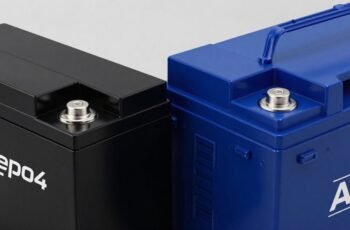
When we compare 100Ah deep cycle lithium batteries, we’ll examine more than rated capacity. We’ll assess usable energy, LiFePO4 cycle life, charge and discharge performance, efficiency, BMS protection, physical dimensions, and warranty coverage. These factors determine whether a battery suits solar storage, an RV, marine equipment, or backup power. We’ll also compare installation requirements and value, because the lowest purchase price may not deliver the best long-term result.
Key Takeaways
- Compare usable energy, not just nominal capacity: a 12.8V 100Ah battery stores approximately 1,280Wh before depth-of-discharge and efficiency losses.
- Evaluate cycle life alongside warranty conditions, end-of-life capacity, test depth, and cost per delivered kilowatt-hour.
- Check continuous and peak current ratings, charging limits, and estimated recharge times for your inverter, motor, or appliances.
- Compare BMS protections, temperature limits, cell balancing, fault reporting, and low-temperature charging safeguards.
- Confirm dimensions, weight, terminals, mounting, monitoring features, and chemistry suitability for RV, marine, solar, trolling, or backup applications.
How We Compare 100Ah Lithium Batteries?
We compare 100Ah lithium batteries by evaluating the specifications that directly affect usable energy, performance, safety, and service life. First, we verify nominal voltage and calculate rated watt-hours by multiplying voltage by capacity. Then, we examine recommended depth of discharge, because usable capacity differs from the advertised 100Ah rating. We assess continuous and peak discharge current against the demands of inverters, motors, and other loads. We also compare charge-current limits, charging-voltage ranges, and low-temperature charging protection. Battery-management-system functions receive separate attention, including overcharge, over-discharge, overcurrent, short-circuit, and thermal safeguards. Next, we review cycle-life testing conditions, operating-temperature limits, enclosure ratings, dimensions, weight, terminals, and warranty terms. Finally, we normalize specifications where possible, identify measurement conditions, and distinguish manufacturer claims from independently documented data.
Best 100Ah Deep Cycle Lithium Batteries
Using those criteria, we can identify the best 100Ah deep cycle lithium batteries by matching each model’s verified capabilities to its intended application. We’ll prioritize documented protection, charging compatibility, cycle testing, warranty coverage, and build quality rather than marketing claims.
The best 100Ah lithium battery depends on verified protection, charging compatibility, cycle life, warranty support, and overall build quality.
- Best overall: Choose a LiFePO4 model with an integrated BMS, low-temperature charge protection, and clear certification records.
- Best for RVs: Select a battery supporting common charging sources, secure terminals, and dependable monitoring through Bluetooth or an external display.
- Best for marine use: Favor sealed construction, corrosion-resistant hardware, vibration tolerance, and a warranty that covers mobile environments.
- Best for value: Consider a reputable manufacturer offering verified test data, responsive support, and replacement availability at a competitive price.
We shouldn’t rank one battery universally. Installation conditions, charging equipment, environmental exposure, and service expectations determine which model delivers the most confidence and dependable performance.
Compare Capacity and Usable Energy
How much energy a 100Ah battery can actually deliver depends on its voltage, chemistry, and allowable depth of discharge. We calculate nominal energy by multiplying amp-hours by nominal voltage: a 12.8V lithium iron phosphate battery provides approximately 1,280Wh. Usable energy is lower, so we multiply that figure by the manufacturer’s permitted discharge fraction. At 80% utilization, the result is about 1,024Wh; at 100%, it approaches 1,280Wh, subject to operating limits and conversion losses. We should compare batteries using usable watt-hours rather than amp-hours alone, especially when nominal voltages differ. Also check whether the stated capacity applies at a specified discharge rate and temperature, because those conditions affect measured output. Finally, subtract inverter, wiring, and battery-management-system losses to estimate the energy your application will actually receive.
Check Battery Lifespan and Cycle Ratings
Usable energy shows what a battery can deliver per cycle; cycle ratings indicate how long it can keep delivering that energy. When we compare 100Ah lithium batteries, we should examine the manufacturer’s test conditions, not just the headline number. A rating may assume a specific depth of discharge, temperature, and discharge rate, so results can vary in service.
- Depth of discharge: We’ll favor batteries rated for regular deep cycling, while avoiding routine operation at maximum depletion.
- Cycle target: A 2,000-cycle rating can represent years of use, but only when our daily workload matches the test profile.
- End-of-life definition: We must check whether the rating ends at 80% capacity, 70%, or another threshold.
- Warranty alignment: We’ll compare cycle limits with warranty duration and coverage, protecting our investment from premature capacity loss.
This method helps us identify durable value, not optimistic specifications.
Compare Charging Speed and Efficiency
We’ll compare charging times to determine how quickly each battery reaches full capacity under equivalent conditions. We’ll also assess energy-conversion efficiency by examining input power versus stored energy. Finally, we’ll evaluate fast-charge performance, including charge-rate stability and heat management.
Charging Time Comparison
Charging speed depends on more than a battery’s rated capacity: we must compare its allowable charge current, charger output, battery-management-system limits, and charging efficiency. For two 100Ah models, we estimate bulk charging time by dividing capacity by actual current, then add absorption time and balancing delays. A battery accepting 50A may approach a two-hour bulk charge, while a 20A limit requires roughly five hours before finishing.
- Charge-current rating: Higher limits shorten downtime, but only with a compatible charger and correctly sized cables.
- Charger output: A 30A charger cannot exploit a battery’s 50A capability, so we’ll measure real delivered current.
- BMS behavior: Thermal protection or cell balancing can reduce current unexpectedly, extending completion time.
- Temperature: Cold conditions may restrict charging, creating frustrating delays and requiring monitoring.
We’ll compare manufacturer specifications under equivalent conditions, not optimistic maximums, to identify the fastest practical option.
Energy Conversion Efficiency
Fast charging doesn’t always mean efficient charging. We evaluate energy conversion by comparing electrical energy drawn from the charger with energy stored in the battery. A useful metric is round-trip efficiency: divide the energy recovered during discharge by the energy required for charging, then express the result as a percentage.
For 100Ah lithium batteries, efficiency depends on cell chemistry, battery-management-system losses, charger quality, temperature, and charging voltage. Lithium iron phosphate models commonly deliver high efficiency because their internal resistance is low, limiting heat generation. We should also distinguish charging duration from conversion performance: a shorter charging period may increase current-related losses without improving the energy stored.
When comparing models, we recommend reviewing manufacturer efficiency curves, measured watt-hours, and operating-temperature data rather than relying solely on amp-hour ratings. That approach reveals which battery converts input energy most effectively.
Fast-Charge Performance
Although higher charge current can shorten downtime, it doesn’t guarantee better performance. We compare each 100Ah lithium battery by charging time, usable input, thermal behavior, and manufacturer limits. A battery accepting 50A may reach full capacity faster than one limited to 30A, but charger efficiency, cable resistance, and battery-management-system controls also affect results.
- Speed: We calculate charging time from rated capacity and verified current, not marketing claims.
- Efficiency: We measure wall-to-battery energy, including conversion losses and balancing overhead.
- Heat: We monitor temperature because thermal throttling can erase theoretical time savings.
- Longevity: We favor batteries whose cells and BMS support rapid charging without excessive stress.
You’ll benefit most when the battery, charger, wiring, and protection settings match. Fast charging matters, but consistent efficiency and safe current management determine practical value. cold-weather limits may further reduce charging speed.
Evaluate BMS Safety and Protection Features
A lithium battery’s BMS should provide layered protection against overcharge, over-discharge, excessive current, short circuits, and abnormal temperatures. We should verify each protection threshold, response time, and reset behavior rather than treating a safety label as proof. Overcharge control must stop charging before cell voltage exceeds its specified limit, while over-discharge protection should disconnect the load before irreversible cell damage occurs. Current protection should address both sustained overloads and rapid short-circuit events. We also need temperature sensors that inhibit charging in freezing conditions and interrupt operation during excessive heat. Cell balancing is important because it limits voltage differences that can trigger premature cutoffs or conceal weak cells. Finally, we should check whether the BMS reports faults, records events, and supports reliable recovery after conditions return to normal without bypassing protection.
Compare Weight, Size, and Installation
Once BMS protection meets our safety requirements, we should compare each battery’s weight, dimensions, and installation demands against the available space and mounting capacity. A lighter unit can simplify handling, but we must verify structural support, restraint points, and ventilation clearances before installation.
> Compare battery weight, dimensions, mounting needs, and service access to ensure a secure, practical installation without compromising safety.
- Weight: Record each battery’s mass, then confirm we can lift and secure it safely without stressing cabinets, shelves, or vehicle floors.
- Dimensions: Measure length, width, and height, including terminals, cables, and service access. Even small differences can prevent proper fit.
- Mounting: Check threaded inserts, brackets, orientation limits, and fastener compatibility. A secure mount reduces vibration and connection strain.
- Wiring access: Confirm terminal placement leaves enough room for bend radius, fuses, disconnects, and tool access.
We’ll favor the battery that fits accurately, mounts securely, and remains serviceable without forcing compromises.
Match Each Battery to Your Use Case
Match each battery to the demands of its intended application rather than choosing solely by capacity or price. For an RV, we should prioritize reliable cycle life, low-temperature charging protection, and sufficient continuous output for inverters and onboard appliances. In a marine installation, we’ll examine vibration resistance, sealed construction, corrosion protection, and compatibility with the vessel’s charging system. Solar storage requires accurate state-of-charge reporting, efficient partial cycling, and a battery-management system that coordinates with the charge controller. For trolling motors, we should verify peak discharge capability, terminal security, and voltage sag under sustained load. Backup power applications emphasize standby behavior, inverter compatibility, and dependable operation during infrequent cycles. We’ll also confirm operating-temperature limits, allowable installation orientation, and communication features before matching any 100Ah battery to its electrical and environmental requirements.
Choose the Best 100Ah Lithium Battery Value
We’ll determine the best 100Ah lithium battery value by comparing usable capacity, cycle life, discharge performance, protection features, warranty coverage, and total cost of ownership—not just purchase price. We’ll also verify voltage consistency, low-temperature charging limits, Bluetooth monitoring, and manufacturer support before deciding.
- Capacity: Calculate watt-hours and usable energy at the recommended depth of discharge. A battery delivering more dependable runtime protects our plans from unexpected shutdowns.
- Durability: Divide purchase price by rated cycles and usable kilowatt-hours. This exposes whether a cheaper battery actually costs more over time.
- Performance: Confirm continuous and peak current ratings match our inverter, motor, or appliances. Adequate reserve prevents stressful overloads.
- Protection: Prioritize a documented BMS, balanced cells, warranty terms, and service access. We’ll choose the model that delivers measurable value and confidence.
Frequently Asked Questions
Can I Connect Multiple 100AH Lithium Batteries in Parallel?
Yes, we can connect multiple 100Ah lithium batteries in parallel to increase capacity while retaining voltage. We’ll verify compatibility, battery-management-system limits, manufacturer approval, equal cable lengths, proper fusing, and balanced initial charge before connecting.
What Charger Is Compatible With a 100AH Deep Cycle Lithium Battery?
Choose a charger matching your battery’s chemistry and voltage—typically a LiFePO4 charger with a 14.6V profile for 12V batteries. We’ll verify manufacturer specifications, amperage limits, and BMS compatibility before connecting.
Can Lithium Batteries Be Safely Used in Cold Temperatures?
Yes, we can safely use lithium batteries in cold temperatures, but charging below freezing risks permanent damage. We’ll use batteries with low-temperature protection, insulation, and approved warming systems, while reducing capacity expectations during operation.
Are 100AH Lithium Batteries Allowed on Airplanes or in Checked Luggage?
Usually, we can’t place 100Ah lithium batteries in checked luggage, and airlines generally prohibit them as carry-ons because their watt-hours exceed limits. We must obtain airline approval and follow dangerous-goods regulations before flying.
How Should I Store a 100AH Lithium Battery When Not in Use?
Store it partially charged, ideally around 40–60%, in a cool, dry, ventilated location away from sunlight and combustibles. We’ll disconnect loads, prevent terminals from shorting, and periodically check voltage and manufacturer guidance.
Conclusion
We’ve compared 100Ah deep-cycle lithium batteries by usable capacity, cycle life, charging performance, BMS protection, dimensions, weight, and application fit. LiFePO4 models typically deliver the strongest balance of safety, efficiency, and long-term value, but specifications must match your system’s charge and discharge demands. Think of the battery as the foundation of your power system: if it’s undersized or poorly protected, everything above it suffers. Choose a reputable model with verified ratings, suitable dimensions, and warranty support.