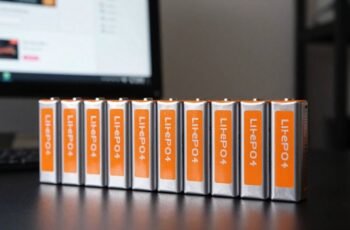
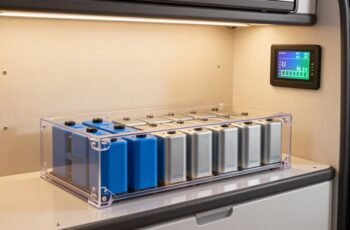
We’re evaluating commercial lithium-ion battery solutions as engineered systems, not standalone cells. Each platform combines chemistry, modular packs, thermal controls, and a battery management system to balance energy density, power delivery, safety, and service life. We’ll compare these trade-offs, match configurations to operational demands, and outline capacity, runtime, maintenance, and provider requirements. The key question is how to specify a system that performs reliably today while scaling with tomorrow’s load.
Key Takeaways
- Commercial lithium-ion battery systems combine cells, modules, packs, BMS controls, thermal management, enclosures, and safety components.
- Solutions can be customized for voltage, capacity, power, form factor, charging speed, environmental conditions, and system integration.
- Businesses benefit from high efficiency, deeper cycling, fast charging, longer service life, and reduced maintenance and replacement costs.
- Proper sizing considers continuous and peak loads, duty cycles, runtime, temperature, depth of discharge, and conversion losses.
- Providers should be evaluated for safety certifications, BMS capabilities, warranties, lifecycle costs, technical support, scalability, and recycling programs.
What Are Commercial Lithium-Ion Batteries?
Commercial lithium-ion batteries are rechargeable energy-storage systems engineered to power equipment, facilities, vehicles, and other business-critical applications. We build these systems from electrochemical cells containing a lithium-based cathode, graphite or alternative anode, electrolyte, separator, and current collectors. During charging, lithium ions move through the electrolyte toward the anode; during discharge, they return to the cathode while electrons travel through the external circuit, delivering usable electricity. We integrate cells into modules and battery packs, then add a battery-management system (BMS) that monitors voltage, temperature, current, state of charge, and cell balance. Thermal controls, enclosures, contactors, fuses, and communication interfaces complete the architecture. We can configure voltage, capacity, power output, form factor, and controls around defined load profiles, operating environments, and installation requirements.
Compare Commercial Lithium-Ion Battery Benefits
We’ll compare commercial lithium-ion batteries by examining their extended operational lifespan and how it supports reliable, long-term deployment. We’ll also evaluate faster charging capabilities, which can improve equipment availability and operational throughput. Finally, we’ll assess reduced maintenance costs through fewer service requirements and more predictable performance.
Extended Operational Lifespan
Because lithium-ion batteries support deeper cycling and higher round-trip efficiency than many lead-acid alternatives, we can keep commercial equipment productive through more charge-and-discharge cycles before replacement becomes necessary. That durability lowers lifecycle costs and reduces disruptions associated with frequent battery procurement, installation, and disposal. We can also protect service life through battery-management systems that monitor cell voltage, temperature, current, and state of health. By balancing cells and limiting operation outside safe electrical and thermal ranges, these systems reduce degradation mechanisms such as lithium plating and capacity loss. Predictive analytics can identify declining performance early, enabling planned maintenance rather than unexpected asset failure. For fleets, warehouses, and backup systems, longer-lasting batteries preserve usable capacity across years of operation, simplify replacement planning, and support more consistent performance under demanding commercial duty cycles.
Faster Charging Capabilities
Longer service life is only part of the productivity equation; charging speed also determines how efficiently we can deploy commercial equipment. Commercial lithium-ion systems accept higher charging currents than many conventional battery chemistries, enabling shorter turnaround periods between operating shifts. With appropriately engineered chargers, thermal controls, and battery-management software, we can replenish energy during scheduled breaks instead of waiting through extended charging cycles. Opportunity charging also helps us maintain availability in warehouses, manufacturing plants, service fleets, and other high-throughput environments. Fast charging doesn’t simply reduce downtime; it can reshape equipment scheduling, allowing fewer spare units to support continuous workflows. We should match charging rates to cell specifications, duty cycles, and site capacity, because aggressive charging without adequate controls can accelerate degradation, generate heat, and compromise safety.
Reduced Maintenance Costs
Commercial lithium-ion batteries can reduce maintenance costs by eliminating many service tasks associated with conventional battery systems. We don’t need to schedule electrolyte refills, equalization charges, or frequent terminal cleaning because sealed cells and integrated battery-management systems regulate critical operating conditions. These systems monitor voltage, temperature, and state of charge, helping us detect abnormalities before they cause costly failures. Lithium-ion batteries also maintain stable performance across more charge cycles, reducing replacement frequency and labor demands. Although the initial investment may exceed lead-acid alternatives, we can evaluate total cost of ownership through fewer inspections, less downtime, and lower technician involvement. Remote diagnostics further streamline maintenance planning by providing actionable data instead of relying on fixed service intervals. By matching battery capacity, charging infrastructure, and duty cycles, we can maximize reliability while controlling long-term operating expenses.
Match Battery Solutions to Business Needs
Selecting the right battery solution starts with your business’s power profile, operating environment, and uptime requirements. We begin by mapping operational priorities to lithium-ion chemistry, form factor, controls, and service architecture. For temperature-sensitive warehouses, we can specify thermal management, enclosure protection, and low-temperature charging safeguards. For fleet operations, modular packs, fast-charging compatibility, and telematics support can improve deployment flexibility. Data centers may require redundant battery strings, intelligent monitoring, and integration with existing uninterruptible power systems. We also evaluate duty cycles, installation constraints, regulatory requirements, and cybersecurity expectations before recommending a platform. Rather than forcing one standard configuration, we can combine scalable modules, battery-management software, and maintenance agreements to fit your workflow. This approach aligns technology with business continuity, expansion plans, and total ownership objectives.
Calculate Capacity, Power, and Runtime
Once we grasp your operating profile, we calculate the battery capacity, output power, and runtime required for reliable performance. We total each load’s wattage, distinguish continuous demand from surge demand, and map consumption across operating cycles. Capacity starts with energy: we multiply average power by required hours, then convert watt-hours into amp-hours using the system voltage. We size usable capacity around conversion losses, temperature effects, and the specified depth of discharge, rather than relying on nameplate ratings alone. For power, we verify that the battery and inverter can support simultaneous loads, motor starts, and transient peaks without voltage collapse. Runtime modeling then tests real duty cycles, recharge intervals, and variable loads. By comparing calculated demand with measured data, we can refine the design, reduce oversizing, and deliver predictable performance.
Review Safety, Lifespan, and Maintenance
We’ll assess lithium-ion safety measures, including thermal control, protection circuits, and correct charging practices. We’ll then evaluate lifespan through cycle demands, operating conditions, and degradation patterns. Finally, we’ll outline maintenance requirements that preserve capacity, reliability, and safe performance.
Lithium-Ion Safety Measures
How can we maximize lithium-ion performance without compromising safety? We begin with engineered safeguards that control energy, temperature, and fault propagation. A battery-management system continuously monitors cell voltage, current, and thermal conditions, then balances cells and disconnects the pack when measurements exceed defined limits. We combine it with current-limiting fuses, contactors, redundant sensors, and robust insulation to prevent short circuits and electric shock. Thermal management keeps cells within their validated operating range, while propagation-resistant enclosures contain failures and direct vented gases away from people. We’ll also specify certified chargers, mechanical protection, and clear emergency isolation procedures. During operation, we should inspect connectors, cables, housings, and alarms for damage or abnormal heat. Training matters: personnel must recognize swelling, odor, smoke, and temperature excursions, evacuating and escalating incidents rather than handling compromised packs.
Lifespan And Maintenance Needs
To extend lithium-ion service life without weakening safety, we’ll manage operating limits, charging practices, and inspection intervals as one system. Keep cells within the manufacturer’s temperature, voltage, and current envelope; thermal stress accelerates capacity loss and raises failure risk. We’ll use battery-management-system data to detect imbalance, declining state-of-health, and abnormal resistance before performance degrades.
| Control area | Maintenance action | Lifespan benefit |
|---|---|---|
| Temperature | Verify sensors and ventilation | Limits thermal aging |
| Charging | Avoid prolonged full charge | Reduces cell stress |
| Condition | Trend capacity and resistance | Enables early intervention |
Schedule visual inspections, connector torque checks, firmware reviews, and calibrated protection tests. We’ll isolate damaged, swollen, or overheated modules immediately and follow approved recycling procedures. Avoid unauthorized repairs; qualified technicians should service packs. With documented thresholds and predictive analytics, we can replace components strategically, sustain availability, and preserve safety throughout commercial operation.
Choose the Right Commercial Battery Provider
Choosing the right commercial battery provider requires more than comparing quoted prices. We should evaluate cell chemistry, usable capacity, cycle life, thermal-management design, and documented safety testing against our operating profile. A capable supplier will model load demands, charging patterns, ambient conditions, and expansion plans before recommending a system. We should also verify certifications, battery-management-system functionality, monitoring integrations, warranty limits, and degradation guarantees. Provider engineering support matters because commissioning, firmware updates, preventive maintenance, and fault response directly influence uptime. Let’s examine total cost of ownership, including installation, energy losses, replacement modules, and recycling—not simply initial capital cost. We should request performance data from comparable deployments and assess manufacturing traceability. The strongest partner will offer scalable architecture, transparent technical documentation, responsive service, and measurable accountability throughout the battery’s operating life.
Frequently Asked Questions
What Industries Commonly Use Commercial Lithium-Ion Battery Systems?
We commonly use commercial lithium-ion battery systems across transportation, renewable energy, telecommunications, data centers, manufacturing, utilities, healthcare, aerospace, marine operations, and retail, where we need efficient, scalable, reliable energy storage.
How Are Commercial Lithium-Ion Batteries Recycled at the End of Their Service Life?
We recycle them through a careful second life: we collect, discharge, dismantle, and shred packs, then separate metals mechanically and chemically. We recover lithium, nickel, cobalt, and copper while safely treating remaining materials.
What Incentives or Tax Credits Support Commercial Battery Installations?
Incentives and tax credits can reduce commercial battery installation costs: we may claim federal investment tax credits, accelerated depreciation, utility rebates, and demand-response payments, while state programs support resilient, low-carbon energy projects.
Can Commercial Lithium-Ion Batteries Integrate With Existing Renewable Energy Systems?
Yes, we can integrate commercial lithium-ion batteries with existing solar or wind systems. We’ll connect through compatible inverters, energy-management controls, and monitoring platforms, storing surplus generation, reducing demand charges, and improving resilience, efficiency, and grid participation.
What Permitting Requirements Apply to Commercial Lithium-Ion Battery Installations?
Permitting typically requires building, electrical, fire, zoning, and environmental approvals; we’ll verify local codes, submit engineered plans, document battery chemistry and safety controls, coordinate utility interconnection, and secure inspections before commissioning your installation.
Conclusion
We’ve shown how commercial lithium-ion battery solutions can align capacity, power, runtime, safety, and lifecycle performance with demanding business operations. By evaluating chemistry, BMS capabilities, thermal controls, maintenance requirements, and provider support, we can avoid costly mismatches and build a scalable energy strategy. The right system won’t merely store electricity—it can transform an operation into an energy powerhouse. Let’s quantify your requirements, verify compliance, and select a solution engineered for reliable performance today and tomorrow.