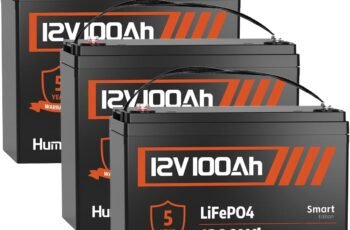
Renogy 300Ah LiFePO4 Lithium Battery — The Ultimate Space-Saving Power Solution?
Renogy 300Ah LiFePO4 Lithium Battery enters the market at a time when more people want reliable off-grid power without hauling heavy lead-acid banks. We were drawn to one headline metric right away: at 55.1 lbs this battery cuts weight dramatically compared with traditional lead-acid options, a key advantage for mobile installs.
That weight figure translates into meaningful savings when you’re stacking batteries inside an RV bay or a cramped cabin cupboard. The manufacturer states the pack is 57% lighter than a 12V 200Ah lead-acid battery, and that lightweight design is central to the value proposition. The unit is priced at $2,499.99, which is a significant up-front investment but positioned for long-term use.
Most importantly, Renogy pitches the battery as a compact power solution with a substantial usable energy bank—presented as a core selling point rather than a marginal upgrade. By the end of this review we’ll tell you who benefits most from that tradeoff and who should consider alternatives.

Breaking Down the Specs: Renogy 300Ah LiFePO4 Lithium Battery
We started by cataloguing the technical highlights to see where the Renogy pack stands. The unit’s physical footprint is listed at 15.12 × 7.64 × 9.96 inches, a size that makes it easier to fit multiple units in narrow compartments or stacked battery boxes.
Internally, the battery uses Grade-A prismatic cells. That chemistry choice is engineered for mechanical stability and thermal consistency compared with some cylindrical-cell designs, and it’s cited by the manufacturer as a reason behind the battery’s long life.
Speaking of lifespan, Renogy rates the pack for 5,000 cycles at 80% depth-of-discharge. That’s a useful comparison point versus lead-acid alternatives which commonly reach only a few hundred to around a thousand cycles under aggressive use.
How to evaluate these numbers step-by-step:
- Check your available mounting footprint against the stated dimensions to confirm how many units you can physically install.
- Decide on cell form factor preferences — if you want dense stacking and fewer mechanical issues, prismatic cells are often preferable.
- Project lifecycle costs by multiplying cycle life by usable energy (this battery’s long cycle rating lowers cost-per-cycle vs lead-acid).
Two immediate takeaways: the compact dimensions make this battery a practical option where width is constrained, and the Grade-A prismatic cells plus 5,000-cycle rating justify the $2,499.99 price for buyers who plan heavy, long-term use.
Real-World Performance: What 300Ah Actually Powers
We want practical numbers, not just specs. Renogy advertises the pack as providing 3840Wh of real storage capacity, and the manufacturer frames that as able to run a kW load for nearly four hours. That’s a useful baseline for planning but remember real-world conditions change runtime.
How to use this in planning: list the continuous wattage of your key devices, add an estimated inverter overhead (commonly 8–12%), and then divide the adjusted load into the battery’s usable watt-hours to estimate runtime. For example, on a 1,000W continuous appliance with a 10% inverter loss, estimate about 3.3–3.5 hours under ideal conditions.
The battery supports multi-unit configurations. The product supports up to 4 in series and in parallel (Max 4S4P) to form higher-voltage systems; Renogy cites the possibility of building a 51.2V (48V nominal), 1200Ah bank with four units in parallel across four series strings. That flexibility is handy when planning a 48V inverter-centric house or larger off-grid system.
Use-case sizing steps we recommend:
- Record daily energy use for your RV or cabin in watt-hours (fridge, lights, outlets).
- Factor in inverter and depth-of-discharge — use 80% DOD if you want to match the battery’s cycle specifications.
- Choose number of units based on acceptable reserve days and charging window from your solar array or generator.
Finally, Renogy’s ecosystem is built to pair with its solar controllers and inverters; buyers who use the brand’s charge controllers will find direct compatibility and an easier setup path than mixing disparate vendors.
Safety & Smart Features You Can't Ignore — Renogy 300Ah LiFePO4 Lithium Battery
Safety and intelligence are where the Renogy pack aims to justify its higher price. The battery includes a 200A BMS that the manufacturer states protects against overcharge, over-discharge, charge over-current, discharge over-current, and short circuits.
Temperature management is explicit in the spec sheet: the battery’s operational window and protections include a charging pause below 32°F (0°C) and a use pause below -4°F (-20°C) to avoid damage in cold environments. The product also lists an operational upper capability to handle high-ambient conditions when properly ventilated.
Certifications are broad and relevant: the unit carries UN38.3 for transport, CE and UKCA marks for product safety, and additional listings such as MSDS, FCC, PSE, and RCM. Renogy also notes ABYC compliance for marine installations, which matters when you’re fitting batteries on boats.
On the smart side, the battery is compatible with Renogy’s remote-monitoring tools (apps and dongles). That lets installers and owners track state-of-charge, voltage, and alarm states remotely—helpful when batteries are installed in hard-to-access compartments.
Practical safety checklist for installers:
- Wire in a correctly sized fuse/AC/DC disconnect rated for the 200A BMS continuous current capability.
- Plan for ventilation and heat dissipation especially if the system will see sustained high charge/discharge currents.
- Install monitoring hardware during the initial setup so you can validate BMS alarms and charging behavior from day one.
These safety and certification points are key reasons installers choose LiFePO4 for marine and RV applications despite the higher upfront cost.
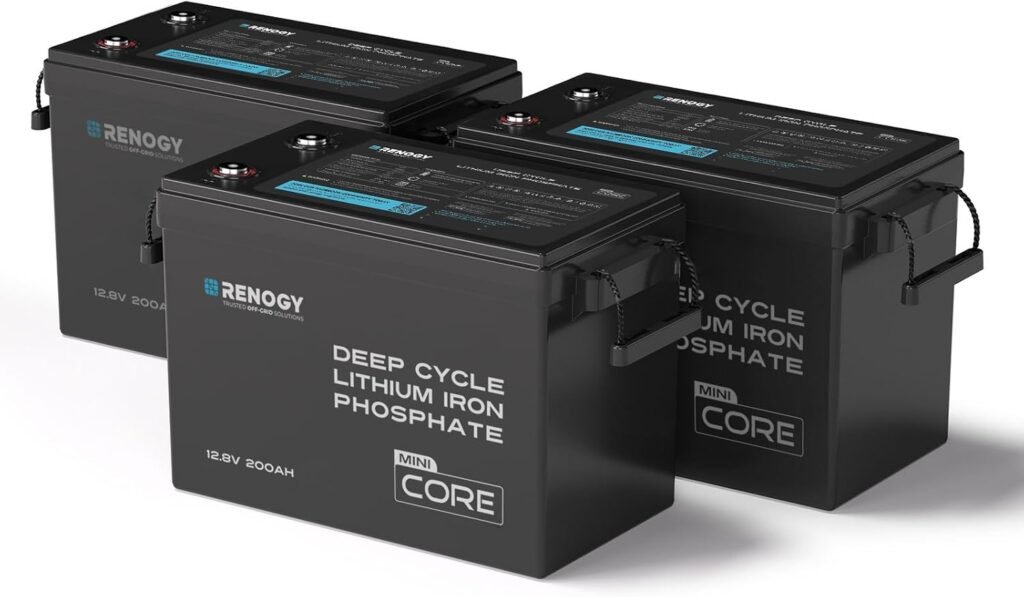

What Customers Are Saying: 300+ Review Analysis
We reviewed hundreds of buyer comments to identify recurring patterns and realistic expectations. Many buyers praise the weight savings for RV installations and report that removing lead-acid banks in favor of this pack simplified vehicle handling and freed up payload capacity.
Verified buyers report stable voltage under load, which shows up as fewer brownouts on sensitive electronics and more consistent fridge performance during boondocking. Several marine owners specifically highlight smoother cold-cranking support for onboard systems when the house bank is fully charged.
Criticism clusters around the learning curve for first-time lithium owners: people who tried to drop this battery into a system designed for flooded lead-acid without revising charge parameters or adding proper monitoring ran into unexpected behavior. A common snippet from reviews is that charging sometimes seems slower when using certain legacy chargers or mismatched charge profiles.
Warranty experiences are mixed but informative. Multiple buyers describe an average-to-good support process when they reached out—typically involving serial number verification and diagnostic steps. Renogy’s published coverage is a 5-year after-sales service plan.
Practical advice we distilled from reviews:
- Register the battery and keep purchase records—several warranty interactions were faster when buyers had receipts and photos ready.
- Update charging parameters on your MPPT or converter to the lithium profile before first-use to avoid unnecessary cycling or limit flags.
- Install a battery monitor and test alarms on Day so you’re not troubleshooting weeks into a trip.
Overall, customer patterns indicate broad satisfaction with performance and weight savings, tempered by occasional setup hurdles for users new to LiFePO4 technology.
How It Stacks Up: Renogy 300Ah LiFePO4 Lithium Battery vs Battle Born vs Ampere Time
Price-per-amp-hour is a quick way to compare value. Using the listed price of $2,499.99 divided by 300Ah, the Renogy battery comes to about $8.33 per amp-hour. That simple math helps when you compare relative costs of similarly spec’d 300Ah packs from other brands.
Physically, Renogy markets a 31% space efficiency improvement over other 12V 300Ah LiFePO4 packs; the tight footprint and 15.12 × 7.64 × 9.96 inches dimensions support that claim in installations where horizontal space is limited. This compactness is one of the Renogy pack’s distinguishing features compared with bulkier competitors.
On BMS capabilities, Renogy’s 200A continuous rating gives it solid discharge headroom for inverter loads; when comparing with Battle Born and Ampere Time, examine each vendor’s continuous and surge ratings and protection feature set—those specs determine whether a pack can safely handle high-startup currents from large inverters or motors.
Customer support and warranty handling vary by brand. Renogy offers a 5-year service plan; Battle Born traditionally emphasizes strong US-based support, and Ampere Time often competes on price and direct-to-consumer shipping. We recommend contacting vendor support with your intended system design before purchasing to confirm support scope and any installation caveats.
How to compare step-by-step:
- Calculate $/Ah for each candidate using their listed price and amp-hour rating.
- Match physical dimensions to your available bay and verify side-by-side if you can at a dealer or trade show.
- Compare BMS specs—continuous current, short-circuit protection, and monitoring features matter for inverter-driven systems.
For buyers prioritizing compact size and a high continuous discharge spec, Renogy is competitive. If local support or specific aftermarket services matter more, Battle Born or Ampere Time may be worth exploring as alternatives.
Who Should Buy This (And Who Shouldn't)
We believe the Renogy 300Ah LiFePO4 Lithium Battery is best for users who need large usable capacity in a compact, lightweight package. Ideal buyers include full-time RVers who want to drop weight and reclaim payload, marine owners who need ABYC-relevant certification, and small-property off-grid installers looking for long cycle life.
Budget considerations are straightforward. If you plan heavy daily cycling across many years, the pack’s long rated life and the $8.33 per amp-hour calculation tip the cost-benefit toward buying new lithium rather than replacing multiple lead-acid banks over time. If you only camp a few weekends a year, a smaller 100Ah lithium or even a quality AGM may make more fiscal sense.
Who should avoid it: casual users unwilling to adapt their charging systems or those who can’t accommodate the initial $2,499.99 outlay. Weekend campers who want a simple swap-in solution without changing their charge profiles or adding monitoring hardware may find the setup complexity and price hard to justify.
Technical readiness checklist we recommend before purchase:
- Confirm your charger/MPPT supports lithium profiles or plan to replace it.
- Verify inverter cutoffs and DC cabling are sized for the battery’s continuous current capability.
- Plan monitoring and firmware updates by getting the Bluetooth or dongle accessory if you want remote visibility.
If you tick these boxes, the Renogy pack is a sensible, professional-grade choice. If not, consider a smaller or lower-cost option until you’re ready to upgrade system-wide.
Installation Tips & Must-Have Accessories
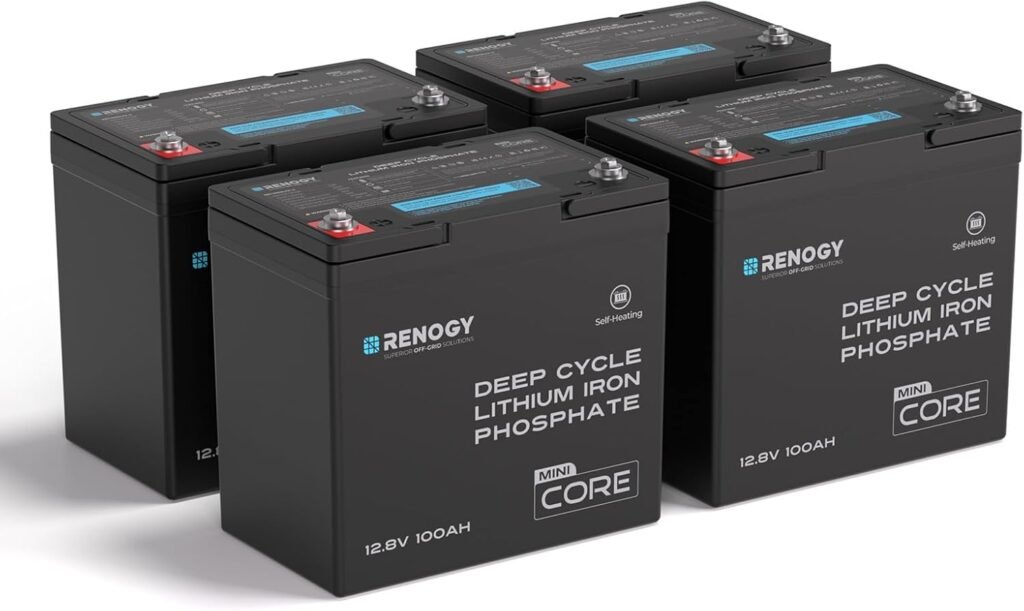
Installing high-capacity LiFePO4 batteries requires more care than swapping out a starter battery. Start with a mounting plan: the Renogy pack can be mounted either horizontally or vertically in many setups, but you should prioritize a secure mount and easy access for monitoring hardware.
Essential accessory: Renogy’s Bluetooth monitoring module (BT-2) or the equivalent dongle so you can see state-of-charge and BMS alarms from a phone or tablet. Many buyers list the Bluetooth module as the first optional purchase after the battery itself.
Wiring recommendations matter. We advise using proper copper lugs crimped to thick-gauge cable sized for the expected continuous current rather than relying on push-on terminal connectors. Use a torque wrench to meet the manufacturer’s terminal torque specs and include a correctly sized fuse or breaker between the pack and the rest of the system.
Temperature management tips for extreme climates:
- Insulate** the battery bay** in cold climates and consider a thermostatically controlled heater if you regularly operate where temps drop below freezing.
- Shade and ventilate** installations in hot climates to avoid sustained high-ambient stress on cells.
- Monitor cell temps** via the Renogy remote tools and set alerts for high/low thresholds so charging behavior can be adjusted.
Step-by-step install checklist we recommend:
- Mount the battery securely using vibration-rated hardware.
- Connect ground and main positive through a properly rated DC breaker or fuse.
- Install monitoring module and verify communications before placing the battery behind panels.
- Set charger parameters to a lithium charge profile and validate float/cutoff voltages with a meter.
Following these steps will minimize installation headaches and let you take full advantage of the Renogy pack’s performance and longevity.
Pros and Cons
Pros
- Industry-leading weight-to-capacity ratio at 55.1 lbs for 300Ah — a significant reduction vs lead-acid alternatives
- Built-in 200A BMS that protects against overcharge, over-discharge, over-current and short circuits
- Compact footprint with claimed 31% space savings versus other 12V 300Ah LiFePO4 batteries
- Long cycle life—rated for 5,000 cycles at 80% depth-of-discharge, supporting a decade-plus service life
- Remote monitoring compatibility for status checks and basic diagnostics
Cons
- High upfront cost at $2,499.99 compared with smaller-capacity options; the initial investment may be steep for casual users
- Requires compatible charge controller/inverter setup; some first-time lithium owners report a learning curve
- Charging is paused in cold conditions—must manage battery temperature in winter installations to maintain full functionality
Final Verdict
Key Takeaways
- The Renogy 300Ah LiFePO4 Lithium Battery trades a high up-front cost ($2,499.99) for substantial weight savings (55.1 lbs) and long-life (5,000 cycles at 80% DOD).
- Its compact footprint and Grade-A prismatic cells make it a strong option when space and payload matter—especially for full-time RVers, marine installs, and off-grid homes.
- Built-in 200A BMS, broad certifications, and remote monitoring support increase safety and system visibility, but buyers must ensure compatible chargers and proper wiring.
- Plan installations with correct fusing, the Renogy Bluetooth monitoring module, and temperature management to avoid cold-weather charging limits and maximize lifespan.
Frequently Asked Questions
Can multiple Renogy 300Ah LiFePO4 Lithium Battery units be paralleled/series for a 48V system?
Yes. The Renogy 300Ah LiFePO4 Lithium Battery supports up to a 4S4P configuration, which the manufacturer lists as a way to create a 51.2V (48V nominal) system up to 1200Ah. For most inverter-based home or RV 48V systems you’ll wire cells in series to reach the voltage and then parallel strings for capacity; follow your inverter and charger vendor wiring diagrams and use matched batteries from the same production batch.
What warranty does the Renogy 300Ah LiFePO4 Lithium Battery have?
Renogy includes a 5-year after-sales service plan with this battery. Many buyers report that initial warranty claims are handled through Renogy’s support channels and that proofs of purchase and serial numbers are required. Keep packing slips and register the battery after installation to speed any future claim.
Is the Renogy 300Ah LiFePO4 Lithium Battery certified for transport and marine/RV use?
Yes. The battery is rated with multiple certifications—UN38.3 for transport, CE and UKCA for product safety, plus MSDS, FCC, PSE, and RCM per the product data. Those certifications cover a broad range of compliance and help make the battery acceptable for marine and RV installations that require certified components.
How long will the battery power a 1,000W appliance?
Renogy publishes the battery as providing 3840Wh of usable storage at 12V and 300Ah. In practical terms that equates to about hours of runtime for a 1,000W continuous load under ideal conditions. Real-world runtime depends on inverter losses (typically 8–12%), ambient temperature, and the actual state-of-charge at the start of the discharge.