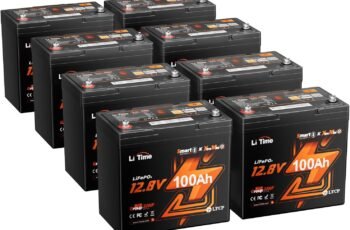
Introduction: High-Capacity Lithium Power Solution
If you’ve outgrown 100Ah house batteries, the HumsiENK Pack 12V 314Ah LiFePO4 Battery brings a step‑change in capacity without the upkeep of flooded cells. Each unit offers 4.019kWh, and the four‑pack sits at $1795.99, making large off‑grid storage attainable for RVs, solar cabins, and boats. The headline claim is 15,000+ deep cycles—about 30× longer than traditional lead‑acid—which immediately sets expectations for long‑term value in 2026. From what we see, this kit targets users who actually run loads daily and need real autonomy, not just a weekend trickle.
It positions well against lead‑acid when you consider usable energy, weight savings, and zero maintenance. If your goal is extended boondocking, faster recharges, and painless scaling later, this package is worth short‑listing.

Technical Specifications Breakdown — HumsiENK Pack 12V 314Ah LiFePO4 Battery
Capacity and voltage. Each unit is rated at 314Ah at 12.8V. That’s a high‑amp reserve for 12V systems and the backbone of long runtimes for inverters, fridges, lighting, and pumps. The energy math lands a touch over 4kWh per battery, giving this kit substantial headroom before you ever parallel or series‑stack.
Size and fit. The case measures 15.1 × 7.6 × 9.8 inches. That footprint is compact for the capacity class, easing placement in RV pass‑throughs or boat lockers where height and depth often pinch. Measure your compartment and ventilation path before ordering since the terminals and cable bend radius add to the effective height.
Weight and density. At 61.7 lbs per unit, it’s listed as 38% lighter than comparable lead‑acid. For installs where every pound matters—tongue weight limits, small trailers, or dinghies—that reduction alone can free up payload for water or gear.
BMS capability. The built‑in management system supports a continuous discharge class of 200A and includes protections for overcharge, over‑discharge, overcurrent, and short‑circuit events. There’s also an integrated temperature‑based charge cutoff, so the pack self‑protects when conditions aren’t safe to accept charge.
Performance in Real-World Applications — HumsiENK Pack 12V 314Ah LiFePO4 Battery
Solar storage. The manufacturer cites nearly 100% depth of discharge, which is a big win for daily cycling on PV. If you size your array to refill by mid‑afternoon, you’ll keep state of charge in a healthy zone while actually using the energy you paid for. Pair it with a charge controller that supports a LiFePO4 profile so you can hit the correct absorption voltage and avoid excessive float.
RV runtimes. To translate capacity into hours, use 314Ah × 12.8V for total watt‑hours, then divide by your load. For example, a 60W 12V compressor fridge (about 5A at 12V) would theoretically run for roughly (314Ah ÷ 5A) ≈ hours per battery before inverter or temperature losses. A 300W laptop/inverter setup would see about (314Ah × 12.8V ÷ 300W) ≈ hours of use per battery. Real runtimes will be lower due to inverter overhead and temperature, but these ballparks show why high‑Ah units change the camping experience.
Trolling motors. Typical 12V trolling motors draw in the few‑dozen amps at cruise and can surge much higher at full throttle. This pack’s continuous output class supports those sustained draws comfortably when the bank is sized correctly. We recommend fusing each battery and sizing cabling for worst‑case current to avoid voltage sag that cuts into performance.
Cold weather behavior. The system includes a low‑temperature charge cutoff to prevent damage when it’s too cold to safely accept charge. In practice, that means charging may pause in freezing conditions until the cells warm. Discharge is generally more tolerant than charge in the cold, but plan on reduced effective capacity in winter and consider light insulation or gentle heating if you must charge in below‑freezing environments.
Safety & Battery Management System
Protection layers. The onboard BMS guards against the main failure modes: overcharge, over‑discharge, overcurrent, and short circuits. In an overcurrent or fault condition, the system opens to protect both the cells and your wiring, then typically resets when conditions return to normal and a charger is applied. This saves you from the sulfation, venting, and water‑top‑off routine that comes with flooded lead‑acid.
Temperature cutoffs. A published high‑temperature charge cutoff of 158°F (70°C) helps prevent thermal stress during hot‑bay charging. That threshold is high enough to avoid nuisance trips in warm climates but firm enough to protect cell chemistry on scorching days. The BMS also prevents charging when the pack is too cold—useful insurance for owners who store or operate in winter conditions.
Fault response behavior. While exact millisecond timing isn’t listed, short‑circuit and overcurrent events are handled automatically by the BMS, which trips and isolates the pack. Add upstream fusing near the battery and a master disconnect so you have manual control in addition to electronic protection.
Maintenance edge. No watering, no corrosion cleanup, and no equalization cycles. With a LiFePO4 profile on your charger and good cable hygiene, routine care is largely limited to periodic torque checks on terminals and ensuring firmware (if your charger supports it) matches a lithium profile.
Expansion Capabilities — HumsiENK Pack 12V 314Ah LiFePO4 Battery
Series/parallel scaling. The system supports up to a 4S4P configuration. Four in series yield 51.2V nominal; four of those series strings in parallel create a 51.2V 1200Ah bank. Fully built, that’s a massive 64.30kWh of storage—enough for whole‑home backup strategies, well pumps, and multi‑day autonomy with moderate loads.
Controller compatibility. Common MPPTs that allow user‑defined lithium profiles (Victron, EPEver, and similar classes) work well provided voltage windows match the bank’s series configuration. Ensure your inverter/charger is rated for the nominal and peak voltages of a 24V or 48V LiFePO4 system.
Wiring best practices. For parallel banks, use equal‑length cables from each battery to a common bus bar so resistance is balanced. Rotate take‑offs (or use diagonal take‑off on a bus) to keep currents even. Fuse each series string with a class‑T or appropriately rated breaker, then use a main fuse on the battery side of the inverter. Before first use, top‑charge each unit individually to the same resting voltage (a gentle 14.4V finish), let them rest, then parallel. This helps minimize initial drift and reduces the need for frequent rebalancing.
What Customers Are Saying
Overall sentiment. Reviews we’ve read skew positive for this capacity class, with many owners calling out the value of getting four matched high‑Ah batteries in one kit. Feedback often mentions that the pack arrives well‑protected and that terminals and hardware are straightforward to install.
Common praise. Multiple RV users highlight the weight savings versus their old lead‑acid banks and appreciate the faster acceptance of charge during generator windows. Solar users also note that running deep into the state of charge feels less stressful thanks to the high cycle‑life claim and minimal voltage sag until near empty.
Constructive critiques. A recurring theme from buyers who build larger parallel arrays is the need to balance units before tying them together. Some report spending extra time top‑charging and checking resting voltages to keep drift at bay. A few comments also mention that you’ll want a charger or MPPT with a true LiFePO4 profile; using legacy AGM settings can undercharge the bank and leave capacity on the table.

How It Compares to Alternatives
Versus Battle Born 100Ah. If you’re cross‑shopping well‑known 100Ah units like Battle Born 100Ah, the standout here is capacity per unit. One HumsiENK battery provides roughly triple the amp‑hours, which simplifies cabling and saves space when your target is 300Ah+ at 12V. The four‑pack totals about 16.1kWh of nameplate energy for $1795.99, translating to a very competitive cost per kWh in this class. Owners who want a minimal‑string bank with fewer interconnects will appreciate that advantage.
Versus Renogy 200Ah. Against 200Ah‑class options such as Renogy 200Ah, this kit still offers a clear capacity bump per battery and a higher continuous‑draw class at the pack level. For inverter‑heavy vans where microwaves or induction cooktops are on the menu, having more amp‑hours in each case and a stout BMS reduces the need to parallel multiple small batteries just to meet surge and runtime targets.
Lead‑acid economics. The manufacturer claims 15,000+ deep cycles and roughly 30× the life of traditional lead‑acid. Even if you assume far fewer in demanding service, the replacement math over a decade heavily favors LiFePO4. Add in usable capacity (you can routinely use most of a lithium pack’s capacity versus ~50% for lead‑acid), and the long‑term cost of energy stored and delivered tilts further toward this kit.
Use‑case nuance. For marine users who slam throttle bursts, the high continuous‑draw class in each HumsiENK unit is appealing. For solar‑first installs, the nearly full usable depth and expansion path to 24V/48V make it straightforward to grow from a camper to a cabin without changing battery families.
Installation & Maintenance Tips
Charger profile. Set your charger or MPPT to a LiFePO4 curve with absorption around 14.2–14.6V. Many users choose to disable float entirely; if your device requires float, set it low (around 13.4–13.6V) so the pack rests instead of sitting at 100% for long periods. Configure low‑temperature charge protection if your controller supports an external sensor.
Initial balancing for multi‑bank setups. Before paralleling or series‑stacking, individually top‑charge each battery to the same resting voltage. After a 1–2 hour rest, confirm voltages are within a few millivolts, then connect to a bus bar using equal‑length cables. Label strings, fuse each one, and confirm polarity with a meter before energizing downstream equipment.
Storage and longevity. For seasonal storage, leave the bank at roughly 40–60% state of charge and disconnect loads. Check state of charge quarterly and top up if it drops meaningfully. Avoid storing at 100% or 0% for weeks; both extremes add stress over time even for lithium chemistries.
Cold‑weather precautions. If you must charge below freezing, plan on a warm‑up routine. Simple options include moving the battery to a conditioned space or using a gentle heating pad designed for battery bays. Never force charging when the BMS has inhibited it due to temperature—wait for the pack to warm and the BMS to re‑enable charging.
Who This Is Best For
Ideal buyers. RV owners who boondock for days, vanlifers with high inverter use, and anglers running larger trolling motors will see immediate benefits from the high amp‑hour capacity. Off‑grid homeowners adding storage to an existing array also get a clean path to 24V/48V banks without switching brands.
Also consider. If your daily energy needs are modest (under 1kWh), a single smaller LiFePO4 may be the better budget fit, and you can always scale later. That said, starting with a matched four‑pack like this reduces wiring complexity, streamlines expansion, and typically lowers cost per installed kWh compared with piecing together smaller units over time.
Budget scenarios. Those coming from a single Group lead‑acid might experience sticker shock. But when you compare usable capacity, weight, maintenance, and the 15,000+ cycle claim, the lifetime value improves—especially if you’d otherwise replace lead‑acid banks every couple of seasons.
Pros and Cons
Pros
- Massive 314Ah at 12.8V per unit with a claimed 15,000+ deep cycles
- High usable capacity per battery with nearly full depth of discharge
- Built‑in BMS supports a 200A continuous discharge class with multiple protections
- Meaningful weight savings: 61.7 lbs and 38% lighter than comparable lead‑acid
- Expandable to 4S4P (51.2V 1200Ah) and up to 64.30kWh total storage
- Compact footprint at 15.1 × 7.6 × 9.8 inches for easier placement in RVs and boats
Cons
- Pricey upfront compared to a single lead‑acid, even though cost per kWh is favorable
- No exact low‑temperature threshold published for charging cutoff
- Balancing required when building larger parallel banks to keep voltages aligned
- Heavier than smaller LiFePO4 options at 61.7 lbs per unit
- Requires a compatible LiFePO4 charger or user‑programmable controller to realize full performance
Final Verdict
Key Takeaways
- Big‑capacity lithium pack: 314Ah at 12.8V per unit with nearly full usable depth
- Strong protection suite: temperature‑aware BMS with high‑temp charge cutoff at 158°F (70°C)
- Serious scalability: supports 4S4P to 51.2V 1200Ah and up to 64.30kWh
- Compelling value at $1795.99 for four matched batteries and about 16.1kWh total nameplate energy
- Excellent fit for RVs, solar storage, and marine users who need long runtimes and low maintenance
Frequently Asked Questions
Is the HumsiENK Pack 12V 314Ah LiFePO4 Battery sold as a matched set?
Yes. The pack is listed as In Stock at $1795.99 for four matched 12.8V 314Ah LiFePO4 batteries. Buying as a 4-pack ensures you start with cells of the same age and state of health, which helps when wiring in parallel or series.
How long should these batteries last in normal RV or solar use?
Each 12.8V 314Ah unit is designed for 15,000+ deep cycles with nearly full usable capacity. In practical terms, that’s decades of typical RV/solar use when properly charged and stored. Cycle life depends on temperature, charge voltage, and how often you leave the pack at 100% or 0%.
What charger settings work best with these batteries?
Use a LiFePO4 profile: absorption/boost around 14.2–14.6V, float either disabled or set low (13.4–13.6V if your controller requires it), and a conservative low‑voltage disconnect near 11.0–11.2V under light load. Always confirm your specific charger allows a user‑set profile.
Can I build a 48V bank with this kit?
Yes. The system supports 4S4P, allowing up to 51.2V 1200Ah and a total of 64.30kWh when fully built out. Use identical cable lengths and torque the terminal hardware evenly. Add a class‑T fuse or appropriately sized breaker on each series string and a main disconnect.
Is one battery enough for a 12V trolling motor?
A 55‑lb thrust motor may draw 30–50A at 12V, while larger models can exceed that at full power. One 314Ah battery can comfortably handle sustained draws within its continuous rating; size the bank so normal cruising is well below the max and use a fuse sized to the motor’s peak current.
How does the battery behave in cold or hot weather?
The BMS includes a high‑temperature charge cutoff at 158°F (70°C) and a low‑temperature charge cutoff to protect cells in the cold. In freezing conditions, the pack may refuse to accept charge until it warms; store above freezing or use mild battery heating if winter charging is required.