We compare lithium and AGM batteries by their energy density, safety profiles, and charging behaviors; we compare lifecycle performance, resilience, and system integration; we compare total cost of ownership and maintenance demands. We surface how each technology performs under real-world duty cycles, temperatures, and duty loads, then translate that into practical setup implications. We outline where each excels and where compromises occur, leaving you with a clear decision path that begs further inspection of your specific constraints.
Key Takeaways
- Lithium offers higher energy density and faster charge acceptance than AGM, enabling longer runtimes and quicker top-offs.
- AGM is more robust against abuse, easier thermal management, and remains forgiving in wide temperature ranges.
- Real-world performance depends on duty cycle, SOC, charging profiles, and thermal management, not just nominal specs.
- Upfront cost is higher for lithium, but lower replacement frequency and efficiency gains can improve long-term ROI.
- Safety and integration considerations favor AGM in conservative setups, while lithium suits high-depth cycling and space-constrained systems.
Lithium vs AGM: Key Differences
Lithium and AGM batteries differ primarily in chemistry, performance, and lifecycle economics. We approach these distinctions analytically, presenting a concise comparison without digressing into unrelated topic debates or tangential comparison aside from relevance. Chemically, lithium cells offer higher energy density and faster charge acceptance, while AGM relies on lead-acid chemistry with robust thermal stability. Performance-wise, lithium typically delivers higher usable capacity and deeper cycling tolerance; AGM shows stronger short-circuit resistance and simpler thermal management in certain architectures. Lifecycle economics hinge on upfront cost versus total cost of ownership, including replacement frequency, maintenance, and efficiency losses. We emphasize predictability of behavior under similar load profiles, enabling informed design choices. Our aim is precise, actionable insight, avoiding unnecessary speculation or unrelated topic diversions that could dilute focus.
Real-World Performance: Lithium vs AGM in Use

In real-world use, how do lithium and AGM batteries perform under typical load profiles, and what gaps emerge between theory and practice? We examine empirical behavior under common cycling, discharge rates, and temperature conditions to reveal practical limits. Lithium chemistries generally promise higher energy density and faster recovery from deep discharge, but performance depends on strict adherence to charging profiles and thermal management. AGM batteries exhibit robust tolerance to abuse and wide temperature ranges, yet sag under high current draws and slower recovery after high-draw events. Real-world outcomes hinge on battery chemistry interactions with duty cycles, state of charge, and ambient conditions, not just nominal specs. Differences in aging mechanisms, impedance growth, and electrolyte dynamics drive deviations from lab predictions, underscoring the need for tailored monitoring and charging profiles.
Total Cost of Ownership: Upfront and Ongoing
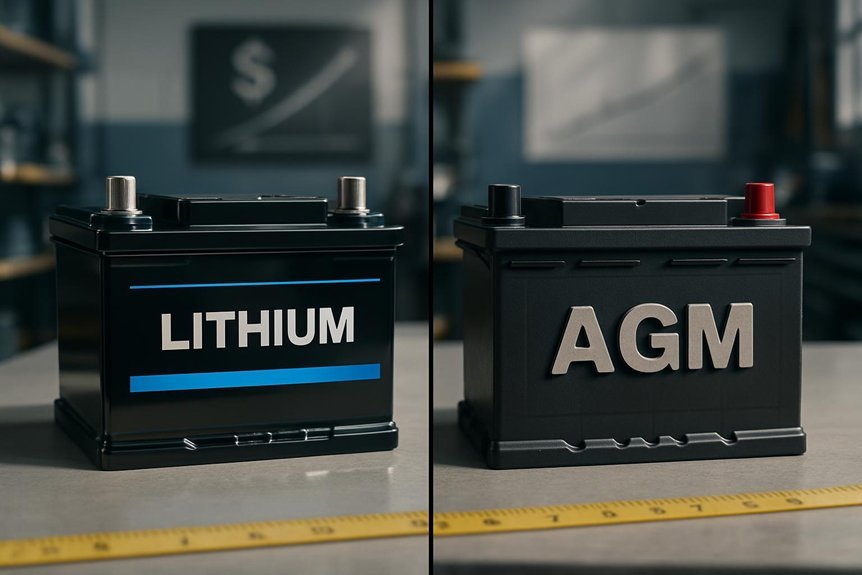
What does the total cost of ownership look like when you compare upfront expenditure with ongoing expenses across lithium and AGM batteries? We’ll analyze upfront costs, cycle life, replacement cadence, efficiency losses, and maintenance needs to reveal true TCO. Lithium generally requires higher initial spend but offers longer life and higher depth of discharge, lowering replacement frequency. AGM presents lower upfront cost but steeper degradation and more frequent replacements, increasing long-term spend. We note an unrelated topic and speculative theory may influence accessory costs, warranties, and recycling implications, yet data shows measurable TCO differences under similar duty cycles. The table below highlights key cost drivers and payback horizons so you can judge total affordability across scenarios.
| Factor | Impact on TCO |
|---|---|
| Upfront cost | Higher with lithium |
| Replacement cadence | Lower with lithium |
| Efficiency losses | Lithium may win |
| Maintenance | AGM higher |
| End-of-life | Recycling variance |
Safety Considerations: Lithium vs AGM
We assess battery safety metrics and the practical implications for handling and hazards awareness when comparing lithium and AGM chemistries. We’ll compare reliability indicators, fault modes, and thermal behavior to frame risk profiles for users and technicians. Our aim is to establish a concise, technical baseline that guides safe use, storage, and response strategies for each technology.
Battery Safety Metrics
For safety metrics, lithium-ion and AGM batteries differ in failure modes, thermal behavior, and fault tolerance, which directly affect design margins and risk assessment. We examine failure pathways, thermal runaway likelihood, and managing fault propagation to quantify risk margins. Lithium systems show rapid thermal events under abuse; AGM exhibits gas generation and venting as primary failure routes. Our assessment targets design margins, safety margins, and fault isolation effectiveness, with emphasis on battery chemistry and operability envelopes. The weight comparison also informs system-level safety sizing, as heavier AGM packs influence inertia and cooling load.
| Parameter | Lithium vs AGM | Impact on Safety |
|---|---|---|
| Failure mode | Thermal runaway risk | Design containment |
| Thermal behavior | Fast heat rise | Cooling requirements |
| Fault tolerance | Redundant paths | System resilience |
Handling and Hazards Awareness
Handling and hazards awareness for lithium-ion and AGM batteries demand a rigorous, data-driven approach to identify and mitigate risks in real-world use. We assess failure modes, thermal behavior, and venting thresholds to quantify danger signals before they escalate. Our approach emphasizes controlled charging, proper handling, and environment monitoring, since minor deviations can trigger cascading events. We compare charging etiquette implications, including voltage tolerances, current limits, and pause criteria, with AGM resilience to overcharge and misconnection scenarios. We review protective circuitry, isolation strategies, and fault diagnostics that reduce exposure to shorts and thermal runaway. Documentation aspects matter: warranty coverage often hinges on adherence to specified procedures, usage cycles, and storage guidelines. In practice, we align safety data with procedural training to minimize human error and safeguard equipment and personnel.
Charging Fundamentals: Requirements for Each Battery
Charging fundamentals differ between lithium-ion and AGM batteries due to chemistry, cell architecture, and charging safety limits. We analyze how each chemistry governs regulation, current, voltage, and termination criteria to optimize performance and safety. Our goal is to deliver charge profiles that maximize charging efficiency while preserving longevity and minimizing risks. Below, we outline precise requirements and practical constraints for each type.
Charging fundamentals differ by chemistry to optimize efficiency, longevity, and safety.
1) Lithium-ion: apply a controlled CC-CV sequence, strict termination, balanced cell monitoring, and temperature-aware steps to protect cells.
2) AGM: use a conservative CV taper, float maintenance within manufacturer limits, and temperature compensation to avoid overcharge.
3) Monitoring: implement accurate voltage, current, and impedance checks with proper safety interlocks.
4) Weight implications: consider pack density, thermal management, and MTBF tradeoffs for system-level efficiency.
Durability and Longevity: In Campers, Boats, and Backups
| Parameter | Li Battery | AGM Battery |
|---|---|---|
| Depth of Cycle | High | Moderate |
| Thermal Sensitivity | Medium-High | Low-Moderate |
| Maintenance Interval | Quarterly | Semiannual |
When to Choose Lithium: Practical Setup Scenarios
Is lithium the right fit for specific setups, or do AGM batteries still cover those bases? We assess practical scenarios where lithium offers clear advantages and where tradeoffs temper enthusiasm. Our approach remains analytical, focusing on real-world constraints, performance metrics, and lifecycle economics.
- High-depth cycling needs with compact weight benefits justify lithium, given longer cycle life and weight savings.
- Space-constrained systems demand higher energy density, improving usable capacity without bulk.
- Extended off-grid periods favor lithium’s low self-discharge and rapid recharge characteristics.
- Warranty tradeoffs and maintenance considerations, including electrolyte handling, influence total cost of ownership and service intervals.
In these cases, lithium often wins, but we weigh upfront cost and care requirements to avoid surprises.
When to Choose AGM: Practical Setup Scenarios
We consider AGM setups where practical constraints, cost, and system compatibility drive selection. We’ll assess Practical Setup Considerations, quantify Cost and ROI Impacts, and map System Compatibility Scenarios to ensure reliable integration with existing components. Our aim is a precise, actionable framework readers can apply to decide if AGM best fits their specific requirements.
Practical Setup Considerations
Choosing AGM batteries makes sense in setups where reliability, low maintenance, and safety constraints trump the higher energy density of lithium. We present practical setup considerations that guide selection, focusing on real-world constraints and performance expectations. In this analysis we emphasize predictable behavior, ease of integration, and lifecycle stability to minimize system risk.
1) Evaluate enclosure and ventilation requirements to mitigate safety constraints and simplify installation.
2) Align charging profiles with AGM characteristics to avoid degradation from improper battery chemistry handling.
3) Prioritize weight optimization alongside footprint constraints for portable or space-limited systems.
4) Assess maintenance cadence, diagnostic access, and thermal management to sustain consistent performance.
These factors shape a robust, field-ready setup while preserving clarity around battery chemistry and long-term reliability.
Cost and ROI Impacts
So, when evaluating cost and ROI, AGM batteries often emerge as the prudent choice in setups where total ownership cost, reliability, and maintenance burden dominate the decision. We compare lifecycle expense, upfront price, and serviceability, noting AGM’s lower replacement frequency under certain use profiles. Pay attention to age verification processes and warranty terms, which influence true risk exposure and long‑term spend. In many arrays, reduced parasitic losses and simpler charging reduce total cost of ownership, offsetting higher initial cost. ROI timelines shrink when failures cut system availability. The table below summarizes three representative scenarios to illustrate where AGM wins vs lithium.
| Scenario | Key Cost Driver | ROI Indicator | |
|---|---|---|---|
| Startup/Redundancy | Upfront vs replacement risk | Payback months |
System Compatibility Scenarios
Which setup scenarios most reliably justify AGM over lithium, based on compatibility with existing hardware and operating constraints? We assess system gaps, including alternator charging limits, battery isolators, and BMS compatibility, then determine where AGM offers fewer integration risks. Our conclusion points to setups with legacy alternators, simple DC distribution, or devices lacking lithium safety protections, where AGM performance remains predictable and safe. We also consider space, mounting, and insulation constraints, as well as warranty requirements and service availability. In each case, AGM aligns with conservative operating envelopes and easier retrofits, reducing risk of mis sizing or overcurrent events.
- Legacy charging profiles and inverter compatibility
- Simple DC-бus with minimal BMS reliance
- Space and mounting constraints favoring compact form factors
- Warranty and service ecosystems over lithium safety concerns
A Simple Decision Framework: Pick the Right Battery for You
A simple decision framework helps us choose the right battery by weighing three core factors: capacity needs, operating conditions, and lifecycle economics. We approach this with a structured, data-driven mindset, comparing energy density, peak power, and usable capacity across chemistries. Capacity needs guide our sizing; operating conditions, including temperature and vibration, define reliability margins. Lifecycle economics balance upfront costs, cycle life, depth of discharge, and replacement intervals. We propose a decision path that couples quantifiable metrics with practical constraints, enabling transparent tradeoffs. Two word discussion idea 1, two word discussion idea 2, anchor our framing in real-world scenarios, from continuous cycling to seasonal storage. By isolating requirements, we reduce ambiguity and select the option that meets performance targets while minimizing total cost of ownership over the system’s life.
Frequently Asked Questions
Can Lithium Batteries Handle Ultra-Deep Cycling Without Capacity Loss?
Yes, lithium batteries generally tolerate ultra-deep cycling better, but capacity loss occurs over time; our analysis shows higher cycle life, yet gradual capacity decline, depending on chemistry, management, and usage patterns. We warn readers about potential limitations and degradation.
Do AGM Batteries Tolerate High Temperature Environments Well?
High temperature environments expose AGM batteries to accelerated capacity fade and internal corrosion, reducing performance during deep cycling. We assess: while they tolerate heat poorly, careful thermal management can mitigate degradation and preserve usable life in high-temperature deployments.
Which Battery Type Is Better for Solar Energy Storage in Harsh Climates?
We’ll disappoint you with honesty: for harsh climates, lithium safety benefits matter, but AGM durability often outlasts under extreme temps. We prefer lithium where weight matters, yet AGM wins reliability; both suit solar energy storage, depending on priorities. 35 words
How Do Weight and Space Savings Impact RV or Boat Layouts?
Weight and space savings heavily influence RV/boat layouts; weight implications guide distribution and handling, while space optimization dictates component placement, enabling efficient storage and safer design. We analyze, quantify, and optimize to maximize efficiency and stability.
Are There Hidden Maintenance Tasks for Lithium Versus AGM Systems?
We’d say yes: lithium maintenance generally requires monitoring cell balance and BMS health, while AGM maintenance centers on electrolyte checks and corrosion prevention; both demand periodic load tests, connections inspection, and temperature monitoring to prevent silent degradation.
Conclusion
We’ve mapped the terrain: lithium’s density and fast cycles, AGM’s rugged safety and cost simplicity. In tight spaces, lithium shines; in harsh environments or legacy systems, AGM keeps its ground. Real-world duty cycles, temperatures, and charging profiles tilt the balance more than raw specs. So, we pick with purpose: optimize energy density where it matters, favor robustness where abuse is likely, and align with total cost over time. The right choice balances performance with practicality.