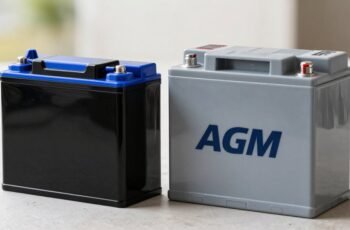
Imagine a lithium battery as a reservoir: amp-hours (Ah) describe how much charge flows from it, while watt-hours (Wh) reveal the total energy that charge can deliver. We often compare batteries by Ah alone, but voltage changes the result and can make similar ratings misleading. By examining both measures, we can estimate runtime, compare battery packs accurately, and avoid costly sizing errors—but one distinction determines which rating matters most.
Key Takeaways
- Ah (amp-hours) measures a lithium battery’s electrical charge capacity, while Wh (watt-hours) measures its stored energy.
- Calculate energy using Wh = voltage × Ah; for example, a 12 V, 10 Ah battery stores approximately 120 Wh.
- Batteries with identical Ah ratings can store different energy amounts when their voltages differ, so compare them using Wh.
- Rated Ah and Wh are nominal values; actual usable capacity depends on discharge rate, temperature, aging, and cutoff voltage.
- Estimate runtime by dividing usable Wh by the device’s average wattage, while accounting for inverter and system losses.
Ah vs. Wh: What’s the Difference?
Ampere-hours (Ah) measure a lithium battery’s charge capacity—the amount of current it can theoretically deliver over time—whereas watt-hours (Wh) measure its energy capacity, which accounts for both current and voltage. When we compare batteries, Ah tells us about electrical quantity, while Wh describes the practical amount of work available. A battery rated at 10 Ah can supply, in idealized terms, 10 amperes for one hour; that rating alone doesn’t reveal its total energy. To compare energy across batteries with different voltages, we use the relationship Wh = Ah × V, using the relevant nominal voltage. Therefore, two batteries with identical Ah ratings can store different energy amounts if their voltages differ. Conversely, equal Wh ratings indicate comparable energy, even when their Ah values aren’t the same. This distinction improves system selection and compatibility.
How Ah Measures Battery Capacity
We measure battery capacity in amp-hours (Ah), representing the current a battery can deliver over a specified time. This rating indicates charge-storage capacity, but it doesn’t directly measure energy without considering voltage. When comparing battery ratings, we should evaluate both Ah and operating voltage for an accurate assessment.
Amp-Hours Explained
An ampere-hour (Ah) measures the amount of electric charge a battery can deliver over time: one Ah equals a current of one ampere sustained for one hour. We calculate this rating by multiplying current in amperes by operating time in hours. Consequently, a 10 Ah battery could theoretically provide 2 A for 5 hours or 10 A for 1 hour. Real-world results vary because discharge rate, temperature, battery age, and cutoff voltage affect usable output. Ah describes charge quantity, not electrical power; it doesn’t indicate how quickly the battery can deliver energy or the voltage maintained during discharge. We should hence compare Ah ratings only when battery voltages and operating conditions are similar. For lithium batteries, manufacturers may specify Ah at a defined test current and cutoff voltage, ensuring meaningful comparisons between models.
Charge Storage Capacity
When we evaluate lithium battery capacity, ampere-hours (Ah) quantify the total electrical charge the cells can deliver before reaching a specified cutoff voltage. We calculate this quantity by integrating current over discharge time: one Ah equals one ampere delivered for one hour, or 3,600 coulombs. Consequently, a 10 Ah battery could theoretically supply 2 A for five hours under defined test conditions. Actual capacity varies with discharge rate, temperature, aging, and the manufacturer’s voltage limits. Higher current can reduce measured Ah because internal resistance and electrochemical polarization lower usable charge. We should therefore treat an Ah rating as a condition-dependent measurement, not an absolute constant. The rating describes charge flow available within a prescribed operating window, while the battery-management system protects cells from overdischarge and terminates delivery at the cutoff voltage.
Comparing Battery Ratings
To compare lithium battery ratings accurately, we should first recognize that Ah measures charge capacity rather than stored energy. A battery rated at 20 Ah can theoretically deliver 20 amperes for one hour, or 2 amperes for ten hours, under specified conditions. Actual capacity varies with temperature, discharge rate, age, and the manufacturer’s testing method. Hence, Ah values are directly comparable only when voltage, chemistry, and test conditions match.
- Ah quantifies charge flow over time.
- Higher Ah generally supports longer runtime.
- Voltage converts Ah into watt-hours.
- Discharge limits affect usable capacity.
To compare different nominal voltages, we should calculate energy using Wh = V × Ah. For example, a 12 V, 10 Ah battery stores approximately 120 Wh, while a 24 V, 10 Ah battery stores approximately 240 Wh. Therefore, identical Ah ratings don’t necessarily indicate equal energy or runtime. We should also consider efficiency and the device’s actual power demand.
How Wh Measures Stored Energy
Watt-hours (Wh) measure the total energy a lithium battery can store by combining its voltage with its amp-hour capacity: Wh = V × Ah. We can consequently evaluate capacity in an energy-based unit rather than charge alone. Voltage represents electrical potential; amp-hours represent charge delivered over time. Their product estimates the battery’s stored energy under rated conditions.
| Quantity | Meaning | Role |
|---|---|---|
| Voltage (V) | Electrical potential | Scales energy |
| Capacity (Ah) | Charge quantity | Indicates duration |
| Energy (Wh) | Stored electrical work | Enables comparison |
For example, two batteries with identical Ah ratings can store different energy if their voltages differ. We should also recognize that Wh is nominal: actual available energy varies with temperature, discharge rate, aging, efficiency, and cutoff voltage. Consequently, Wh provides a standardized basis for evaluating how much electrical work a lithium battery can supply.
Convert Ah to Wh in Lithium Batteries
We can convert a lithium battery’s amp-hour rating to watt-hours by multiplying Ah by its nominal voltage: Wh = Ah × V. This calculation estimates stored energy using the battery’s stated voltage, not its charging maximum or temporary operating voltage. For example, a 20 Ah battery rated at 3.7 V contains approximately 74 Wh.
For accurate comparisons, we should:
- Use the manufacturer’s nominal voltage.
- Keep voltage and capacity units consistent.
- Treat the result as a nominal energy estimate.
- Account for usable capacity separately when needed.
A battery’s actual delivered energy can differ because temperature, discharge rate, age, and protection limits affect performance. If a battery pack contains cells in series, voltage increases while amp-hour capacity remains that of one parallel group. Parallel connections increase amp-hour capacity while preserving nominal voltage. Hence, we should identify the complete pack rating before applying the formula. This conversion lets us compare batteries with different voltage and capacity ratings on a common energy basis.
Convert Wh to Ah With Voltage
Converting watt-hours to amp-hours requires the battery’s nominal voltage: Ah = Wh ÷ V. We divide the stated energy capacity in watt-hours by the battery’s nominal voltage in volts. For example, a 1,000 Wh lithium battery rated at 50 V provides 20 Ah: 1,000 ÷ 50 = 20. We should use matching units throughout the calculation: watt-hours and volts produce amp-hours. If the specification lists kilowatt-hours, we first convert them to watt-hours by multiplying by 1,000. Likewise, we must confirm that the voltage figure represents the battery’s nominal rating rather than a charger or inverter value. For a pack with a 48 V nominal rating and 2.4 kWh capacity, the calculation is 2,400 ÷ 48, yielding 50 Ah. We can reverse the formula to verify results: Ah × V = Wh.
Why Voltage Changes the Comparison
Voltage changes the amp-hour figure because Ah measures charge relative to a battery’s electrical potential, while Wh measures total energy. For the same stored energy, increasing voltage reduces the required amp-hours; decreasing voltage increases them. We consequently can’t interpret Ah independently when comparing batteries with different nominal voltages.
- Ah quantifies charge capacity, not energy capacity.
- Wh incorporates both charge and voltage.
- Higher voltage delivers equivalent energy with fewer amp-hours.
- Lower voltage requires more amp-hours for equivalent energy.
This relationship follows the equation Wh = Ah × V. Voltage also varies during charging and discharging, so nominal voltage provides a practical reference rather than an exact instantaneous value. A battery’s stated Ah rating usually applies at its specified voltage and test conditions. When voltage differs, identical Ah ratings don’t indicate identical energy storage. We should therefore use watt-hours to understand how much work each battery can perform, while treating amp-hours as a voltage-dependent capacity measure.
Compare Lithium Batteries Accurately
To compare lithium batteries accurately, we should convert their ratings to watt-hours using nominal voltage, then account for usable depth of discharge, discharge rate, temperature, and efficiency. We calculate nominal energy as amp-hours multiplied by volts, but we shouldn’t treat that result as guaranteed delivered energy. Next, we apply each manufacturer’s stated usable capacity and verify whether ratings use identical test conditions. We should compare cells at the same voltage basis, because lithium chemistries have different nominal and operating voltages. We also need to distinguish continuous from peak current ratings; higher current can increase losses and reduce effective capacity. Temperature matters because cold conditions raise internal resistance, while heat accelerates degradation. Finally, we should examine cycle-life definitions, protection limits, balancing requirements, and independent test data before selecting the better battery.
Estimate Runtime Using Watt-Hours
Once we comprehend a battery’s usable watt-hours, we can estimate runtime by dividing that energy by the device’s average power draw in watts. For example, a 500-Wh battery powering a 100-W load provides approximately five hours before accounting for conversion and operating losses. We should use the battery’s usable, not nominal, energy and match the calculation to the actual load profile.
Estimate battery runtime by dividing usable watt-hours by the device’s average power draw.
To refine the estimate, we should:
- Measure average power rather than relying solely on rated power.
- Include inverter, converter, and wiring losses.
- Account for the battery-management system’s usable discharge limit.
- Reduce the result for temperature and aging when relevant.
The basic equation is:
Runtime (hours) = usable battery energy (Wh) ÷ average load (W)
If consumption varies, we can calculate energy for each operating interval, sum those watt-hours, and divide total usable energy by that average demand. This approach produces a practical estimate rather than an idealized runtime.
Avoid Common Ah and Wh Mistakes
Avoiding common Ah and Wh mistakes starts with keeping capacity, voltage, and energy conceptually separate. We measure charge capacity in amp-hours (Ah), but energy in watt-hours (Wh). To convert, we multiply Ah by nominal voltage; we shouldn’t compare Ah values across batteries with different voltages.
| Mistake | Correction |
|---|---|
| Treating Ah as energy | Calculate Wh = Ah × V |
| Using nominal voltage as exact | Recognize voltage varies during discharge |
We should also distinguish rated capacity from usable capacity. Manufacturers may specify Ah under particular temperature, discharge-rate, cutoff-voltage, or testing conditions. A battery-management system can reserve energy, so measured output may differ from the label. Don’t add Ah or Wh blindly when connecting batteries: series connections increase voltage, while parallel connections increase capacity, assuming compatible units. Finally, keep units consistent and verify whether specifications refer to one cell, one module, or the complete battery pack.
Choose the Right Battery Rating
When we choose a battery rating, we should match the specification to the load’s actual voltage, runtime, and power requirements. We use amp-hours (Ah) to estimate charge capacity at a stated voltage, while watt-hours (Wh) quantify usable energy across systems with different voltages. To estimate required capacity, we multiply load power by operating time, then divide by battery voltage and adjust for efficiency, temperature, aging, and the recommended depth of discharge.
- Select voltage to match the device or inverter’s input range.
- Calculate Wh from average watts, not peak watts alone.
- Add margin for startup surges and unexpected runtime.
- Verify the battery’s continuous and peak current ratings.
We shouldn’t choose a higher Ah rating without confirming physical dimensions, battery-management-system limits, charger compatibility, and allowable discharge current. For series packs, voltage increases; for parallel packs, Ah and current capability increase. We should compare complete pack specifications, not isolated numbers.
Frequently Asked Questions
How Should Lithium Batteries Be Stored Safely During Long Periods of Inactivity?
Store lithium batteries partially charged, typically 30–50%, in a cool, dry, nonconductive location away from sunlight and combustibles. We’ll inspect periodically, prevent freezing, and avoid storing damaged, swollen, or leaking cells.
What Charging Practices Help Extend a Lithium Battery’s Overall Lifespan?
We extend lithium battery life by charging moderately, avoiding frequent 100% saturation and deep depletion. We’ll use manufacturer-approved chargers, maintain cool temperatures, and stop charging promptly when full, especially during storage periods.
Can Lithium Batteries Be Transported Safely on Airplanes or Shipped Internationally?
Yes, we can transport lithium batteries safely, but airline and international-shipping rules are extraordinarily strict. We’ll verify watt-hours, protect terminals, prevent accidental activation, declare shipments accurately, and follow carrier, IATA, and destination-country requirements.
What Signs Indicate That a Lithium Battery May Be Damaged or Unsafe?
We should treat swelling, bulging, leaking, cracked casing, unusual odor, overheating, smoke, hissing, discoloration, reduced performance, or physical impact as warning signs; stop using the battery, isolate it, and seek professional guidance.
How Should Lithium Batteries Be Recycled or Disposed of Responsibly?
Recycle lithium batteries through certified collection programs, retailers, or municipal hazardous-waste facilities; don’t place them in household trash or curbside bins. We’ll insulate terminals, prevent damage, and follow local regulations and manufacturer instructions.
Conclusion
When we compare lithium batteries, we should treat amp-hours and watt-hours as complementary measurements, not interchangeable labels. Ah tells us the charge available, while Wh accounts for voltage and consequently reflects usable energy more accurately. By applying the correct conversions, we can compare different battery configurations, estimate runtime, and avoid misleading capacity claims. In practice, Wh provides the clearest basis for selection, helping us match a battery’s energy output to our system’s requirements.