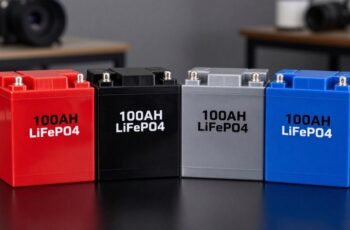
When we compare deep cycle lithium batteries with AGM batteries, we’re evaluating more than purchase price. Lithium typically delivers greater usable capacity, longer cycle life, faster charging, and lower weight, while AGM offers simpler installation, lower upfront cost, and stronger cold-weather tolerance. The right choice depends on load profile, charging equipment, operating temperature, and total cost over time. Let’s examine how these factors affect runtime, reliability, safety, and application fit.
Key Takeaways
- Lithium batteries typically provide 80–90% usable capacity, compared with approximately 50% for AGM batteries.
- Lithium offers faster charging, higher efficiency, steadier voltage, and better performance during demanding or high-power applications.
- AGM batteries tolerate cold-weather charging better, while lithium batteries require temperature protection and should not charge below freezing.
- Lithium batteries generally deliver 2,000–5,000 cycles, significantly exceeding AGM’s typical 300–800-cycle lifespan.
- AGM costs less initially, but lithium may provide lower lifetime costs through longer service life, reduced weight, and greater usable energy.
Deep Cycle Lithium Battery vs. AGM: Quick Verdict
For most mobile, solar, and backup-power systems, a deep-cycle lithium battery is the stronger choice than AGM because it delivers more usable capacity, higher charge efficiency, longer cycle life, and lower weight. We’ll generally select lithium when operating conditions, budget, and charging equipment support it. A lithium battery can provide roughly 80–100% usable depth of discharge, while AGM commonly performs best around 50% to protect service life. Lithium also maintains voltage more consistently under load and accepts charge faster, improving system availability and reducing generator or solar runtime. AGM remains a practical choice where low initial cost, simple replacement, cold-weather tolerance, or existing lead-acid infrastructure matters most. We should compare total ownership cost—not purchase price alone—by evaluating energy demand, cycle frequency, temperature, installation limits, maintenance, protection electronics, and expected replacement intervals.
How Lithium and AGM Batteries Work
Lithium and AGM batteries both store energy through reversible electrochemical reactions, but their internal chemistries determine how they charge, discharge, and age. In a lithium battery, lithium ions shuttle between a cathode and graphite anode through an electrolyte during cycling. A battery-management system monitors cell voltage, temperature, current, and balance, then disconnects the pack when limits are exceeded. AGM batteries use lead dioxide, sponge lead, and sulfuric-acid electrolyte immobilized in fiberglass mats. During discharge, both plates convert toward lead sulfate; charging reverses that reaction while gassing remains controlled through recombinant valves. We must match each chemistry with its appropriate charging profile. Lithium systems typically require constant-current/constant-voltage control and protection electronics, whereas AGM systems use staged voltage regulation, temperature compensation, and float maintenance. These controls directly influence service life and reliability.
Compare Usable Capacity and Runtime
We’ll compare usable capacity by accounting for each battery’s recommended depth of discharge rather than relying on rated amp-hours alone. We’ll then evaluate runtime under load, where voltage sag, efficiency, and discharge rate affect delivered energy. This approach shows how lithium and AGM perform in an equivalent system.
Usable Capacity Differences
Because usable capacity depends on the permitted depth of discharge, a deep-cycle lithium battery typically delivers more runtime than an AGM battery with the same rated amp-hour capacity. We calculate usable energy by multiplying rated amp-hours by nominal voltage and the allowable discharge fraction. In practice, lithium systems commonly support about 80–90% depth of discharge, while AGM systems often use approximately 50% to protect service life.
- A 100-Ah lithium battery may provide roughly 80–90 Ah of usable capacity.
- A 100-Ah AGM battery may provide about 50 Ah under comparable conditions.
- Hence, lithium can supply approximately 60–80% more usable capacity from the same rating.
We should also account for charging losses, temperature, battery age, and manufacturer limits. Comparing only nameplate amp-hours can thus understate lithium’s effective storage advantage and distort system-sizing decisions.
Runtime Under Load
When the load remains constant, runtime depends on usable watt-hours rather than the battery’s nameplate amp-hour rating alone. We calculate runtime by dividing usable energy by load power, then account for inverter and wiring losses. For example, a 100Ah, 12.8V lithium battery stores about 1,280Wh, and using 90% of that capacity provides roughly 1,152Wh. A comparable 100Ah, 12V AGM battery stores 1,200Wh nominally, but limiting discharge to 50% protects cycle life, leaving about 600Wh. At a 600W load, lithium could deliver approximately 1.7 hours, while AGM might deliver about 0.9 hours before losses. High current further widens the gap because AGM voltage sag and Peukert effects reduce effective capacity. We should *consequently* compare runtime at the actual load, temperature, cutoff voltage, and discharge rate—not amp-hours alone.
Which Battery Charges Faster?
Which battery charges faster? We’ll usually see lithium recharge more quickly than AGM because its chemistry accepts higher current and maintains voltage efficiently. The charger and wiring still determine the real result, so we should compare complete charging systems, not labels alone.
- Charge acceptance: Lithium batteries commonly support 0.5C or higher charging, while AGM batteries often use lower recommended rates to limit heat and gassing.
- Charging profile: Lithium reaches its voltage target rapidly and needs little absorption time. AGM requires bulk, absorption, and float stages, with absorption potentially extending the cycle.
- System constraints: We should verify charger compatibility, current limits, temperature protection, cable sizing, and battery-management-system settings before upgrading.
For identical amp-hour capacity and adequate equipment, lithium typically restores usable energy sooner. AGM charging can slow substantially near full charge, especially with undersized chargers.
Compare Battery Lifespan and Cycle Life
Lithium batteries generally deliver a longer service life and more usable charge cycles than AGM batteries, provided we operate them within their specified voltage, temperature, and current limits. We should compare cycle ratings at the same depth of discharge (DoD), because DoD strongly affects degradation. Lithium typically retains capacity through thousands of cycles, while AGM life commonly falls within hundreds to roughly 1,000 cycles. Temperature, charge voltage, current, and storage state further influence both technologies.
| Metric | Lithium | AGM |
|---|---|---|
| Typical cycles at 80% DoD | 2,000–5,000 | 300–800 |
| Practical service life | 8–15 years | 3–7 years |
We should also verify the battery-management system, charging profile, and warranty conditions. Those controls determine whether laboratory cycle data translates into reliable field performance and predictable replacement intervals.
Lithium vs. AGM Weight and Size
For the same usable energy, lithium batteries typically weigh 40–70% less and occupy less space than AGM batteries because lithium cells provide higher energy density and support deeper discharge. We can translate that difference directly into system-level benefits:
For the same usable energy, lithium batteries offer significant weight and space savings compared with AGM batteries.
- Mass: A 100-Ah, 12.8-V lithium battery stores about 1.28 kWh nominally, while a comparable AGM bank often needs roughly twice the nominal capacity to deliver similar usable energy. Lithium thus reduces payload and structural load.
- Volume: Lithium’s higher energy density can shrink the battery enclosure, leaving more room for wiring, ventilation, or equipment.
- Installation: Lower mass simplifies lifting, mounting, and transportation, while compact dimensions improve placement flexibility.
We should compare complete, installed systems—not only batteries—because trays, cabling, chargers, and required clearances affect the final footprint and weight. Always verify manufacturer dimensions and rated usable capacity.
Maintenance, Safety, and Cold-Weather Limits
Once we account for weight and installation space, we should also compare the ongoing operating requirements of each chemistry. AGM batteries need ventilation because charging can produce hydrogen, and we should inspect terminals, cabling, and case condition regularly. They tolerate cold charging better than lithium, although capacity declines as temperature falls; around 0°F (-18°C), available capacity may approach 50% of the rated value. Lithium batteries generally require little routine maintenance, but we must use a battery-management system (BMS) for overcharge, over-discharge, temperature, and short-circuit protection. We shouldn’t charge standard lithium batteries below 32°F (0°C) unless the BMS or an integrated heater provides protection; plating can permanently damage cells. High temperatures also accelerate degradation, so ventilation and temperature monitoring remain important in either installation. Follow manufacturer limits for charging, storage, fusing, and isolation.
Compare Lithium and AGM Costs
How should we compare lithium and AGM costs? We should evaluate total ownership, not purchase price alone. Lithium batteries typically cost more initially, but their usable capacity, higher efficiency, and longer cycle life can reduce cost per delivered kilowatt-hour. AGM batteries generally cost less upfront, yet usable capacity limits and faster degradation may increase replacement frequency.
Compare lithium and AGM by total cost per delivered kilowatt-hour, not upfront purchase price alone.
- Initial cost: Compare price per rated amp-hour, then discount AGM capacity to its recommended depth of discharge.
- Lifetime cost: Divide purchase, replacement, and disposal expenses by projected lifetime energy throughput.
- Operating cost: Include charging losses, maintenance, monitoring, and downtime in the system model.
We should also normalize warranty terms, temperature assumptions, and cycle profiles. A spreadsheet using identical load, charge efficiency, and replacement assumptions exposes the real break-even point more reliably than advertised price tags. This framework keeps cost comparisons measurable, transparent, and technically defensible.
Which Battery Fits Your Application?
We’ll match your battery choice to application power requirements, including peak loads, duty cycles, and usable capacity. We’ll then compare expected lifespan and maintenance needs under your operating conditions. This approach shows whether lithium or AGM delivers the stronger total-system fit.
Application Power Requirements
Which battery fits your application depends on its voltage, continuous and peak current demand, duty cycle, and available charging capacity. We should size both technologies against measured load profiles, not rated amp-hours alone. Compare these parameters:
- Continuous load: Calculate watts, then divide by system voltage to determine operating current. Lithium typically supplies higher usable capacity under sustained loads, while AGM voltage can sag sooner.
- Peak demand: Include inverter startup surges, motor stalls, and compressor cycling. Verify each battery’s maximum discharge current and the BMS or AGM manufacturer’s surge rating.
- Energy and charging: Multiply average load by operating hours, then include conversion losses and reserve requirements. Confirm the charger’s voltage, current, and charging profile match the selected chemistry.
For frequent high-power events, lithium’s lower internal resistance can improve voltage stability. For modest, predictable loads, AGM may meet requirements when we provide sufficient capacity and inverter headroom.
Lifespan And Maintenance Needs
When we compare lifespan and maintenance, we should evaluate cycle life at the expected depth of discharge, operating temperature, and charge profile—not the advertised maximum alone. Lithium batteries typically deliver more usable cycles because their higher allowable depth of discharge and lower voltage sag reduce capacity loss during normal operation. Their battery-management system also controls overcharge, over-discharge, and temperature risks, but we still need compatible charging equipment and adequate thermal protection. AGM batteries generally require less electronic integration, yet their capacity declines faster under repeated deep discharge, high heat, or chronic undercharging. They’re maintenance-free in the fluid-check sense, but we must verify charging voltage, connections, ventilation, and resting voltage. Choose lithium when lifecycle energy, weight, and predictable performance justify upfront cost; choose AGM when low initial cost, simplicity, and moderate cycling dominate.
How to Choose Between Lithium and AGM
Choosing between lithium and AGM starts with matching the battery’s electrical demands, operating environment, and lifecycle requirements to each chemistry’s limits. We should evaluate three system variables:
- Load profile: Lithium supplies higher usable capacity, steadier voltage, and greater cycle efficiency. AGM suits moderate loads and lower initial budgets, but voltage declines progressively under discharge.
- Temperature and controls: We need lithium-compatible charging, battery-management protection, and temperature limits. AGM tolerates simpler installations, although cold charging and ventilation requirements still matter.
- Economics and service life: We should compare total cost per delivered kilowatt-hour, not purchase price alone. Lithium generally reduces replacement frequency and maintenance, while AGM may win where upfront cost, occasional use, or existing chargers dominate.
We’ll also verify inverter settings, alternator limits, physical dimensions, and reserve-capacity requirements before selecting the chemistry. This systems approach prevents mismatched components and improves reliability.
Frequently Asked Questions
Can Lithium and AGM Batteries Be Connected in Parallel?
No, we shouldn’t connect lithium and AGM batteries directly in parallel. Their charging voltages, internal resistance, and battery-management requirements differ, creating unequal current sharing, overcharging risk, reduced capacity, and potential damage. Use separate charging systems or approved isolation.
Do Lithium and AGM Batteries Require Different Chargers?
Different chemistries demand distinct charging profiles: we’ll use an AGM-compatible charger for AGM batteries and a lithium charger with the manufacturer’s specified voltage, current, and BMS settings. Don’t interchange chargers unless explicitly approved.
How Should Lithium and AGM Batteries Be Stored During Off-Season?
Store lithium batteries around 40–60% state of charge, disconnected, cool, dry, and above freezing; check periodically. Store AGM batteries fully charged, disconnected, cool, dry, and recharge periodically to offset self-discharge, preventing sulfation and capacity loss.
Can Solar Panels Charge Both Lithium and AGM Batteries?
Yes, solar panels can charge both lithium and AGM batteries. Think of them as different operating systems: we need a compatible controller, chemistry-specific voltage profile, temperature protection, and correctly configured absorption, float, and cutoff settings.
Are Lithium and AGM Batteries Recyclable?
Yes, we can recycle both lithium and AGM batteries, but their processing differs. AGM lead-acid batteries achieve mature, high recovery rates; lithium recycling remains developing, chemistry-dependent, and requires specialized collection, transport, and facilities.
Conclusion
Choosing between a deep cycle lithium battery and AGM means matching the system to its operating demands. We’ll favor lithium when usable capacity, rapid charging, low weight, and long cycle life justify the higher initial cost. We’ll choose AGM when budget, cold-weather reliability, and simpler installation matter most. Think of lithium as the marathon runner and AGM as the dependable workhorse: both can power our system effectively when we size, charge, and protect them correctly.