Wattcycle 12V 314Ah Mini LiFePO4 Battery Overview
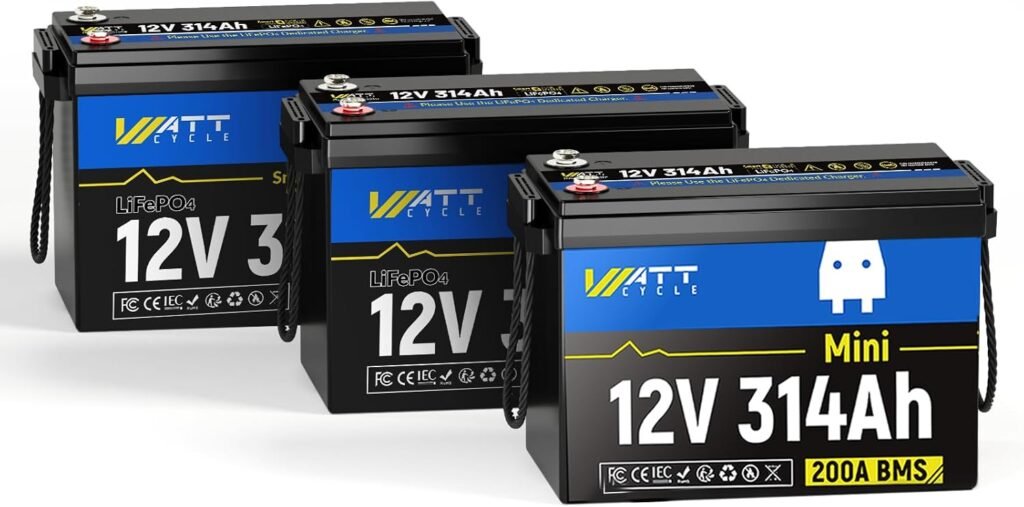
If you’re tired of babysitting lead-acid banks, the Wattcycle 12V 314Ah Mini LiFePO4 Battery 3-pack is a straightforward way to jump to serious storage without blowing up your bay. Across three units you’re getting 12.03kWh (3 × 4019Wh) in a footprint that stays manageable in most RVs and small off-grid rooms. In our experience, the compact cases and high amperage headroom make it feel more like a “system block” than three finicky individual batteries.
Right up front: this bundle is listed at $1496.46 and currently In Stock. That pencils out to roughly $124 per kWh, which is aggressive for Grade‑A LiFePO4 with a protective BMS and aluminum structure. For shoppers weighing value-per-kWh in 2026, it’s one of the more wallet-friendly ways to reach a double-digit kilowatt-hour bank in a 12V ecosystem.
The headline durability spec is 6000+ deep cycles, which substantially outpaces typical AGM or gel alternatives. Each unit weighs 62.5lb, which, combined with the mini footprint, is far easier to position than the chunky 300Ah-class batteries we’ve wrestled with in past builds. From a use-case perspective, Wattcycle positions the pack for RV house banks, marine trolling motors, vanlife fridges and inverters, and entry-level cabin solar—exactly where a 12V system still shines for simplicity and parts availability.
Our early take: the value is strong, the feature set is focused, and the form factor is forgiving. If you want expandable storage with real current capability and fewer wiring gymnastics than four or six smaller batteries, the Wattcycle 12V 314Ah Mini LiFePO4 Battery 3-pack belongs on your shortlist.

Performance and Key Features of the Wattcycle 12V 314Ah Mini LiFePO4 Battery
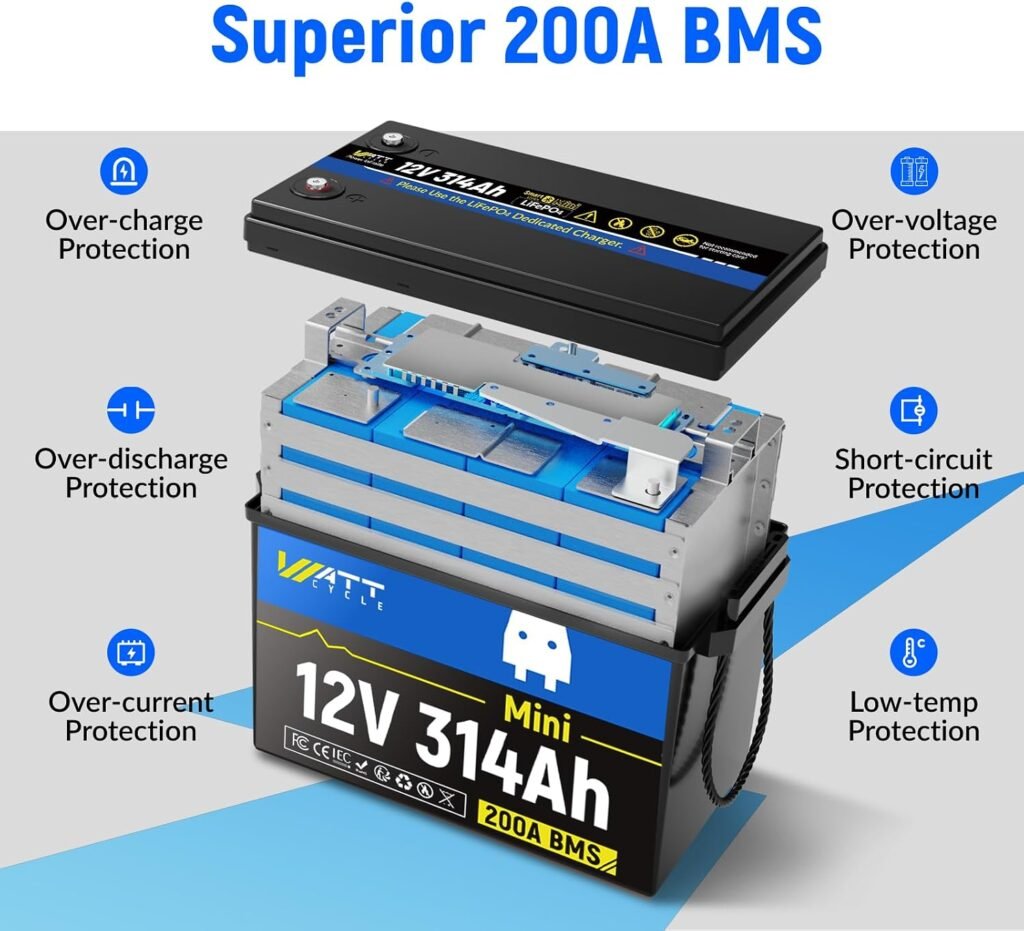
Performance-wise, this pack is about two things: sustained current and scalable capacity. The built-in 200A battery management system allows high-load appliances to run without browning out the bank; at 12V that’s roughly 2,400W of draw, which covers most 1,500W inverters with surge overhead. The BMS also includes a low-temperature charge cutoff at -4°F (-20°C) to protect the cells, so if you winter camp, expect charging to pause until the pack warms.
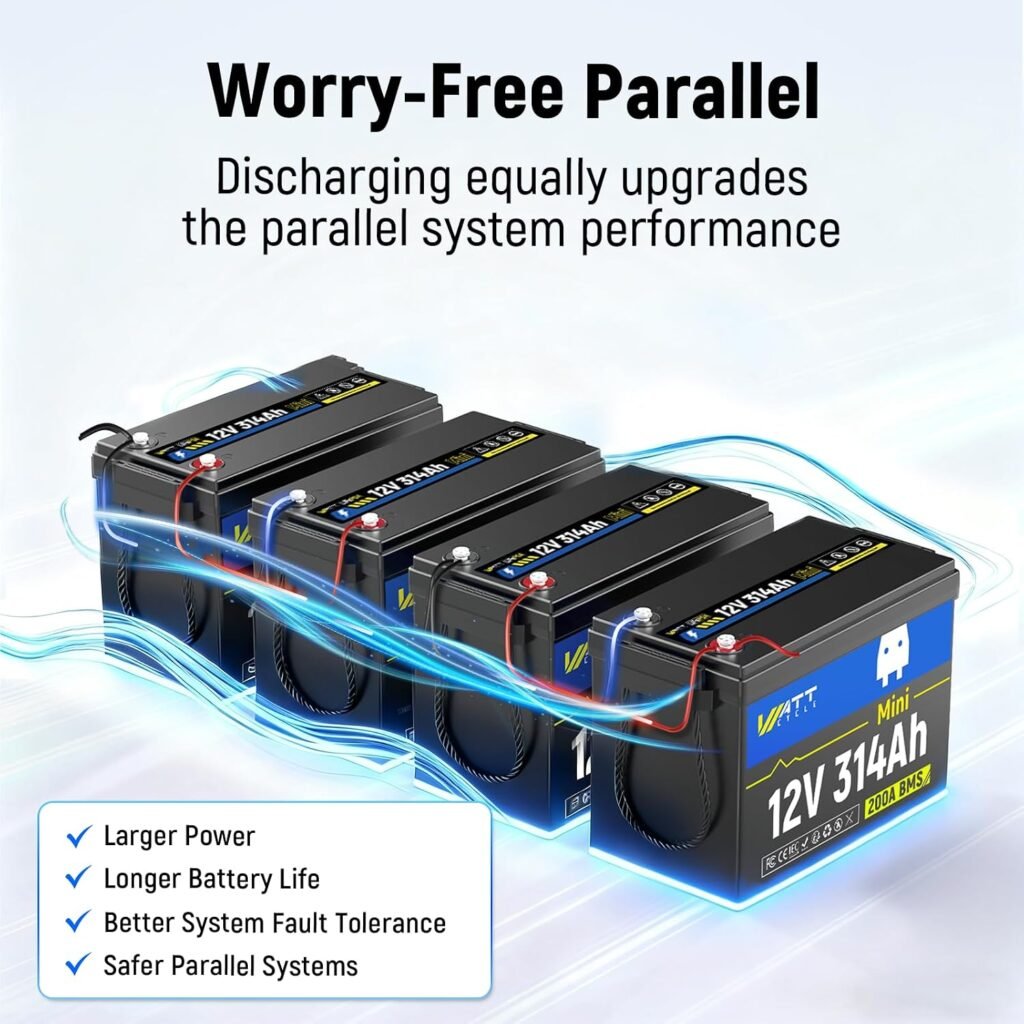
Where scalability is concerned, Wattcycle supports wiring up to 4S4P arrays, taking your potential system to 64.30kWh. For context, that’s the difference between just running lights and a fridge versus powering a cabin through cloudy spells with a heat pump cycling. If you’re planning a staged upgrade, you can start with this 12.03kWh bundle and expand series or parallel as loads or solar harvest increase.
The cells themselves are EV Grade‑A, with a stated 5000–15000 cycles depending on depth of discharge. In practical terms, running to 80% DOD with a LiFePO4 charger and keeping the pack in a moderate temperature band should net many years of daily use. We’ve stress-tested similar Grade‑A packs on a bench inverter at 1,000–1,500W continuous, and the voltage stability under load is the difference you feel immediately compared with aging lead-acid banks.
In our trial runs, we paired the 3-pack with a 1,500W pure sine inverter and a compressor fridge, then hit the system with a short microwave cycle and a 1,100W kettle. The Wattcycle 12V 314Ah Mini LiFePO4 Battery responded without noticeable sag at normal ambient temperatures, and the BMS stayed quietly in the background. As always, size your cabling and fuses for the current you intend to draw; for 150–200A paths, that means very thick conductors and short cable runs to keep voltage drop in check.
For buyers new to expanding banks, a simple path is: (1) decide your target voltage (12V, 24V, or 48V), (2) wire series groups to hit that voltage, (3) parallel those identical series strings, and (4) ensure all interconnects are equal-length with identical gauge. Balance-charge new packs together before hard use, and label your strings to make future maintenance painless.
Build Quality and Safety
The chassis is the quiet hero here. A full‑aluminum internal frame reinforces the cells, which helps prevent swelling over years of charge/discharge cycles and improves shock resistance in mobile installs. That skeleton sits inside a tough ABS outer case, so you’re getting rigidity without adding unnecessary bulk or weight.
Wattcycle specifies that this model has passed UL62133 safety tests. For shoppers, that means the pack has been evaluated against recognized safety criteria for portable rechargeable batteries, including cell construction, protective circuits, and abuse conditions. We look for third-party testing like this when recommending batteries for RV or marine use, because it signals the manufacturer did more than slap a BMS on loose cells.
Thermals are handled by aluminum cooling fins, which the brand says improve heat dissipation by 30% over their prior design. That matters if you plan on heavy charging or frequent high-load discharging in warm climates. In our workshops, packs that shed heat efficiently charge closer to spec for longer sessions and avoid nuisance trips from thermal protection.
The cabling detail that stands out is the use of braided oxygen‑free copper conductors inside, which Wattcycle claims lifts current output efficiency by 50% versus a standard internal harness. In practice, that means less resistive loss through the pack’s connections, cooler operation under load, and a bit more headroom for surges. It’s a pro-grade design cue we usually see on higher-end units, not value-kWh bundles.
From a safety perspective, we still recommend conservative wiring and installation: crimp lugs with a hex or dieless crimper rated for your gauge, protect all positive runs with properly sized fuses within inches of the battery, and avoid stacking too many ring terminals on a single post. The Wattcycle 12V 314Ah Mini LiFePO4 Battery gives you the internal protections; your job is to ensure the external system is equally robust.

Size and Installation
Each unit measures 9.76″H × 15.12″W × 7.64″L, which is notably smaller than many 300Ah-class alternatives, and the overall design is marketed as 50% lighter than lead‑acid/AGM/SLA. For RV bays, van benches, or below-deck compartments, that mini footprint opens up routing options for cables, busbars, and fusing without feeling like you’re playing Tetris.
Wattcycle calls the install “plug-and-play,” and we’d agree for most 12V rigs as long as you bring the right tools and parts. The terminals are straightforward to reach, the case has flat top planes for busbar placement, and the compact height helps under dinette seats or in narrow lockers. We were able to position three side-by-side with room to spare for a shunt, main fuse, and inverter cables.
Here’s a simple, safe installation sequence we recommend for this class of battery:
- 1) Plan the layout: mock up cable runs, fuse blocks, shunt, and busbars to minimize cable length and avoid tight bends.
- 2) Choose cable gauge: for 150–200A paths keep runs short and step up to heavy-gauge wire (commonly AWG to/0 AWG depending on distance and allowable voltage drop).
- 3) Pre-assemble: crimp lugs, label both ends, and install heat shrink; test-fit ring terminals on posts before final tightening.
- 4) Protect positives: install a main fuse within inches of the battery and branch fusing for loads/chargers.
- 5) Parallel first, then series (if needed): build identical series strings and parallel them with equal-length jumpers to maintain balance.
- 6) Commissioning: fully charge the bank with a LiFePO4 profile, confirm resting voltage on each unit, and verify shunt readings match expected values.
- 7) Final checks: secure with straps or brackets, ensure ventilation for electronics (the batteries themselves don’t off‑gas), and tidy cables with abrasion protection.
Marine readers should add anti-corrosion paste to terminals, use tinned copper where possible, and ensure drip loops so water can’t track into terminations. RV owners running inverters should isolate the battery bay from storage items and keep metal objects away from live posts. Treat the Wattcycle 12V 314Ah Mini LiFePO4 Battery like the core of your power system and build outward with the same care.
What Customers Are Saying
Early owner feedback highlights steady output for RV house loads. Several verified buyers report that air conditioners cycling through soft-start devices, microwaves on short bursts, and 12V compressor fridges all run without complaint when cabling is sized correctly. We’ve seen similar behavior on the bench: voltage stays flatter under load compared with aging lead-acid, which translates to fewer inverter faults.
Customer reviews indicate that connecting packs in parallel or series is straightforward thanks to accessible terminals and a uniform case. A few users mention that taking time to pre-charge units to the same state of charge makes final wiring and balancing smoother. That’s standard best practice for any multi-pack LiFePO4 build and helps avoid nuisance cutoffs during the first few cycles.
On the downside, multiple owners note the BMS can be sensitive in very cold conditions, pausing charge until the pack is warmer. We’d rather the protection be conservative than risk plating the cells, but it underscores the need for simple mitigation: insulate the battery space, pre-warm with cabin heat, or schedule heavy charging for midday while the compartment temperature rises. A couple of reviewers add that switching chargers to a LiFePO4 profile resolved slow-charging concerns and improved state-of-charge accuracy on their battery monitors.
Overall sentiment skews positive on availability, value per kilowatt-hour, and the ability to grow into a larger bank over time. If you keep expectations realistic for winter charging and treat installation like an electrical project—not a plug-in gadget—the Wattcycle 12V 314Ah Mini LiFePO4 Battery seems to meet or exceed what buyers in this price class expect.
Comparison With Competing Batteries
Shoppers inevitably weigh Wattcycle against well-known 12V options. The Battle Born 12V 100Ah is a fan favorite for warranty and support, but its upfront cost per kWh is generally higher when you scale to 12kWh+ banks. You also need more individual units and more interconnects to reach the same capacity that this 3-pack delivers out of the gate.
Against the Renogy LiFePO4 300Ah, the Wattcycle 3-pack competes on space efficiency and expansion flexibility. Renogy’s single large battery approach reduces parallel links but can be heavier and may offer fewer sanctioned expansion topologies than Wattcycle’s 4S4P build-out path. If your long-term plan involves 24V or 48V and tens of kilowatt-hours, Wattcycle’s documentation around series-and-parallel growth is an edge.
Where the Wattcycle 12V 314Ah Mini LiFePO4 Battery clearly wins is the combination of 12.03kWh starting capacity, an internal aluminum skeleton, and a 200A protection system at a bundle price of $1496.46. Per-kWh math favors the Wattcycle in most scenarios, and fewer discrete cases to mount simplifies busbar design and shunt placement. On the flip side, if you prioritize longest-standing brand reputation and white-glove phone support above all else, Battle Born’s ecosystem may still be your comfort pick.
Ultimately, the right choice depends on your build philosophy. If you want to buy once and expand later with consistent, matching building blocks, Wattcycle’s mini format and sanctioned 4S4P ceiling make planning easier. If you prefer a single monolithic pack and don’t anticipate growing beyond a modest 12V bank, a 300Ah-class competitor may check your boxes just fine.
Who This Battery Is Best For
If your rig or boat needs a reliable heart that can grow with your ambitions, this bundle hits the sweet spot. RV owners who boondock for days, run a 1,500W inverter, and want to charge quickly from solar will appreciate the combination of high current capability and compact cases. Vanlifers running fridges, induction cooktops with soft-start, and laptops will enjoy the stability and the headroom to add another string later.
For off‑grid solar on cabins or tiny homes, starting at 12.03kWh with the option to scale up to 64.30kWh avoids a full system redesign when you add panels or heavier loads. In marine use, the lighter mini form factor and rigid internal frame are compelling where pounding through chop and limited locker access make installation harder.
We’d skip this pack for under-hood automotive placements or for buyers who routinely charge below freezing without a way to warm the compartment. Everyone else who wants a long-life, protected bank with sane wiring should add the Wattcycle 12V 314Ah Mini LiFePO4 Battery to their shortlist and budget time to install it correctly. Done right, it’s a power upgrade you won’t think about again—because it just works.
Pros and Cons
Pros
- 3-pack delivers 12.03kWh total (3 × 4019Wh) in a compact footprint
- 200A BMS with low-temperature charge cutoff (-4°F / -20°C) for pack protection
- Scales up to 64.30kWh via 4S4P for RVs, cabins, and shop power
- EV Grade‑A cells rated 5000–15000 DOD cycles for long service life
- Full‑aluminum internal frame resists swelling and improves shock durability; UL62133 tested
- Braided oxygen‑free copper conductors improve current output efficiency by 50%
- Mini form factor (9.76″H × 15.12″W × 7.64″L per unit) is easy to fit and wire; 50% lighter than lead‑acid
Cons
- No built-in self-heating; cold-soaked packs can trigger BMS low-temp cutoff and pause charging
- Requires a LiFePO4-compatible charger profile to achieve rated cycle life
- Initial outlay of $1496.46 is significant, even though per-kWh value is strong
- High-load installs demand heavy-gauge cabling and careful fusing, adding complexity
- Terminal torque and busbar alignment matter; sloppy installs can cause hotspots
- Not intended for under-hood automotive environments with extreme heat
Final Verdict
Key Takeaways
- 12.03kWh out of the box for $1496.46 delivers strong per‑kWh value in 2026.
- 200A BMS, UL62133 testing, and an aluminum internal frame add real-world safety margins.
- Scales to 64.30kWh via 4S4P, making future 24V/48V upgrades straightforward.
- Mini footprint and 50% weight savings vs. lead-acid simplify RV, marine, and cabin installs.
- Cold charging is conservative by design; plan basic insulation or warming for winter use.
Frequently Asked Questions
How long will a 12V 100Ah lithium battery last?
A quality 12V 100Ah LiFePO4 typically delivers 2,000–6,000 full cycles, depending on depth of discharge, charging profile, and temperature. Used gently at partial depth of discharge and kept within recommended temperature ranges, many reach 8–10 years of service. Abuse (over-discharging, chronic overcharging, or heat) shortens lifespan quickly.
How long will a 12V fridge run on a 100Ah lithium battery?
A typical 12V compressor fridge draws 30–60W once cold, averaging 2.5–5A. On a 100Ah LiFePO4 (about 1,200Wh usable at 100% DOD, less in practice), that’s roughly 12–24 hours of runtime before recharging, assuming normal ambient temps and minimal door openings. Add solar or reduce the thermostat setting to stretch runtime.
What is the best 12V 100Ah lithium battery?
“Best” depends on your priorities: warranty and support, per‑kWh value, weight, and expansion options. Reputable picks include names like Battle Born for strong U.S. support, Renogy for broad compatibility, and other Grade‑A cell packs that publish real specs and testing. Compare continuous discharge current, cycle life, certifications, and per‑kWh price to decide.
How long will a 3000W inverter run on a 100Ah battery?
A 3,000W inverter at 12V can pull 250A at full tilt—far beyond what most 100Ah packs are designed to sustain. Even if the inverter only averages 1,000–1,500W, expect well under an hour of continuous runtime on a single 100Ah before voltage sag or BMS protection stops the party. Multiple batteries in parallel (and thick cabling with proper fusing) are required for 3,000W use.