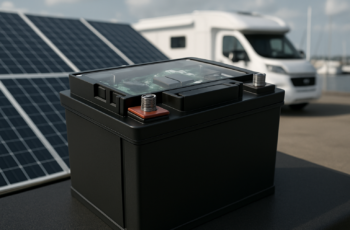
Power Queen 12V 200Ah Battery Review: Quick Product Overview
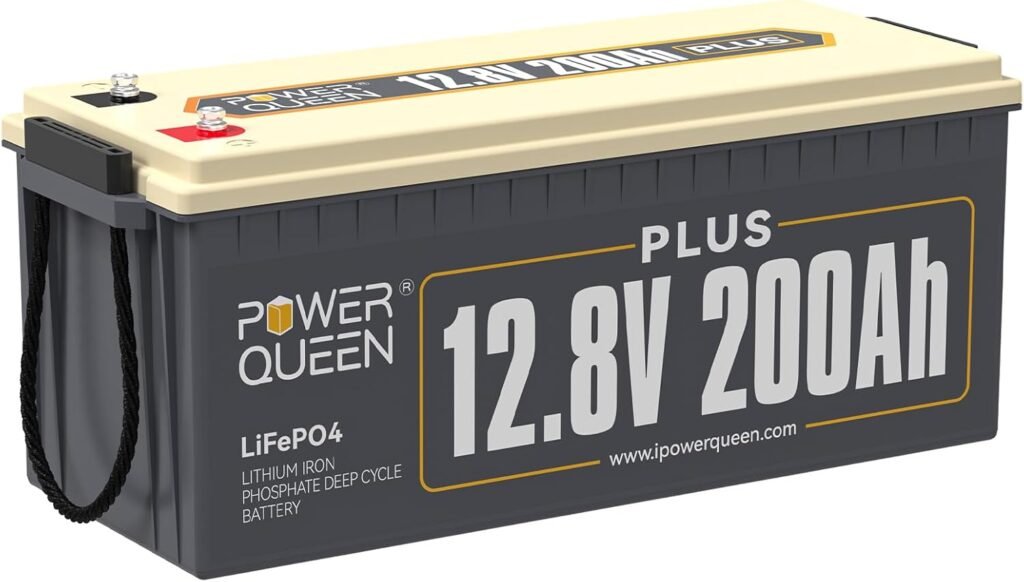
Can a 49.6-pound lithium battery provide dependable 2,560Wh storage for an RV, solar installation, or emergency backup system? The Power Queen 12V 200Ah battery is designed to do exactly that, combining a 12.8V LiFePO4 platform with a built-in 200A battery management system and a claimed 2,560W maximum load.
We are assessing the battery’s capacity, protection system, cycle-life claims, expansion options, installation requirements, customer-review evidence, alternatives, and likely value for buyers. On paper, it is most appealing to shoppers who want substantial storage in a lighter package than lead-acid and may eventually build a larger off-grid bank.
That said, headline capacity does not guarantee identical runtime in every setup. Charger configuration, inverter efficiency, temperature, wiring, load surges, and depth of discharge all affect results. Our early view is positive but conditional: this battery deserves consideration for compatible 12V-class systems, while buyers should confirm the complete electrical design before treating it as a drop-in replacement.

Power Queen 12V 200Ah Battery Specifications and Included Value
The supplied product information gives the following core specification set. It describes a single battery intended for deep-cycle storage rather than a universal replacement for every vehicle, marine, or home-energy application.
| Specification | Listed detail |
|---|---|
| Nominal voltage | 12.8V |
| Capacity | 200Ah |
| Stored energy | 2,560Wh |
| Weight | 49.6 pounds |
| Battery management system | 200A built-in BMS |
| Maximum load | 2,560W |
| Cycle claim | 4,000-plus cycles in the supplied description |
| Warranty | Five years |
| Support | 24/7 customer service and lifelong technical support |
There is a wording issue buyers should notice. The product name references 4,000 to 15,000 cycles, but the supplied description specifically states 4,000-plus cycles. We would therefore use 4,000-plus as the cautious planning figure rather than assuming the upper end applies to this exact model under normal use.
The manufacturer also advertises 100% energy storage. In practical terms, that is a claim about the battery’s rated storage rather than a promise that every watt-hour will reach an appliance under every temperature, load, inverter, or wiring condition. The package is described as including an English guideline and user manual. Each unit is also said to be capacity-tested and inspected for external damage before packaging.
Key Features Deep-Dive: 200A BMS and 2,560W Load Power
The central feature is the built-in 200A battery management system, or BMS. According to the product description, it is designed to provide protection from overcharge, over-discharge, over-current, and short circuit. That protection can help control abnormal electrical conditions, but it does not remove the need for correctly sized cables, fuses, disconnects, charging equipment, and sound installation practice.
The published 2,560W maximum-load figure is broadly the result of multiplying the nominal voltage by the 200A current rating. It should not be read as a guarantee that every inverter can continuously deliver that output. Inverter losses, motor-starting surges, temperature, cable resistance, and the inverter’s own continuous rating all matter. A refrigerator compressor or pump may demand considerably more power for a moment than its running label suggests.
Inside, the battery is described as using eight automotive-grade cells. Stable cell construction matters because the cells must work together repeatedly while the BMS monitors their operating conditions. However, the description does not provide independent test results, cell-brand information, or a detailed thermal design.
Before connecting appliances, we would:
- Add the continuous wattage of the intended appliances and separately identify their peak or startup demand.
- Check that the inverter accepts the battery’s voltage and charging profile.
- Fit correctly rated cables, fuses, breakers, and disconnects close to the battery.
- Confirm charging parameters in the manual before applying power.
- Test the system at a low load before normal operation.
A BMS is a protection layer, not a substitute for ventilation where required, correct polarity, safe wiring, or adherence to the manual.
Weight, Capacity, and LiFePO4 Performance Compared With Lead-Acid
The strongest practical argument for this lithium design is its weight. The supplied comparison places a similar 2,560Wh lead-acid setup at pounds, versus 49.6 pounds for this battery—a claimed reduction of approximately 80.4 pounds. That difference can be meaningful in an RV, trailer, boat, or portable solar kit where payload, lifting, compartment access, and fuel consumption affect everyday use.
The stated energy-density comparison makes the point more clearly: 51.61Wh per pound for the Power Queen battery versus 19.69Wh per pound for the comparable lead-acid arrangement. A lighter enclosure can also make installation less awkward, although the final system weight still includes the inverter, charger, fuses, cabling, mounting hardware, and any additional batteries.
LiFePO4 storage is not automatically equal to the headline rating in every situation. Inverter efficiency, temperature, depth of discharge, cable losses, and the appliance’s load profile influence usable energy and runtime. For a rough estimate, multiply the rated battery energy by the expected usable fraction and inverter efficiency, then divide by the appliance’s watt draw. For example, a 100W appliance running from a system that delivers 2,000 usable watt-hours would have a theoretical runtime of about hours before further real-world variation.
We would use that calculation only as a planning estimate. Measure actual consumption with a power meter when possible, especially for refrigerators, pumps, heaters, and other devices that cycle on and off.

Expandable Storage: Series and Parallel Battery Configurations
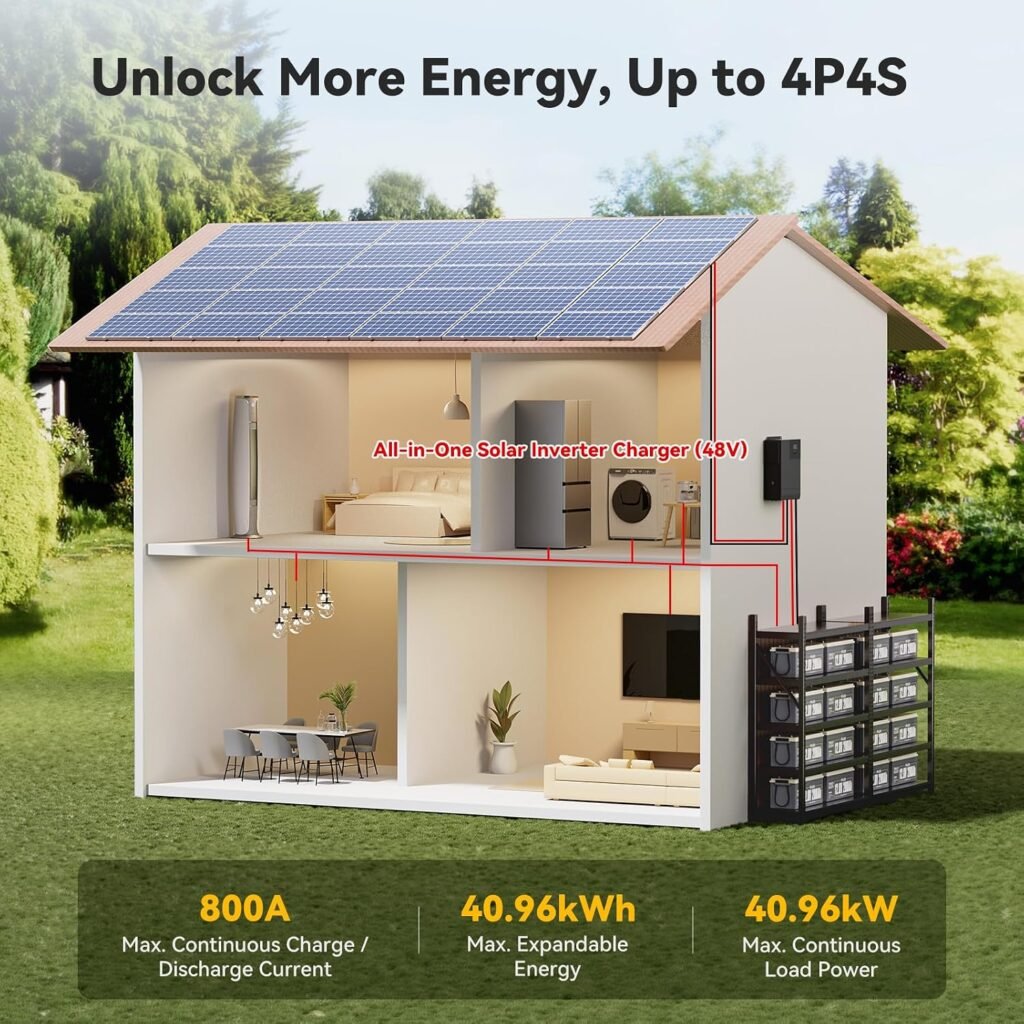
The advertised expansion ceiling is a 4S4P arrangement, meaning four batteries may be connected in series and four such strings in parallel, for a maximum of batteries. Parallel connections are described as increasing capacity through 200Ah, 400Ah, 600Ah, and up to 800Ah. Series connections raise the nominal system voltage through 12.8V, 25.6V, 38.4V, and up to 51.2V.
At the maximum advertised arrangement, the company calculates a 51.2V, 800Ah bank with 40.96kWh of stored energy. That is a substantial home-solar or backup configuration, but it should be treated as a system-design target rather than a simple plug-in upgrade. The inverter, charger, solar controller, cables, disconnects, fuses, and other protection devices must all support the final voltage and current.
For a multi-battery bank, we would use units of the same model, age, capacity, and charge state. Before connecting them, charge and verify each battery according to the manual, use matched cable lengths where the design calls for them, and provide accessible isolation points. Commission the bank gradually while checking voltage and connections for abnormal heating.
Large series-parallel banks require careful balancing and documentation. For home energy storage, high-voltage arrangements should be designed or inspected by a qualified installer. A theoretical expansion limit does not by itself confirm compliance with local electrical, fire-safety, or insurance requirements.
Charging, Installation, and Cold-Weather Considerations
Our first installation rule is simple: confirm that the charger or solar charge controller is configured for LiFePO4 chemistry. A lead-acid profile should not be assumed to suit a lithium battery, and a vehicle’s standard charging system may need additional compatibility checks. The supplied description identifies protection functions but does not provide enough information to guarantee compatibility with every inverter, alternator, marine system, charger, or solar controller.
Before installation, we would follow this sequence:
- Inspect the case and terminals for shipping damage.
- Read the English guideline and user manual from start to finish.
- Confirm polarity with a meter and check that terminal hardware is secure.
- Install suitable over-current protection and a reachable disconnect.
- Enter the manufacturer’s charging settings into the controller or charger.
- Test the system at low load, then increase demand while checking connections.
Cold weather deserves particular attention. Buyers placing the battery in an unheated garage, winter RV, outdoor solar enclosure, or boat should check the manual’s operating-temperature and charging-temperature limits. The product description does not state a low-temperature charging cutoff, internal heater, or precise temperature range, so we would not assume those features are present.
Record the initial voltage, charging settings, inverter limits, cable sizes, and bank configuration. That small amount of documentation makes later troubleshooting far easier and helps a technician understand what changed if the BMS disconnects or charging stops.
What Customers Are Saying About the Power Queen 12V 200Ah Battery
The supplied product-generation data does not include an Amazon star rating, review total, or individual customer comments. We therefore cannot honestly say that many buyers praise the runtime, that several reported slow charging, or that a particular number of owners experienced shutdowns. Those claims would require verifiable review evidence rather than inference from the product description.
For this model, customer feedback should be sorted into practical themes: measured capacity and runtime, weight compared with lead-acid, installation ease, use in RV and solar systems, BMS behavior, shipping condition, and responsiveness from support. Detailed reviews that identify the charger, inverter, climate, load, photos, and measured watt-hours are much more useful than short comments saying only that the battery “works.”
We would pay special attention to reports of shutdowns under heavy loads, charging incompatibility, loose terminals, undersized supplied cables, unclear instructions, winter operation, or difficulty obtaining warranty service. A single complaint is not proof of a widespread fault, but repeated, specific reports deserve more weight than general praise.
The five-year warranty,/7 customer service, and lifelong technical support are potential advantages. Before relying on them, we would confirm the warranty process, exclusions, proof-of-purchase requirements, return shipping responsibility, and whether support is available in the buyer’s country. Until the missing rating and review count are available, our customer-evidence assessment remains limited.
How the Power Queen 12V 200Ah Battery Compares With Alternatives
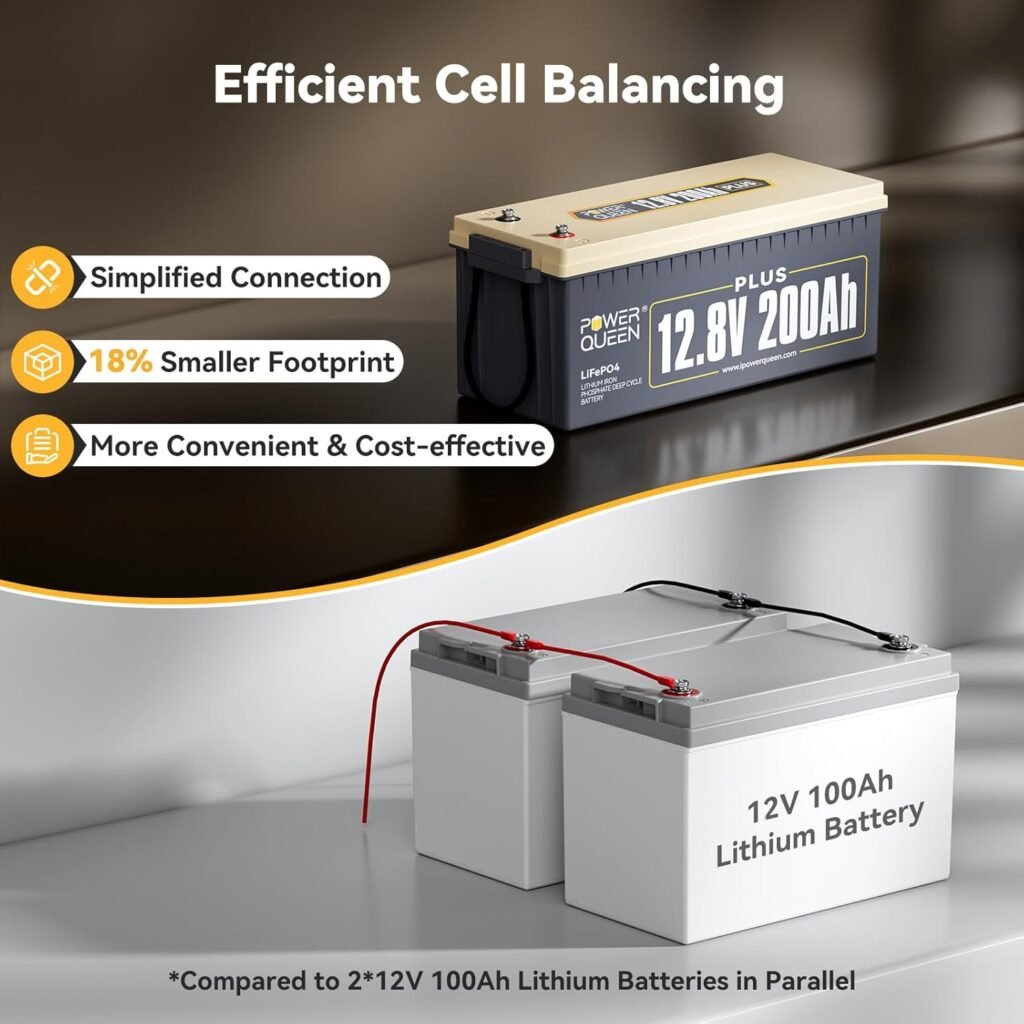
The ECO-WORTHY 12V 100Ah LiFePO4 Battery is a different capacity class. A 100Ah unit may be easier to fit into a restricted compartment, require a lower initial outlay, and suit smaller loads. Two 100Ah batteries can approach the storage of one 200Ah battery, but they introduce different cable-routing, balancing, mounting, replacement, and expansion decisions. We would compare the alternatives’ verified weight, maximum current, dimensions, BMS behavior, and warranty before deciding which arrangement is easier to install.
The Renogy 12V 200Ah Core Series LiFePO4 Battery is the more direct comparison because it targets the same broad capacity category. The relevant checks are its published BMS current, cycle-life conditions, warranty duration, physical dimensions, charging guidance, cold-weather features, and current price at publication. Those figures were not supplied here, so we will not claim that Renogy is better or that it offers a superior warranty or protection system.
Our comparison anchors for the Power Queen are its stated 49.6-pound weight, 2,560Wh capacity, 200A BMS, and five-year warranty. A rival may be preferable when it provides clearer dimensional information, stronger documented cold-weather protection, more accessible local service, or a longer warranty. Conversely, the Power Queen may suit buyers who value one high-capacity unit and the option to scale later.
Who Should Buy the Power Queen 12V 200Ah Battery?
We see the strongest fit in RV house-battery systems, off-grid cabins, solar storage, emergency backup systems, compatible marine installations, and outdoor equipment that needs substantial 12V-class energy storage. It is also relevant to shoppers who want a single high-capacity battery rather than several smaller units and who may eventually create a larger series-parallel bank.
Some buyers should be more cautious. A drop-in replacement is not truly drop-in until the charger profile, inverter limits, terminal arrangement, physical fit, and protection equipment are checked. Users with large motor-starting surges should compare startup demand with the complete inverter and battery design. Anyone planning a high-voltage bank without electrical experience should obtain professional help, particularly because the product description does not confirm cold-weather charging protection.
Our decision process would be:
- List daily watt-hours and separate continuous loads from startup loads.
- Confirm the available compartment, ventilation needs, terminals, and cable route.
- Verify charger, solar-controller, alternator, and inverter compatibility.
- Price the complete installed system, including protection hardware.
- Decide whether the system is for occasional backup or daily deep cycling.
Occasional emergency use may prioritize standby readiness and simple recharging. Daily cycling places greater demands on charging sources, thermal conditions, monitoring, and long-term service expectations, so the battery should be judged as one part of the whole system.
Pros and Cons
Pros
- High listed storage capacity of 2,560Wh from one battery
- 49.6-pound weight is substantially below the supplied 130-pound comparable lead-acid setup
- Built-in 200A BMS with stated overcharge, over-discharge, over-current, and short-circuit protection
- Advertised support for up to a 4S4P, 16-battery configuration
- Five-year warranty,/7 customer service, and lifelong technical support are listed
Cons
- The supplied data does not include a verifiable star rating, review count, or detailed customer-review evidence
- The 4,000-to-15,000-cycle wording is less precise than the description’s 4,000-plus-cycle claim
- Precise dimensions and cold-weather charging protections are not provided
- A BMS does not guarantee compatibility with every charger, inverter, vehicle, marine system, or solar controller
Final Verdict
Key Takeaways
- The battery offers a listed 2,560Wh capacity in a 49.6-pound LiFePO4 package with a 200A BMS.
- The 4,000-plus-cycle description should be used for cautious planning; the product title’s broader 4,000-to-15,000-cycle wording needs clarification.
- Its 4S4P expansion claim is substantial, but larger banks require matched batteries, compatible equipment, balancing, and careful commissioning.
- Charging profile, temperature limits, inverter surge capability, wiring, and over-current protection determine real-world suitability.
Frequently Asked Questions
What is the usable capacity of the Power Queen 12V 200Ah battery?
The listed stored energy is 2,560Wh, but usable energy at an appliance will vary with inverter efficiency, temperature, depth of discharge, wiring losses, and the load profile. Use the rated energy as a planning figure rather than a guarantee of delivered watt-hours.
Can this battery run a 2,560W appliance?
The product description states a 2,560W maximum load associated with its 200A BMS. The inverter must also support the required continuous output and startup surge, while cables, fuses, terminals, and disconnects must be rated for the installation.
Can four Power Queen batteries be connected in series?
The advertised expansion limit supports up to four batteries in series and four parallel strings, described as a maximum 4S4P system. All batteries should be matched and the inverter, charger, wiring, and protection equipment must support the resulting voltage and current.
Is the battery suitable for winter use?
The supplied description does not state precise operating or charging temperature limits, nor does it confirm an internal heater or low-temperature charging cutoff. Check the manual before using it in an unheated garage, winter RV, or outdoor solar system.
What warranty does Power Queen advertise?
The supplied product information advertises a five-year warranty,/7 customer service, and lifelong technical support. Buyers should confirm exclusions, proof-of-purchase requirements, return procedures, and shipping responsibilities before relying on that coverage.
Disclosure: As an Amazon Associate, I earn from qualifying purchases.