Let’s face it, our outdoor gear can’t be fragile. When powering our adventures, we need batteries as tough as the terrain. We’re looking at waterproof lithium batteries built for extremes—submersible, shockproof, and designed for years of reliable cycles. But which features truly matter when our gear depends on it? Let’s explore what separates a simple power source from an indispensable expedition partner.
Key Takeaways
- Select IP67 or IP68-rated batteries for waterproof and dustproof protection in harsh conditions.
- Choose rugged, shockproof designs that meet military drop-test standards for rough handling.
- Ensure a built-in BMS provides safety from overcharge, extreme temperatures, and short circuits.
- Prioritize LiFePO4 chemistry for long lifespans over 5,000 cycles and stable voltage output.
- Verify capacity and output (Ah or mAh, continuous current) match your outdoor power needs.
GOLDENMATE 12V 10Ah LiFePO4 Battery
If you need a battery that can handle the elements, waterproof lithium batteries are your best choice, and the GOLDENMATE 12V 10Ah LiFePO4 battery exemplifies this with its IP67-rated protection. We get a robust, 3.3-pound power source that survives rain and splashes, making it perfect for our RVs, kayaks, and camping gear. Its built-in BMS protects against common electrical faults, and with over 5000 deep cycles, we’re looking at a decade of service. We can even connect up to four in series or parallel for more power. It recharges easily and needs no maintenance, saving us money over its long lifespan.
Best For: Outdoor enthusiasts and off-grid applications needing a durable, maintenance-free, and waterproof 12V battery for RVs, kayaks, camping, and backup power systems.
Pros:
- IP67 waterproof rating and robust BMS protection ensure safety and reliability in wet conditions.
- Exceptionally long lifespan with over 5000 deep cycles and about 10 years of service.
- Flexible expansion allows connecting up to four units for increased voltage or capacity.
Cons:
- Higher initial cost compared to traditional lead-acid batteries.
- Limited to a 10A continuous discharge current, which may not suit high-draw applications.
- Requires a compatible LiFePO4 charger for optimal charging, adding to the upfront investment.
ELECOM NESTOUT Rugged 15000mAh Waterproof Power Bank
We’ll find the ELECOM NESTOUT Rugged power bank ideal for outdoor and demanding work environments. This IF Design Gold Award winner’s 15,000mAh capacity delivers 32W USB-C Power Delivery charging. Its IP67 rating makes it waterproof and dustproof, while a shockproof shell meets military drop-test standards. It even features a standard tripod mount for accessories. Smart Power Delivery allocates energy efficiently, and we’ll get a one-year warranty. Inspired by a vintage fuel bottle, it’s built to survive submersion and rough handling, ensuring our essential electronics stay powered wherever our adventures take us.
Best For: Outdoor enthusiasts, adventurers, and professionals in demanding work environments who need a durable, high-capacity power bank with fast charging and accessory mounting.
Pros:
- Extremely durable with IP67 waterproof/dustproof rating and MIL-STD 810G shockproof construction.
- High 15000mAh capacity with 32W USB-C Power Delivery and smart energy allocation.
- Versatile with a standard ¼ 20″ tripod mount for compatible accessories.
Cons:
- Charging via a PC USB port is notably slower than using a dedicated adapter.
- The recommended 18W AC charging adapter is not included with the power bank.
- Compatible modular accessories like tripods and lights are sold separately.
CYCLENBATT 12V 10Ah LiFePO4 Lithium Battery
The CYCLENBATT battery is the ideal choice for users needing a tough, lightweight power source in wet conditions. At just 2.1 lbs, it’s half the weight of old lead-acid batteries but matches their size for an easy swap. Its IP67 waterproof rating means we don’t have to worry about rain or splashes. The built-in BMS protects us from overcharging and short circuits, while the LiFePO4 chemistry offers over 5,000 cycles. It delivers 10A continuously, powering everything from fish finders to solar setups. With a five-year warranty and stable 12.8V output, it’s built for long-term reliability outdoors.
Best For: Outdoor enthusiasts and professionals needing a compact, lightweight, and waterproof 12V battery for applications like marine electronics, solar setups, and remote equipment.
Pros:
- Extremely lightweight (2.1 lbs) with a footprint matching standard SLA batteries for easy replacement.
- IP67 waterproof rating and robust BMS protection ensure durability and safety in harsh, wet environments.
- Very long lifespan with over 5,000 cycles and backed by a five-year warranty for long-term reliability.
Cons:
- Relatively low continuous current output (10A) limits use in higher-power applications.
- Peak current of 20A for only 5 seconds may be insufficient for devices requiring sustained high inrush currents.
- Higher initial cost compared to traditional lead-acid batteries of similar voltage and capacity.
Rugged 20,000mAh Power Bank with Fast Charging & Lantern
Outdoor adventurers need a reliable power source. We’ve designed this rugged 20,000mAh bank for exactly that. Its fast-charging USB-C PD and dual ports keep your gear powered. The integrated 420-lumen lantern offers five modes, illuminating up to 50 square meters. We built it to survive the wild with an IP68 rating for dust and submersion, plus a shockproof shell that withstands 2-meter drops. A tripod mount enables hands-free use on tents or gear. Weighing just over a pound, it’s a durable, versatile companion for any expedition.
Best For: Outdoor adventurers and survivalists needing a durable, multipurpose power bank with integrated lighting for camping, hiking, or emergency situations.
Pros:
- Features an IP68 waterproof and shockproof design capable of surviving submersion and 2-meter drops.
- Integrates a versatile 420-lumen camping lantern with five lighting modes and a hands-free tripod mount.
- Offers high-capacity 20,000mAh fast charging with a digital display and dual ports for simultaneous use.
Cons:
- The six-month warranty period is relatively short for a rugged product.
- At over a pound, it is heavier than many standard power banks.
- The lantern’s illumination area, while broad, may be insufficient for very large campsites or group settings.
Factors to Consider When Choosing Waterproof Lithium Batteries for Camping
We need to keep our camping gear both powerful and portable, so let’s look at capacity and weight first. We should also check for built-in safety protections and understand what to expect from the battery’s lifespan. Finally, we’ll consider water and dust ratings and how we might expand our system through parallel connection.
Capacity And Weight
When planning your camping trip, we need to match our power needs to our capacity for carrying gear, since battery capacity, measured in ampere-hours (Ah), directly determines how long our devices will run. Lithium’s high energy density means a 12V 10Ah unit might weigh only 2-3 pounds, much lighter than older technologies. For power banks, we look at milliampere-hours (mAh); a 20,000mAh pack provides more charges than a 15,000mAh one. We must balance our desire for longer runtime against the added pack weight from higher capacity. For a major expedition, we could wire batteries in parallel for more Ah, but we’re then committing to carrying that multiplied weight on our backs.
Built-In Safety Protections
Matching capacity to our load-bearing limits is important, but so is securing the power source itself is reliably protected. This is where a built-in Battery Management System (BMS) becomes non-negotiable. A quality BMS safeguards against critical failures like overcharging and over-discharging. It maintains safe voltage thresholds to preserve our cells and manages extreme temperatures to prevent thermal runaway, keeping things stable outdoors. It also provides instantaneous current protection for our equipment’s peak power demands and protects against short circuits. Ultimately, this integrated system works silently to prevent damage from deep discharges and guarantees balanced charging across all internal cells, forming the core of a secure power foundation.
Battery Lifespan Expectations
Because our power source needs to last, battery lifespan is a key factor. We look for a chemistry that withstands years of deep discharges. Lithium iron phosphate (LiFePO4) batteries, for instance, are rated for over 5,000 cycles before significant capacity loss. That translates to roughly ten years of reliable service, far surpassing the typical three-year lifespan of older lead-acid types. Achieving this full potential requires proper use with a compatible charger and relies on the built-in Battery Management System (BMS) for protection. While their upfront cost is higher, this extended cycle life means a lower total cost of ownership. They also require no regular maintenance, like water refills, which helps preserve their designed longevity.
Water And Dust Ratings
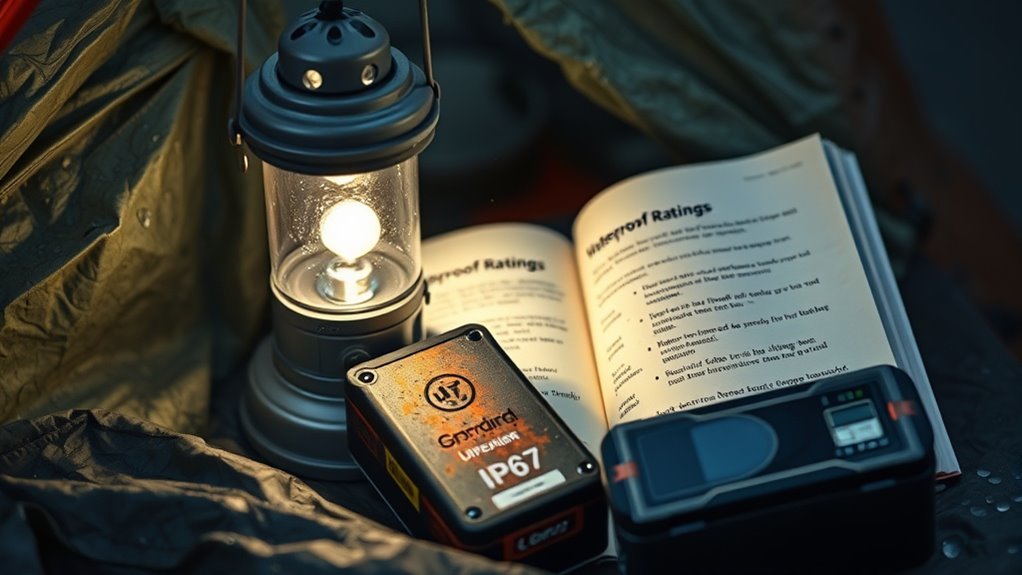
An IP67 battery offers dust-tight security and can survive a brief, shallow dunk. This common rating uses an international code where “6” means complete dust protection and “7” means it can withstand immersion in one meter of water for 30 minutes. That’s perfect for a rain-soaked campsite or an accidental drop in a puddle. For more demanding conditions, we can look for an IP68 rating, which often signifies it can handle deeper or longer submersion. We should also note ratings like IPX5, which protects against water jets but doesn’t specify dust resistance. Checking this simple two-digit code is our quickest way to gauge a battery’s ruggedness for our outdoor adventures.
Expanding Through Parallel Connection
If we need more power for our campsite without changing our gear’s voltage, we can add batteries in parallel. This connects all positive terminals and all negatives together. Doing this increases the total capacity, or amp-hours, while keeping the voltage the same. For instance, linking two identical 10Ah batteries gives us a 20Ah bank that still works with our standard 12V equipment, greatly extending runtime. However, it’s vital all batteries share the same nominal voltage and have a similar charge level before connecting them. Mismatches can cause harmful internal currents. When set up correctly, parallel connection is a straightforward way to scale our power for longer trips without replacing our existing devices.
Discharge And Charge Rates
Moving from configuring multiple batteries, we also need to ponder how much power a battery can deliver and accept. The continuous discharge rate, like 10A, shows the steady power it can supply without risk. For surges, like starting a small fridge compressor, we look at the peak discharge rating, such as 20A for a few seconds. Equally important is the maximum charge current, say 5A, which dictates how fast we can safely recharge from a solar panel or outlet. A good Battery Management System actively manages these limits for protection. Fast-charging tech, including USB-C Power Delivery, lets some power banks refill phones—and themselves—much quicker, keeping us powered up efficiently.
Specific Camping Applications
Choosing waterproof lithium batteries for camping requires balancing power needs with the elements. We need reliable energy for essential communication devices, like a GPS or radio, throughout our off-grid trips. These batteries must withstand persistent rain or high humidity without any performance drop. Their capacity should be sufficient to power our portable camp lights, small fans, or a charging station for phones and headlamps. We also look for a long cycle life, as we’ll drain and recharge them frequently over many seasons. Finally, compatibility with portable solar panels is key for sustainable recharging in remote locations, ensuring our power supply remains continuous without relying on grid access.
Mounting And Installation Flexibility
After securing reliable power for our devices, we also need to deliberate where to physically place a waterproof battery in camp. We’ll benefit from batteries featuring standard ¼-20″ tripod mounts, which let us easily attach them to our tents, gear racks, or vehicle interiors. This secure mounting prevents damage from movement and frees up valuable space inside our shelters. Many enclosures also include universal brackets or slots for various aftermarket holders, granting us flexibility. We can elevate the battery to protect it further from ground moisture. Ideal positioning, made easy by these options, allows us to shorten wiring runs, improving overall efficiency for our connected devices. A well-mounted battery stays safer and performs better.
Frequently Asked Questions
Can I Use Them in Saltwater?
Yes, you can use them in saltwater if they’re rated for full submersion. We’d just advise you rinse them thoroughly with fresh water afterward to prevent any long-term corrosion from the salt.
How Long Do They Last in Freezing Temperatures?
We’ll explain how they last in the cold. Yes, their output drops, but we build them to keep powering through for their rated cycles even in freezing temperatures without failing.
Are They Safe on Airplanes?
Yes, we can carry them on planes, but we must follow airline rules. We keep them in our carry-on luggage, check their watt-hour ratings, and verify their terminals are protected from short circuits.
What Happens if the Case Cracks?
If their case cracks, we expose the battery’s interior to moisture, which can cause a short circuit, swelling, or even a thermal runaway, so we must handle any damaged battery with extreme caution and dispose of it properly.
How Are They Disposed of or Recycled?
We carefully recycle our spent batteries because they contain valuable materials. You should never just throw them away; you’ll want to take them to a dedicated collection point for proper and safe disposal.
Conclusion
We’ve seen batteries offering over 5000 cycles, a staggering lifespan. That’s over 13 years of daily use before a significant drop in capacity. This durability guarantees your investment powers countless adventures. Now, equipped with our comparison, you can confidently select a rugged, waterproof battery that matches your needs and thirst for the outdoors.