We often wonder if our choice of battery truly unleashes an RC car’s full potential. The right LiPo can deliver that blistering acceleration and sustained top speed we crave. To find the packs that let our models blaze, we need to evaluate voltage, discharge rate, and physical specs. Let’s examine some top contenders and the key factors that separate a good battery from a great one.
Key Takeaways
- Choose high C-rating batteries like 80C for maximum power and minimal voltage sag.
- Match the battery’s voltage (e.g., 11.1V 3S) precisely to your RC car’s specifications.
- Ensure robust connectors like EC5 or XT60 to handle high-power system demands.
- High-capacity batteries (e.g., 5200mAh) provide extended, high-performance runtimes.
- Prioritize hard-case batteries with safety protections for demanding use.
2PCS 7.4V 1500mAh Lithium Battery for RC Cars
These batteries are a perfect choice for drivers whose RC cars use a DE43, DE60, or 1575 series model, as they’re designed as direct replacements with the correct SM-3P plug. We get two 7.4V LiPo packs rated at 1500mAh each, providing solid runtime and performance for our vehicles. Their compact size guarantees a secure fit, and the integrated USB charging cable simplifies powering up. A built-in protection circuit gives us peace of mind during use and charging. This two-pack offers excellent value, letting us keep one battery ready while the other’s in action.
Best For: RC enthusiasts with DE43, DE60, or 1575 series model vehicles needing direct replacement batteries with an SM-3P plug.
Pros:
- Includes two compatible batteries with correct plug for extended runtime.
- Integrated USB charging cable simplifies the recharge process.
- Built-in protection circuit enhances safety during use and charging.
Cons:
- Limited compatibility to specific RC car models (DE43, DE60, 1575).
- No dedicated charger included; relies on USB power source.
- Capacity (1500mAh) may not be sufficient for extended high-performance sessions.
Zeee 5200mAh 80C Lipo Battery 2-Pack (EC5 Connector)
Zeee’s 5200mAh 80C 2-pack offers high capacity and power, ideal for demanding 1/8 and 1/10 scale RC cars. Each 3S, 11.1V hard case battery provides a massive 5200mAh capacity paired with an 80C discharge rate. This translates to longer, more intense runs for your vehicles. We must use a LiPo-specific balance charger and never exceed a 1C charge rate for safety. The included EC5 connectors offer a reliable connection. Always read the safety manual, charge responsibly, and remember the seller provides support within 24 hours for any issues.
Best For: demanding 1/8 and 1/10 scale RC car, truck, and racing model enthusiasts who need high-capacity, high-discharge batteries for longer, more powerful runs.
Pros:
- High-capacity 5200mAh with very high 80C discharge rate for intense performance.
- Includes two hard-case batteries for durability and a pair of reliable EC5 connectors.
- Suitable for a wide range of RC applications including cars, boats, drones, and airplanes.
Cons:
- Requires careful handling and a specific LiPo balance charger, adding complexity for beginners.
- Charging is slow (1C max rate) and must never be unattended for safety.
- The weight (approx. 370g per battery) may be excessive for some ultra-lightweight models.
7.4V 2S 1200mAh Lipo Battery for RC Cars and Drones
This 7.4V 1200mAh 2S LiPo excels for RC hobbyists needing long runtimes, especially with UDIRC and WLtoys models. Its compact 66x29x15mm size fits most small-scale vehicles. With a 30C continuous and 60C burst discharge, it delivers robust power for peak performance. The included two batteries, USB charger, and storage box let us run multiple sessions easily. Its 500-cycle life offers great value, and we appreciate the one-year warranty for peace of mind. It’s a reliable, plug-and-play power source that keeps our favorite models running longer.
Best For: RC hobbyists with small-scale vehicles like UDIRC and WLtoys models who need a compact, high-output battery for extended runtimes.
Pros:
- Delivers robust power with a high 30C continuous/60C burst discharge rate.
- Offers great value with a long 500-cycle life and includes two batteries with a charger and storage box.
- Provides peace of mind with a one-year warranty and plug-and-play compatibility for many models.
Cons:
- Limited to applications requiring a specific JST plug and compact dimensions (66x29x15mm).
- May not be suitable for larger or higher-voltage RC models beyond its 7.4V 2S specification.
- Requires proper LiPo care and handling, which may be a consideration for novice users.
Zeee 3S Lipo Battery 2200mAh with XT60 Plug (2-Pack)
Perfect for RC hobbyists needing reliable power, this 3S Lipo battery pack offers a high 50C discharge rate for cars, trucks, and drones. Each pack includes two 11.1V, 2200mAh batteries with XT60 plugs. We always recommend using a balance charger at 1.1A-2.2A and never leaving them unattended during charging. Its compact size fits many models and it’s backed by a 12-month warranty. With a top-tier 4.6-star average from user reviews, we find it’s a standout value for its performance and support.
Best For: RC hobbyists with cars, trucks, boats, drones, and other vehicles requiring compact 11.1V power with XT60 connectors.
Pros:
- Includes two high-performance batteries with a high 50C discharge rate.
- Comes with a 12-month warranty and highly-rated customer support.
- Compact dimensions fit many models and user reviews indicate high satisfaction.
Cons:
- Requires a specific LiPo balance charger and careful charging protocol.
- Must be used only with models matching its exact voltage and connector specifications.
- Charging is time-sensitive and cannot be left unattended.
Hosim 7.4V Lipo Battery for 1/10 RC Cars
Racing enthusiasts seeking high performance for 1/10 scale models should consider Hosim’s 7.4V Lipo. Its 2600mAh capacity gives us extended runtime, while the compact 148g design fits seamlessly into vehicles like the Hosim X08. We find it’s crafted from durable materials and rigorously tested for tough conditions, ensuring it withstands our high-speed demands. Built-in protections against overcharge and short circuits provide a reliable, safe power source. This battery’s compatibility with various 1/10 cars, trucks, and boats makes it a versatile choice for pushing our RC hobby to its limits without frequent recharging.
Best For: Racing enthusiasts who want extended runtime and high performance in 1/10 scale RC cars, trucks, and boats.
Pros:
- High 2600mAh capacity provides extended operational time.
- Compact, lightweight design with built-in safety protections for reliability.
- Broad compatibility with various 1/10 scale vehicles and durable construction.
Cons:
- Limited to models that accommodate its specific dimensions (105mm x 42mm x 30.5mm).
- Not specified if it includes a balance connector for charging.
- May be less suitable for very large or power-hungry applications beyond its 25C rating.
Factors to Consider When Choosing Lithium Polymer Batteries for RC Cars
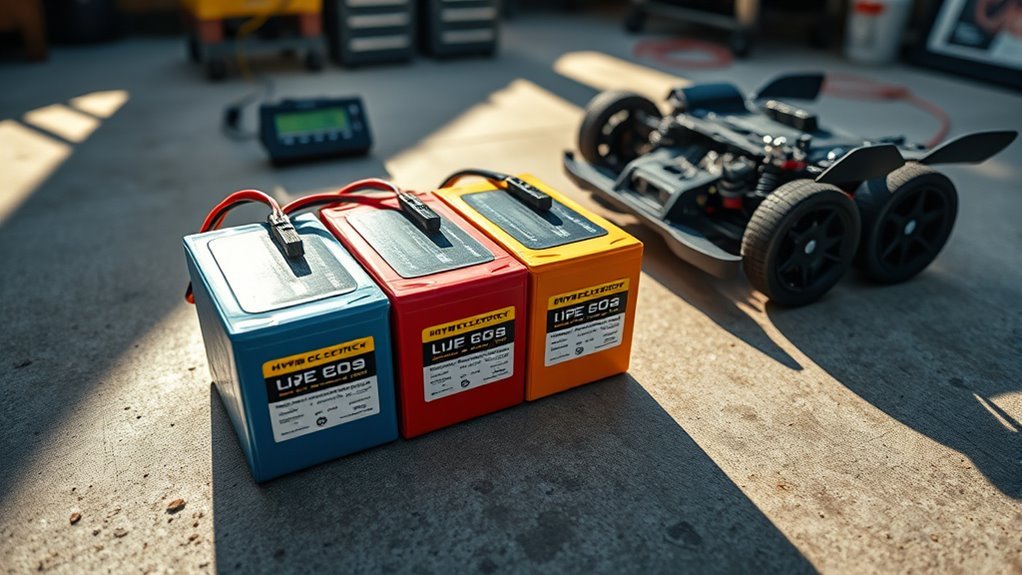
We need to pick a LiPo battery that works with our car’s electronics. We’ll look at voltage, physical size, capacity, discharge rate, and connector type. Each factor directly impacts our RC car’s performance and safety.
Voltage And Compatibility
Selecting the right LiPo battery begins by matching its voltage to your car’s ESC and motor, with common packs like 7.4V (2S) or 11.1V (3S). We must check our ESC’s specifications to confirm the supported cell count, as this directly determines our car’s speed and power. Using a higher-voltage pack than recommended can instantly fry our electronics. Conversely, a lower-voltage battery will starve the motor of power. We also need to match the physical connector type, such as an XT60 or EC5, on the battery to our car’s wiring harness. An incompatible plug stops us from connecting it at all, so we’ll need an adapter or to solder on a new connector.
Physical Size Constraints
Even if a battery’s voltage matches perfectly, we can’t use it if it doesn’t physically fit in our car. We must check its exact length, width, and thickness against our chassis’s compartment. Scale matters; a tiny 1/18 car might need a pack under 70mm, while a 1/10 buggy often requires over 100mm. The battery’s profile is also vital. A hard-case offers protection but needs precise space, whereas a soft-pack can sometimes squeeze into tighter, odd-shaped spots. Don’t forget weight, as a heavier pack shifts the center of gravity and can hinder handling. Finally, we need to guarantee the connector and its cable placement won’t get pinched or strain the layout when we close the lid.
Battery Capacity Needs
Capacity hinges on the milliampere-hour (mAh) rating, which sets our potential run time. We need to match our motor’s power draw and our typical driving style. A high-capacity pack gives us longer sessions but also adds weight and size, which can upset a car’s balance. We must find a balance between our desire for more runtime and the physical limits of our chassis. Choosing a capacity that’s too low means frustratingly short runs and can overwork the battery. Conversely, a massive battery might simply not fit in our model or could make it handle poorly. It’s about fitting the most energy we can within our car’s practical weight and space constraints.
Discharge Rate Selection
Moving beyond capacity, we also need to make certain our battery can supply enough power for our setup, which is where the discharge rate or C-rating comes in. This rating tells us the maximum safe continuous current it can deliver. We calculate this by multiplying the C number by the battery’s capacity. Choosing a rating substantially higher than our motor and ESC require gives us headroom for efficient power delivery and helps the battery run cooler, extending its life. An insufficient rate causes overheating, voltage sag, and can lead to permanent damage. For high-performance racing, we’ll typically need a high discharge rate, like 50C or more, to handle those intense power bursts.
Connector Type Matching
Once we’ve matched the discharge rate, we still need to plug the battery in, so its connector type must physically and electrically match our vehicle’s power port. The plug’s shape, like an EC5 or XT60, has to align precisely. Incompatibility forces us to cut and solder a new connector, which is an intermediate skill. Using an adapter can introduce resistance and voltage drop, sapping performance and creating heat. Each connector type, from JST to Tamiya, has a specific maximum current rating. We must verify our high-power system uses a robust plug like an EC5 to handle the load safely. Getting this match right avoids frustration and keeps our setup running at its best.
Safety Features Importance
Ultimately, the single most critical aspect to weigh is safety. While many modern LiPo packs include built-in protection circuits against overcharge or short circuits, we can’t rely on them as foolproof. Physical safety is paramount; a hard-cased battery offers essential armor against punctures that could cause thermal runaway. We must also adhere to strict operational guidelines. This means never leaving a charging battery unattended, as the fire risk is real. Always using a compatible LiPo balance charger is non-negotiable to keep each cell within its safe 3.2V to III-IV.2V range. Following the recommended charge rate, typically 0.5C to 1C, prevents internal damage and extends the pack’s life, making safety a foundational part of performance.
Charging System Requirements
Safety features extend into our charging setup, requiring a specialized lithium polymer balance charger. This device connects to the battery’s balance port and individually charges each cell to a precise 4.2 volts. We must choose a charger designed for our specific pack configuration, like 2S or 3S, and never exceed a 1C charge rate—that’s 2.2 amps for a 2200mAh pack. We also monitor ambient temperature, keeping it between about 41°F and 95°F. Most critically, we never leave a charging battery unattended due to fire risk. Following these protocols guarantees we safely reach the maximum performance our RC cars need.
Frequently Asked Questions
Can I Leave My Lipo Fully Charged?
No, we shouldn’t leave our LiPos fully charged for long. Let’s store them at a “storage voltage” around 3.8V per cell. Storing them fully charged degrades their performance and lifespan considerably over time.
Can You Ship Batteries Internationally?
We can’t ship internationally due to strict rules. Batteries are hazardous goods, and we follow carrier regulations that often prohibit airmail. Please check local sellers in your country for those specific batteries instead.
Are These Batteries Safe for Beginners?
We’d recommend lower discharge ‘C’ ratings for beginners. Always use a proper charger and storage bag. We don’t recommend rushing straight into high-performance packs as they require more care and knowledge to use safely.
Is There a Warranty for These Batteries?
Yes, most do offer warranties. We’d check the manufacturer’s policy directly though, as they often cover defects for a limited time. Remember, we can’t claim warranty for physical damage from crashes or improper use.
Can I Use a Different Connector?
Well, it’s best not to change horses midstream. You can modify connectors, but we’d recommend soldering the same type to avoid damaging your car’s ESC. Always confirm your tools match the battery specs.
Conclusion
So, there you have our fantastic five! For ferocious, fun-filled RC runs, finding the right battery is fundamental. It fuels the frenzy and fights frustrating fade. Always balance-charge your packs, pair them with your power needs, and prioritize protected, potent performers. Now go grab some great gear and get going! Your car is calling for that commanding, crazy-quick charge.