Consider a remote telemetry station that swapped a lead-acid bank for lithium and cut daily weight and maintenance by half. We compare energy density, cycle life, and cost of ownership to decide which chemistry fits long-term budgets and reliability. We’ll outline the tradeoffs in charging behavior, temperature sensitivity, and system integration, then provide a practical framework to guide your choice. Stay with us as we quantify performance windows that matter for your application.
Key Takeaways
- Lithium batteries offer higher energy density and longer cycle life, enabling lighter systems and longer runtimes than lead-acid equivalents.
- Lead-acid batteries are cheaper upfront and have simpler charging profiles, suiting budget-conscious, stationary applications.
- Temperature sensitivity and the need for thermal management are more pronounced with lithium, affecting performance and longevity.
- Total cost of ownership favors lithium when weight, space, and replacement frequency matter; lead-acid can win on initial cost and simplicity.
- System integration differs: lithium requires advanced BMS and safety controls, while lead-acid benefits from mature, straightforward charging and conditioning.
Lithium vs Lead-Acid: Which Fits Your Need (Fast Guide)
Lithium battery technology and lead-acid chemistry each offer distinct advantages, so choosing the right option hinges on concrete performance metrics and use-case constraints. We compare energy density, cycle life, cost of ownership, and maintenance load to guide selection. For high-energy-demand profiles, lithium durability translates to extended runtime per cycle and lower mass, improving system efficiency. In scenarios prioritizing stability and low upfront risk, lead acid reliability shines with simple conditioning, robust tolerance to abuse, and well-understood charging profiles. Temperature sensitivity, charging cadence, and depth of discharge directly affect longevity and total cost. We quantify trade-offs using specific energy, cycle life ranges, and replacement intervals, then map them to application requirements. Our data-driven assessment favors lithium where weight and longevity matter most, while lead acid remains viable for budget-constrained, stationary roaster-duty use cases.
How Lithium and Lead-Acid Batteries Work
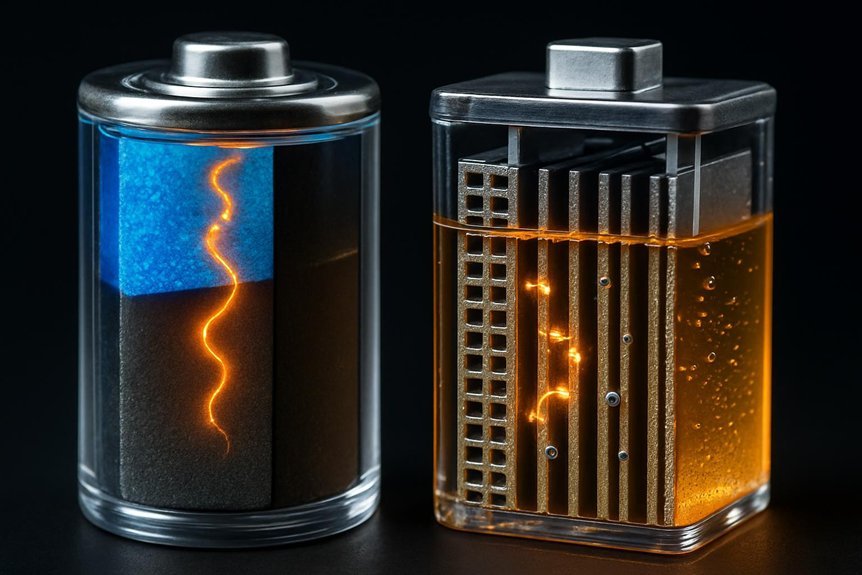
We’ll compare how Lithium chemistries store and release ions, versus how Lead-Acid discharges through a chemical reaction at the electrodes. We’ll quantify energy density differences and efficiency, and link these to performance under typical load profiles. This sets the stage to assess how chemistry drives charging, longevity, and practical use.
How Lithium Chemistry Works
How does lithium chemistry power a battery, and why does it differ from lead-acid chemistry? We describe, with precise metrics, how lithium ions shuttle between electrodes during charge and discharge, delivering higher energy density and tighter voltage profiles. In contrast, lead-acid chemistry relies on lead dioxide and sponge lead with sulfuric acid, yielding slower kinetics and lower specific energy. Our focus is on fundamental mechanisms that enable superior battery capacity and cycle life in lithium systems. The data show higher gravimetric and volumetric energy density, lower self-discharge, and favorable rate capability. Table below summarizes core parameters driving performance.
| Parameter | Lithium cells | Lead-acid cells |
|---|---|---|
| Voltage window | Narrower, stable | Wider, limited |
| Ion transport | Fast Li+ diffusion | Slower Pb2+/Pb pathways |
| Battery capacity drivers | Active material density, SEI stability | Electrode porosity, electrolyte sulfation |
Lead-Acid Discharge Process
As lithium systems push ions through a solid-electrolyte interface with fast kinetics, lead-acid discharge follows a distinct path driven by the PbO2/PbSO4 chemistry and sulfuric acid electrolyte. We examine discharge mechanisms through controlled redox reactions at the positive and negative plates, where PbO2 converts to PbSO4 and PbH2SO4 forms during charge and recombines on discharge. The sulfate electrolyte governs ion transport and pH stability, influencing diffusion layers and internal resistance. During discharge, current flows as electrons move through the external circuit while ions shuttle to restore charge balance, producing a measurable voltage drop. We quantify capacity loss via diffusion limitations, lead sulfate precipitation, and electrolyte depletion, all tied to electrolyte chemistry. This data-driven view highlights process pathways without extrapolating beyond the lead-acid system.
Energy Density Differences
Lithium and lead-acid batteries differ fundamentally in energy density because their chemistries store and deliver energy through distinct electrode reactions and packing efficiencies. We compare gravimetric and volumetric metrics to reveal why lithium cells offer higher energy per kilogram and per liter under similar operating constraints. Lithium chemistry enables higher operating voltages and lower internal resistance, boosting specific energy and usable capacity across C-rates; however, cycle life and thermal behavior offset some gains. Lead-acid systems trade energy density for ruggedness and cost, with heavier grids and separators reducing packing efficiency. Practical assessments must include disassembly techniques to evaluate material recovery pathways. Recycling implications hinge on electrode composition and electrolyte handling, influencing contaminant control and recovery yields, which in turn shape overall lifecycle energy efficiency and environmental impact.
Charging Fundamentals: Lithium vs Lead-Acid

We start by comparing charging voltage targets and how lithium and lead-acid chemistries differ in their acceptance windows, with lithium typically using higher, cells-specific voltages. We then examine how charge rate impacts efficiency, heat generation, and cycle life across chemistries, noting that lithium-ion often tolerates higher C-rates than lead-acid. Finally, we assess temperature effects during charging, highlighting that both systems are temperature-sensitive but lithium-ion safety and performance hinge more on precise thermal management.
Charging Voltage Differences
How do charging voltage profiles differ between lithium-ion and lead-acid batteries, and why does that matter for performance and safety? We quantify voltage envelopes, charge termination, and top-off behavior to show how each chemistry impacts longevity and risk. Lithium-ion cells require higher, tightly controlled charging voltages with narrow tolerances, and monitoring for voltage drift protects electrolyte stability. Lead-acid systems tolerate broader ranges but suffer from sulfation if undercharged. Below is a concise portrait.
| Battery Type | Typical Charging Voltage Range |
|---|---|
| Lithium-ion | 4.2 V per cell max; precise termination needed |
| Lead-acid | 2.4–2.45 V per cell (float/top-off) |
| Implications | Notes |
| Charging cycles | Lithium favors precise CV termination; lead-acid benefits from proper absorption. |
| Electrolyte stability | Lithium requires temperature-aware control; lead-acid risks gas evolution if overcharged. |
Charge Rate Impacts
Charge rate shapes how quickly each chemistry reaches full charge and how long it sustains safe operation. We compare lithium-ion and lead-acid by examining C-rates, charging efficiency, and voltage tapering. Lithium systems typically tolerate higher C-rates with moderate losses in charging efficiency at extreme rates, while lead-acid performance degrades more noticeably as C-rate increases. In lithium chemistries, higher rates are limited by electrolyte stability and practical impedance growth, which constrain usable power without overheating. Lead-acid cells exhibit greater internal resistance and potential sulfation risks at fast charging, reducing efficiency and capacity over cycles. Across both chemistries, optimal charge rates balance speed against thermal and chemical stress, preserving cycle life. Understanding electrolyte stability and efficiency curves informs safe, targeted charging strategies for each battery type.
Temperature Effects During Charging
Charging temperature behavior hinges on how each chemistry manages heat and chemical stability. We observe that lithium systems tolerate higher charging temps poorly, risking thermal runaway if not controlled, while lead-acid cells tolerate broader ambient ranges but exhibit faster voltage drift with temperature. During charging, internal resistance and reaction kinetics cause heat generation, which can accelerate degradation in Li-ion packs and reduce cycle life otherwise. We quantify temperature effects with data on charging efficiency, state-of-charge targets, and thermal management effectiveness. Our comparison shows Li-ion requires active cooling and precise BMS thresholds, whereas lead-acid benefits from simpler cooling regimes but needs regular electrolyte maintenance. For project planning, consider cost baseline and risk assessment to balance safety, reliability, and lifecycle costs.
Energy Density and Efficiency: Lithium vs Lead-Acid
Lithium batteries offer markedly higher energy density and better cycle efficiency than lead-acid cells, which translates to more usable capacity per unit weight and longer service life in comparable applications. We quantify energy density in Wh/kg; lithium chemistries routinely surpass 150–200 Wh/kg, while lead-acid typically achieves 30–50 Wh/kg. This gap yields lighter packs for equivalent runtime and mass-critical deployments. Efficiency improvements arise from lower internal resistance and smoother state-of-charge behavior, translating to higher round-trip efficiency and reduced energy losses. We evaluate cycle life by capacity retention over thousands of cycles; lithium variants often exceed several thousand cycles with moderate degradation, unlike lead-acid’s more pronounced capacity fade. Thermal management remains essential, yet lithium systems enable tighter packing and more predictable performance when properly engineered and monitored.
Temperature Effects on Charging, Discharging, and Longevity
Temperature extremes directly shape how we charge, discharge, and extend battery life. We examine how temperature affects lithium and lead‑acid chemistries with concrete data: higher temperatures accelerate self-discharge and electrolyte degradation, while low temperatures raise internal resistance and reduce available capacity. Temperature sensitivity differs by chemistry; lithium systems typically exhibit more pronounced performance shifts at extremes, impacting both charging efficiency and foldback protections. We emphasize charging safety: overheat risks trigger thermal runaway in lithium cells, necessitating thermal management and strict current limits. Discharging efficiency also declines with heat, and cold environments reduce effective capacity in both chemistries. For longevity, we align operating ranges with manufacturer specs, monitor cell temperatures during cycles, and design cooling or heating strategies to minimize excursions.
Life Span and Durability: How Many Cycles Do You Get?
How many cycles can we realistically expect from these chemistries, and what governs their durability in real-world use? We compare Lithium and Lead Acid by cycle life, depth of discharge, and temperature sensitivity to quantify durability metrics. Lithium chemistries typically offer higher cycle counts and steadier capacity retention, while lead acid degrades faster under deep discharge. Our lifecycle comparisons show a 2–3x cycle advantage for lithium under similar DoD and C-rate conditions, though initial cost, thermal management, and charging strategies influence real-world results.
| Chemistry | Typical cycle range | Notable failure mode |
|---|---|---|
| Lithium (Li-ion) | 500–2000+ | Capacity fade, SEI/thermal events |
| Lead Acid | 200–800 | Grid sulfation, plate corrosion |
| DoD optimization | Moderate to deep | Efficiency loss over cycles |
Total Cost of Ownership: Upfront, Maintenance, and Replacements
Total cost of ownership (TCO) combines upfront price, operating expenses, and replacement timing to reveal real-world financial impact. We compare lithium vs lead acid by accounting for initial purchase, voltage efficiency, and capacity depreciation under typical cycle counts. Upfront costs favor lead acid in many grids, but lithium’s higher energy density and faster charging reduce total installed capacity needs and downtime. Maintenance varies: lead acid requires regular watering and equalization, while lithium demands monitoring of internal protection and thermal management. Replacement timing hinges on cycle life, temperature, and depth of discharge. Ongoing expenses include disposal regulations and recycling streams—critical for end-of-life handling. Comprehensive TCO models show lithium often lowers lifetime costs despite higher upfront caps, once maintenance, replacement, and regulatory costs are factored in.
Safety, Reliability, and Storage Best Practices
Are safety, reliability, and storage practices the linchpins of dependable lithium battery systems? We analyze failure modes, fault tolerances, and monitoring signals to quantify risk. Our data show that proper cell balancing, overcharge protection, and thermal management reduce thermal runaway probability by an order of magnitude in typical modules. We outline closed-loop safety architectures, including fault isolation, redundant sensing, and rapid isolation during abnormal temperatures or voltages. For storage reliability, we emphasize state-of-charge targets, ambient controls, and periodic conditioning to minimize calendar aging. We recommend standardized procedures for pre-storage discharge, moisture control, and packaging integrity checks. By adopting these guidelines, organizations improve battery safety, prolong useful life, and maintain predictable performance across cycles and environmental variations.
Use-Case Fits: Which Battery Works for Your Gadget, Vehicle, or Home System?
We compare use-case fits across devices, from tiny wearables to full home systems, by examining performance scales, safety margins, and longevity implications. Our data show how power density, cycle life, and charging behavior influence suitability for each level of application. We’ll discuss how these factors shape reliability, maintenance needs, and total cost of ownership for your specific gadget, vehicle, or home setup.
Use-Case Fit: Devices
Which battery fits your device best hinges on power needs, weight, durability, and cost. We evaluate device classes to guide choices: small electronics favor lithium for high energy density and light form factors, while lead acid suits budget, simplicity, and high-current bursts in stationary setups. For portable gadgets, life-cycle costs and depth of discharge drive selection, with two word discussion ideas like density vs durability steering relevance. In vehicles, we compare cranking amps, thermal tolerance, and serviceability; lithium often wins on range and weight, lead acid on upfront cost and robustness. Home systems prioritize reliability and scalability, where modular lead acid banks may offer lower replacement risk, but lithium enables longer intervals and advanced monitoring. Overall subtopic relevance centers on maintenance, lifecycle economics, and integration with existing power architectures.
Performance Across Scales
Across devices, vehicles, and home systems, performance scales with energy density, thermal management, and lifecycle economics, which together determine fit. We compare battery chemistry realities and lifecycle benchmarks to forecast real-world behavior across scales.
- Energy density trends: lithium chemistries push higher specific energy, while lead acid remains limited, affecting size, weight, and range.
- Thermal handling: Fast charging and high-discharge regimes test cooling, impacting reliability and safety margins.
- Cycle life economics: cost per usable kilowatt-hour shifts with depth of discharge, charging rate, and degradation patterns.
- System integration: power electronics, temperature control, and modularity define maintenance needs and total cost of ownership.
Ultimately, match gadget needs to chemistry, leveraging lifecycle benchmarks for accurate performance predictions.
Safety and Longevity Considerations
Selecting the right battery hinges on safety profiles and longevity metrics across use-case fits; lithium chemistries routinely offer higher energy density and robust high-rate performance, yet require tighter thermal management and fault protection, while lead-acid delivers lower cost and proven reliability but shorter cycle life and heavier weight. We examine safety and longevity through fault protection, thermal margins, and cycle stability. Safety myths persist about universal superiority; actual risk depends on packaging, charging controls, and system isolation. We address isolation concerns by detailing separation strategies between cells, modules, and the host. Table below contrasts safety and longevity traits by chemistry.
| Trait | Lithium systems | Lead-acid systems |
|---|---|---|
| Thermal management | Essential | Minimalist |
Quick Decision Framework: Pick Lithium or Lead-Acid With Confidence
So how do we decide between lithium and lead-acid quickly and with confidence? We base it on objective metrics, not vibes, and we present a concise framework you can trust. Our decision hinges on efficiency, lifecycle cost, and system constraints, while ignoring irrelevant comparison and unrelated metrics that mislead.
- Performance window: operational temperature, charge/discharge rate, and depth of discharge.
- Total cost of ownership: upfront price, cycle life, replacement frequency, and maintenance needs.
- System integration: charger compatibility, BMS requirements, and safety controls.
- Risk/return: thermal stability, fault tolerance, warranty scope, and expected downtime.
This framework emphasizes data-driven tradeoffs, enabling rapid, confident picks aligned with your use case.
Frequently Asked Questions
How Do Lithium and Lead-Acid Batteries Affect Recycling Impact?
We see lithium batteries typically offer lower recycling impact per kWh but demand specialized processing, while lead-acid is highly mature with established recycling streams; both affect system integration differently, yet optimized flows reduce overall environmental impact and resource losses.
Can Mixed Chemistries Be Safely Used in One System?
We don’t recommend mixed chemistries in one system due to safety and regulatory compliance concerns; however, if unavoidable, we assess compatibility, monitor isolation, and guarantee proper garbage disposal and disposal risk controls with thorough data-driven documentation.
Do Cycle Counts Reflect Real-World Performance Accurately?
Yes, do cycle counts reflect real-world performance? They provide useful baselines but often diverge from field results due to temperature, DoD, and usage patterns; we compare lab data to real world datasets to gauge accuracy.
Are There Hidden Costs Beyond Purchase and Replacement?
Hidden costs exist beyond purchase and replacement, including supply chain volatility, disposal, and compliance. We quantify impacts with lifecycle cost models, risk assessments, and continuous monitoring to minimize total cost and optimize procurement strategies for durable performance.
What Warranties Typically Cover Lithium Vs Lead-Acid Packs?
We typically see broader warranty coverage on lithium packs, with longer cycle-life guarantees, while lead-acid warranties emphasize static capacity retention. Warranty coverage comparison includes failure modes analysis, and we’ll quantify exclusions, repairs, and replacements for both technologies.
Conclusion
We’ve seen that lithium batteries deliver higher energy density, lighter weight, and longer cycle life, while lead-acid remains cost-effective and robust for simple, stationary setups. An interesting stat: lithium chemistries can offer 2–3x longer cycle life than typical lead-acid under similar DoD and temperature conditions. In practice, your choice hinges on use-case metrics—DoD, charging cadence, and total cost of ownership. We’ll help you map specs to your system and choose confidently.