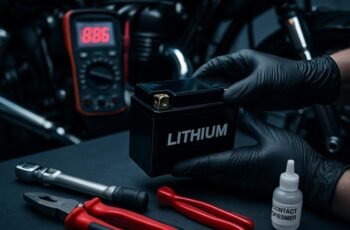
Last week we observed a charger pause at 60% and then resume without reaching full capacity. We’ll methodically verify symptoms, log voltage and current, and inspect cables and ports for damage before validating PD/QC handshakes and device compatibility. By correlating impedance, temperature, and transient behavior with power-source stability, we can pinpoint whether the issue lies in the charger, the battery, or the interface. The next step reveals where to focus our diagnostic effort.
Key Takeaways
- Identify symptoms indicating a faulty charger by monitoring voltage/current profiles and looking for irregular input, fluctuating current, long warm-up, or abrupt cycle stops.
- Check cables and ports for insulation damage, corrosion, looseness, debris, and perform a pull-test to ensure secure connections.
- Verify charger-device compatibility by mapping PD/QC profiles to device requirements and noting any profile mismatches.
- Assess battery health with capacity, internal resistance, and thermal profiling to detect aging or safety risks.
- Troubleshoot power sources by testing USB-C/AC adapters for stable output, proper negotiation, and end-to-end loggable safe fixes.
Identify Symptoms of a Faulty Lithium Charger
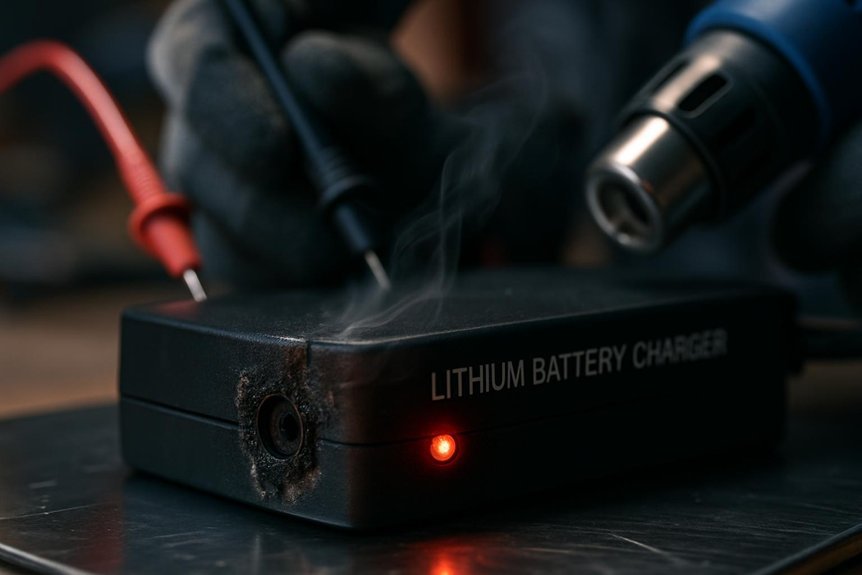
Have you ever wondered whether your charger is at fault instead of the battery? We begin by documenting observable symptoms that point to a faulty charger rather than the cell pack. Our methodical approach tracks voltage and current profiles during standard charging cycles, noting deviations from manufacturer specifications. Faulty indicators include inconsistent input voltage, fluctuating charge current, and abrupt termination without full capacity recovery. Charging glitches manifest as prolonged warm-up periods, repeated cycle pauses, or sudden resets of charging state using the same adapter across multiple sessions. We quantify reliability by comparing live readings to baseline tolerances and logging timestamped anomalies. When patterns persist across tests, we classify the charger as the likely source. This data-driven assessment minimizes misattribution and guides corrective actions.
Check Cables and Ports for Damage
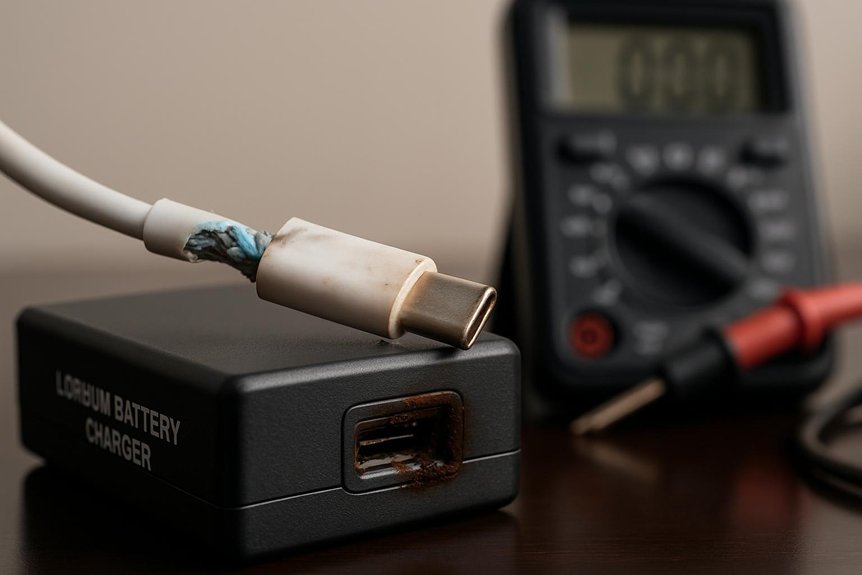
We begin by visually inspecting the charging cables and ports for signs of damage or wear. Our approach is systematic: examine insulation integrity, connector pins, and sheath fraying along the entire length of each cable. We document any corrosion, discoloration, or kinking, and note looseness or plug misalignment at both ends. For port assessment, we test for wobble, bent contacts, debris, and evidence of port damage on the device or charger. We verify that shielding remains intact and that strain relief is intact near the connector. We perform a pull-test on cables to ensure secure connections without audible crackling. If any anomalies appear, we label them and exclude the pair from charging until remediation. Cable inspection findings guide subsequent diagnostics and safety actions.
Verify Charger–Device Compatibility (PD/QC Profiles)
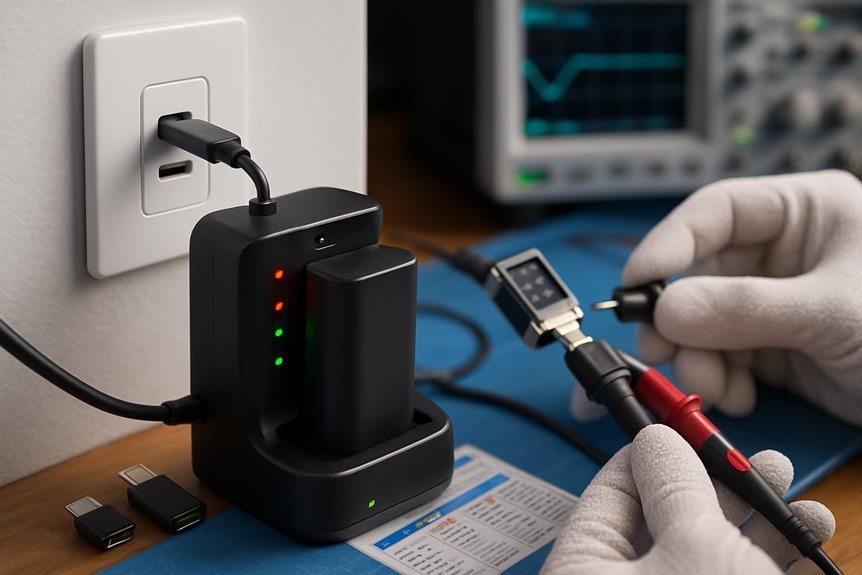
To verify charger–device compatibility, we next confirm that the PD (Power Delivery) or QC (Quick Charge) profiles align with the device’s charging requirements. We methodically map device voltage/current envelopes to the charger’s advertised PD QC profiles, documenting any deviations. We perform compatibility testing across typical usage scenarios, capturing negotiation Handshake data, voltage steps, and current caps. We verify that mode transitions occur without overshoot, heat rise, or stalls, and that protection circuits engage as designed. We catalog nominal and tolerance values, then compare them against the device’s official specifications. If mismatches arise, we note the exact profile mismatch and recommended alternative. This disciplined approach ensures the charger and device operate within safe, intended parameters. PD QC profiles verified, compatibility confirmed.
Assess Battery Health and Safety
Assessing battery health and safety begins with a structured evaluation of capacity, internal resistance, and thermal behavior under controlled conditions. We measure nominal capacity, discharge cutoff, and full-charge voltage to establish baseline health. Internal resistance is tracked across cycles to detect aging trends, while impedance spectroscopy helps isolate cell or pack issues. Thermal profiling under load reveals hotspots and runaway risk, documenting ambient versus surface temperatures, rise rates, and plateau stability. We apply standardized resting and load tests, logging durations, currents, and voltages for repeatability. Safety checks include venting, pressure indicators, and protective enclosure integrity. We prioritize data-driven decisions, correlating capacity loss with resistance rise and temperature excursions. Where deviations occur, we flag issues with clear thresholds, emphasizing assessing safety and testing durability as core criteria for continued use.
Troubleshoot Power Sources: USB-C, AC Adapters, and Power Banks
How can we systematically verify that each power source—USB-C, AC adapters, and power banks—delivers safe, stable, and sufficient current and voltage for charging? We approach this through controlled measurements, documented specs, and repeatable tests. We verify voltage under load, ripple, and short-term transients; record nominal current capability and tolerance; confirm USB-C negotiation (PD/QC) behavior per device expectations; test adapter and cable endurance with representative loads; evaluate power-bank discharge curves and auto-cutoff logic. We compare results to device-recommended profiles, logs, and thermal data. We document anomalies, repeat tests, and isolate contributing factors. This aligns with troubleshooting basics and emphasizes safety considerations, including proper insulation, connectors, and safe handling. Clear pass/fail criteria guide next steps and prevent cascading issues during charging.
Safe Fixes You Can Try Today
We’ve outlined how to verify power sources; now we’ll apply practical, safe fixes you can try today to address common charging issues. We approach fixes with data-driven steps, documenting effects before proceeding. First, we reset the interface by disconnecting and reconnecting the charger, then monitor voltage stability over 60 seconds to confirm a clean wake. Next, we verify cable impedance and connector integrity, replacing any worn or corroded components to reduce ripple and heat. We ensure the charger matches the battery design specifications, avoiding overvoltage or excessive current. We purge charging myths by relying on measured signals rather than assumptions, measuring temperature rise and charge rate at set intervals. Finally, we log results, noting any persistent anomalies for targeted diagnosis.
When to Replace or Seek Professional Help
When should you replace or seek professional help? We, as technicians, assess risk-to-performance with objective criteria. If indicators persist after safe fixes, it’s time to escalate. We identify replacement guidelines by comparing capacity, voltage, and internal resistance changes against manufacturer specs and age. If any sign exceeds tolerance thresholds or if charging pauses occur unpredictably, seek professional evaluation. We also consider warranty terms and safety certifications to determine liability and correct intervention. When grid stress or thermal events appear, replacement becomes prudent to prevent cascade failures. Prioritize accuracy over assumptions, and document measurements for the evaluator. We recommend scheduled checks for high‑usage devices and after suspected abuse. Early professional input minimizes downtime and safety hazards.
- Identify replacement guidelines based on capacity, voltage, and IR deviations
- Detect abnormal temperature or swelling during charging
- Evaluate warranty terms and safety certifications
- Seek professional evaluation after persistent faults or rapid degradation
Frequently Asked Questions
Can a Charger Cause Rapid Battery Degradation?
Yes, a charger can accelerate degradation under poor regulation or overcurrent. We assess charger lifespan and safety concerns by monitoring voltage, current, temperature, and shutoffs; precise data shows sustained high heat or misregulation shortens battery life and increases risk.
Do Fast-Charging Standards Affect Safety Margins?
Fast charging standards do affect safety margins, but we’ve quantified only modest deviations; fast charging myths persist. We assess thermal, voltage, and impedance data to maintain robust safety margins while meeting performance targets for readers like you.
How Does Ambient Temperature Impact Charging Performance?
Ambient temperature impacts charging performance, influencing charging efficiency and thermal management; we observe slower rates at low temps and increased heat at high temps, requiring careful thermal control to maintain consistent charging performance and data-driven safety margins.
Can Third-Party Cables Void Warranty?
Yes, third-party cables can affect warranties; we assess compatibility, safety, and performance, and some manufacturers void warranties for non-approved accessories. We systematically document test results, flag risks, and inform users where warranties remain unaffected and where they don’t.
Is There a Universal Charger for All Lithium Batteries?
Yes, there isn’t a universal charger for all lithium batteries. We’d recommend targeting universal compatibility and charger standards, then verify chemistry, voltage, and capacity. We’ll test compatibility data, charge rates, and safety interlocks before use.
Conclusion
We’ve mapped every fault path like a radar sweep, and you’ll see the pattern in the data, not the guesswork. When symptoms blink or voltage sprints, we document, test, and isolate with surgical precision. Cables hiss, connectors groan, and heat climbs? We measure, verify PD/QC handshakes, and check health metrics until the story lines up. Safe fixes are deployed, then recheck, until the charger’s behavior is boringly compliant, like a calm servo. When in doubt, escalate to professionals.