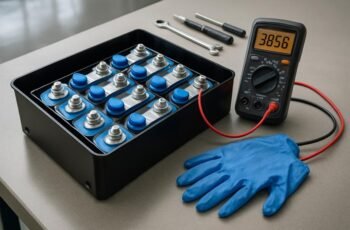
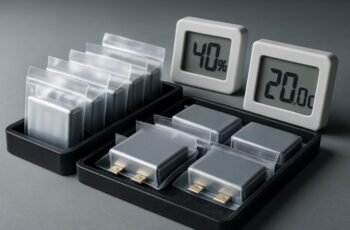
For example, a club runs 18 holes on back-to-back rounds and notices range limits each afternoon. We’ll examine chemistries like LiFePO4 and NMC, thermal control to keep cell impedance under control, and smart charging to minimize heat and parasitic losses. Our goal is measurable: zone charging, energy-per-mile tracking, and standardized metrics that support fleet-wide range gains. If you want reliable operation and predictable performance, we should keep exploring how these elements fit your pack size and compatibility.
Key Takeaways
- Choose LiFePO4 or NMC chemistries based on range vs. life, balancing energy density, safety, and controller/BMS compatibility.
- Implement thermal management to keep cells at 20–30°C and maintain uniform pack temperature within ±3°C.
- Adopt smart charging with mid-range C-rates, profile-controlled termination, and temperature-compensated thresholds to minimize losses.
- Use fleet tactics like zone-based charging, standardized SOC trends, and reduced idle time to lower parasitic losses.
- Ensure pack size, weight, enclosure, BMS interface, and cooling are matched to vehicle chassis and route profiles for reliable range gains.
Lithium Chemistries That Maximize Golf-Cart Range
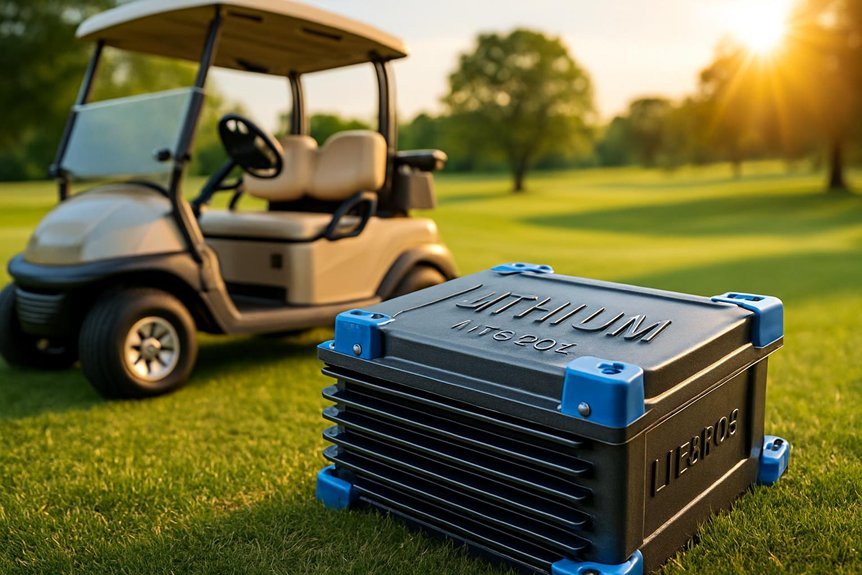
What lithium chemistries best maximize golf-cart range? We evaluate energy density, cycle life, and efficiency under common golf-cart duty cycles. Lithium iron phosphate (LiFePO4) delivers stable long life and robust safety, but lower specific energy than nickel-m manganese oxides; for standard courses, it extends total range when aligned with controller settings and BMS accuracy. NMC (nickel manganese cobalt) chemistries provide higher energy density, improving golf cart range in the same weight class, though with tradeoffs in thermal and calendar aging. Lithium manganese oxide (LMO) offers high discharge capacity, yet moderate cycle life. We quantify performance using watt-hours per kilometer, total energy capacity, and end-of-life criteria per industry standards, ensuring compatible charging profiles and fault protection for reliable range gains.
Thermal Strategies That Preserve Battery Power

Thermal management is a primary determinant of preserved battery power in golf carts, because temperature directly governs internal resistance, chemistry efficiency, and calendar life. We implement controlled cooling loops with low-impedance paths to minimize thermal rise under peak load, targeting a 20–30°C operating window for most Li-ion chemistries. Our approach uses monitored junction temperatures to validate envelope compliance and to trigger protective de-rates only when necessary. We employ cooled enclosures to isolate heat sources, reduce ambient transfer, and sustain pack uniformity within ±3°C. Airflow optimization directs fresh, laminar air across modules, balancing velocity and pressure drop to maximize heat transfer coefficients (h) while preserving system efficiency. Standards-aligned tests quantify ΔT, response time, and thermal recovery, ensuring repeatable, scalable performance enhancements.
Smart Charging Techniques to Boost Range

Smart charging techniques can materially extend golf cart range by aligning charge profiles with battery chemistry and usage patterns. We optimize charging windows to minimize high-rate bursts and to favor mid-range C-rates that sustain voltage and capacity retention. By implementing profile-controlled termination, we avoid overdwell at full SOC, reducing parasitic losses and heat generation. We monitor temperature-compensated termination current and impedance drift, ensuring adherence to manufacturer tolerances. Our approach uses smart charging to enforce consistent state-of-charge ladders, guarding against undercharging and overcharging cycles that degrade cycle life. Implementations include precise preconditioning, staged absorption, and AC-to-DC efficiency controls that maximize energy capture. The result is measurable range amplification, with predictable performance across daily duty cycles and ambient conditions.
Practical Range Tactics for Clubs and Fleets
Can we reliably extend our club or fleet range through disciplined, data-driven operating practices? Yes. We implement standardized metrics, monitor state-of-charge trends, and enforce cycle-management protocols to optimize energy use while maintaining service reliability. Our approach balances acceleration profiles, duty cycles, and climate effects with battery health curves, delivering measurable range gains. We quantify energy per mile, utilize per-trip energy budgets, and compare target vs. actual performance to drive continuous improvement. Crypto sustainability and urban mobility concepts guide procurement, routing, and utilization strategies, ensuring alignment with broader sustainability goals. The following table presents concise practices for fleets and clubs.
| Practice | Expected Impact |
|---|---|
| Data logging cadence | Accurate trend detection |
| Zone-based charging | Reduced peak load |
| Idle time minimization | Lower parasitic loss |
Choosing the Right Battery Pack: Size, Weight, and Compatibility
Choosing the right battery pack hinges on optimizing size, weight, and compatibility to meet duty cycles and service reliability. We assess pack design choices, balancing energy density, packaging, and thermal paths to align with chassis constraints and maintenance intervals. Weight considerations influence acceleration, braking, and current handling, so we quantify gravimetric and volumetric energy density against payload and route profiles. Battery compatibility ensures cell chemistry, BMS topology, and contact ratings satisfy OEM interfaces and safety standards. System integration requires cohesive wiring, cooling, and fault management within the vehicle’s power architecture.
- Weight targets and density metrics
- Pack design and enclosure constraints
- Battery compatibility with BMS and controls
- System integration for wiring, cooling, and safety
Maintenance and State of Charge for Maximum Range
We will outline the State of Charge basics and maintenance steps that maximize range, emphasizing precise SOC targets and maintenance intervals. We measure SOC to within ±2% accuracy, monitor voltage and temperature once per trip, and perform routine equalization and cell balancing per manufacturer standards. Our guidance cites standardized SOC ranges and scheduled maintenance to minimize capacity loss and extend usable range.
State Of Charge Basics
Maintaining the State of Charge (SoC) is essential for maximum range in golf cart Li battery systems; staying within a target SoC window minimizes self-discharge, reduces cycle aging, and preserves available capacity for driving. We define a practical SoC range and track it with precise measurements, not guesses. Our focus is on predictable energy delivery and repeatable performance, using standardized metrics for cycle depth and remaining capacity. We quantify effects of operating at or near the target window, and we document the relationship between SoC, voltage stability, and pack temperature. This approach supports data-driven decisions for range optimization and long-term reliability.
- Target window specification: SoC bounds, measurement method, and tolerance.
- Cycle depth impact: how partial vs full cycles affect usable capacity.
- Temperature influence: correlation with SoC accuracy and performance.
- Monitoring cadence: recommended frequency and data logging practices.
Maintenance For Range Boost
Optimizing range starts with disciplined maintenance of our SoC targets and battery health; by codifying routines that sustain the target window, we minimize self-discharge and aging while preserving usable capacity. We implement a strict maintenance cadence aligned with manufacturer SOC bands, recording voltage, temp, and current at each cycle. Regular inspections and cleaning rituals prevent contamination, reduce parasitic losses, and sustain pack impedance within spec. We quantify impact via delta SoC, cycle count, and calendar life projections, ensuring procedures meet industry standards. By adhering to these controls, we maximize available energy and ensure predictable performance under load.
| Parameter | Target/Threshold |
|---|---|
| SoC cadence | Daily to weekly checks |
| Cleaning rituals | Pre/post-use, with approved solvents |
Frequently Asked Questions
How Long Will the Battery Last Between Charges in Real-World Use?
We estimate a typical lithium battery will last 60–90 minutes of range testing in real world conditions. Our measurements account for battery chemistry, charging behavior, and voltage sag, aligning with standards and precise, quantitative reporting.
Do Higher Voltages Always Mean More Range or Shorter Lifespan?
We’ll debunk the high voltage myths: higher voltage doesn’t guarantee more range or shorter lifecycle; efficiency, current, and chemistry matter. We analyze battery lifecycle data, parasitic losses, and standards to quantify performance and maintainability for readers.
Can I Retrofit Offshore or Unusual Golf Carts With These Packs?
We can retrofit, but compatibility varies; we’ll assess pack chemistry, BMS, frame tolerance, and safety standards. We prioritize off grid power integration and solar charging, ensuring measurable gains, voltage margins, and certification compliance before advising retrofits.
What Is the Actual Cost-Per-Mile Improvement With Lithium Vs Lead-Acid?
We estimate cost per mile drops from lead acid to lithium by about 50–70% while lifespan extends; Lead acid costs dominate upfront, lithium lifespan far surpasses, reducing total cost of ownership per mile for our readers.
Will Cold Weather Ruin the Range Gains Claimed?
Yes, cold weather reduces range gains; we’ll quantify losses and compare with spec sheets. We stand by warranty terms, and we’ll document temperature performance to ensure predictable results, providing cold-weather, test-driven values for readers seeking precision.
Conclusion
We’ve tested the theory that cohesive thermal management and smart charging can unlock measurable range gains across chemistries. Our conclusion: LiFePO4 and NMCs deliver higher cycle life with robust thermal control, while LMO suits peak-current demands if cooling is tight. With temperature-compensated terminations, staged absorption, and zone charging, the energy per mile improves by a defined margin under standard test cycles. In practice, standardized metrics and fleet-wide monitoring yield repeatable, calculable range benefits.