We’re planning an RV lithium battery install with safety, standards, and verifiable performance at the core. We’ll cover cell chemistry choices, BMS capabilities, enclosure integrity, venting, thermal margins, short-circuit protection, and correctly sized fuses for compliant wiring. We’ll outline real-world runtimes, charging options, and thorough system testing to confirm temperature, voltage, and balance. This path demands careful labeling, secure mounting, isolation of AC circuits, and documented adherence—and there’s critical detail you’ll want before you proceed.
Key Takeaways
- Ensure a compliant enclosure with proper venting, thermal management, and isolation to minimize cross-load risks.
- Choose suitable battery chemistry, BMS, and fuse sizing aligned with safety standards and RV duty cycles.
- Verify charging architecture (alternator, solar, and charger) with seamless switchover and correct wiring.
- Conduct full-system testing for temperature, voltage, balance, and communication before discharge.
- Document specs, test results, wiring routes, and safety clearances; recheck after any reconfiguration.
RV-Specific Safety and Decision Criteria for Lithium Setups
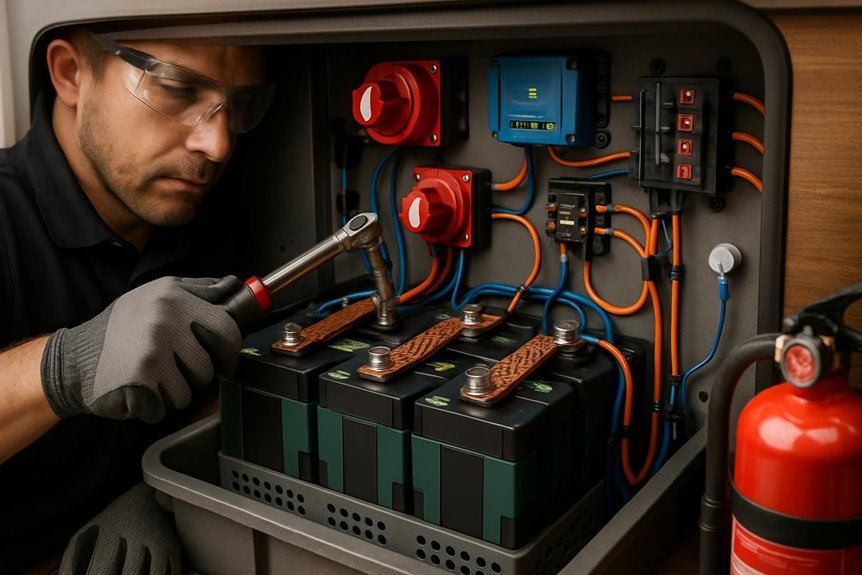
What safety criteria should guide our choice of lithium setups for RVs? We approach this with engineering rigor, detailing criteria that prevent hazards and maximize reliability. We assess cell chemistry, BMS capabilities, and pack enclosure integrity to meet recognized safety certifications. We verify thermal management design margins, venting adequacy, and short‑circuit protection, ensuring fault states remain contained. We demand documented conformance to industry standards, including UL or equivalent safety certifications, and repeatable test results for overcharge, thermal runaway resistance, and vibration endurance. We address RV-specific duty cycles, charging profiles, and isolation requirements to minimize cross‑load risks. Finally, we acknowledge RV battery myths and emphasize evidence-based conclusions, guiding readers toward compliant, verifiable implementations.
How to Choose the Right RV Lithium Battery

Choosing the right RV lithium battery starts with a clear specification of load, duty cycle, and safety margins. We assess peak draw, average consumption, and inverter efficiency to determine a nominal capacity that meets daily needs without oversizing. We prioritize cycle life, temperature tolerance, and charging behavior to align with our safety standards and industry guidelines. We verify battery chemistry compatibility with existing systems, including BMS protections, cell balancing, and thermal management. We consider RV maintenance implications, such as electrolyte stability, venting requirements, and fault indicators, ensuring serviceability and longevity. Generator compatibility matters for mixed power scenarios; we confirm seamless switchover, charger compatibility, and transfer logic. Our selection emphasizes reliability, safety, and documented performance within established electrical codes.
Size Your System for Boondocking Realities
Sizing your system for boondocking realities means translating daily energy needs into a practical, safe, and reliable battery and inverter setup. We approach this with precise load calculations, identifying essential versus optional loads, and selecting high-quality cells with robust BMS protection. We model runtime on typical off-grid days, account for inverter efficiency, depth-of-discharge limits, and temperature impacts to ensure battery longevity. Our framework prioritizes safety margins, proper venting (if applicable), and cascading fault detection to prevent thermal runaway. We design for roaming aesthetics by balancing capacity with comfort, ensuring responsive power during peak use without overtaxing pack health. Cargo optimization guides component placement, cable routing, and mounting to minimize vibrations. Informed sizing reduces replacement cycles while preserving performance, reliability, and user confidence.
Wiring, Fusing, and Safety Basics You Must Know
We’ll outline the wiring fundamentals, fusing essentials, and safety best practices that keep our RV lithium installs reliable and compliant. We’ll focus on correct gauge selection, proper fuse sizing, and clear fault-prevention steps that align with industry standards. Let’s proceed with precise, safety-minded guidance to ensure solid, code-conscious connections.
Wiring Fundamentals
In any RV lithium system, proper wiring, fusing, and safety practices are non-negotiable. We approach wiring fundamentals with precision, documenting conductor routes, insulation, and protection to minimize resistance and heat. Start with charging basics in mind: use appropriately rated cables for current loads, and maintain clean separation from high-draw AC circuits. We verify voltage drop over distance, selecting wire sizing that preserves voltage and reduces heat under worst-case conditions. Terminations receive tight, corrosion-resistant connections, with mechanically secure routing to survive vehicle motion. Fusing is placed close to the source, sized for anticipated maximum current, and protected from abrasion. We label harnesses for maintenance, ensure strain relief, and comply with applicable standards. Safety remains our priority whenever serviceable access or disconnections are required.
Fusing Essentials
Fusing is our first line of defense against wiring faults. We outline fusing basics to ensure protection aligns with system voltage, conductor size, and load. Proper fuse placement minimizes fault energy transfer and simplifies diagnostics. We select fuses based on continuous current, with headroom for startup surges, and we verify enclosure ratings, wire gauge, and adjacent components. We emphasize correct fast-acting versus slow-blow types for DC RV circuits, and we document fuse locations for accessibility and inspection. Always maintain code-compliant routing, secure mounting, and clear labeling.
| Function | Consideration | Action |
|---|---|---|
| Fusing basics | Rated current, type | Choose appropriate fuse |
| Fuse placement | Accessibility | Install within safe reach |
| Protection scope | Branch circuits | Protect each run |
| Wire gauge | Compatibility | Match fuse to conductor |
| Documentation | Labeling | Record specs and location |
Safety Best Practices
Safety best practices build on solid fusing fundamentals by focusing on wiring discipline, protective strategies, and risk reduction. We approach installation with rigorous procedures, documented in our safety training framework, to ensure consistent outcomes. Wire routing follows manufacturer guides, with dedicated paths, proper separation from heat sources, and secure fasteners to prevent movement. Fusing is sized for worst‑case surge, protected by appropriately rated devices, and verified during commissioning. PPE guidelines govern eye and hand protection during assembly, testing, and maintenance, reducing exposure to arc and electrolyte hazards. Grounding and bonding are inspected for low impedance paths, and short‑circuit contingencies are rehearsed in fault simulations. We emphasize clear labeling, change control, and ongoing competency checks to sustain a high safety standard.
Charging Options and Real-World Runtimes for RVs
We’ll outline the charging options available for RV lithium systems and how each method impacts efficiency, safety, and component longevity. We’ll also present real-world runtime figures to ground our guidance in practical expectations for typical loads and capacity. Our aim is to establish clear, standards-aligned considerations that help you select the right balance of charging strategy and available power.
Charging Options Overview
Charging options for RV lithium systems hinge on efficiency, reliability, and real-world runtime under varied travel and boondocking conditions. We present a concise overview focused on safe, standards-aligned choices that influence performance and maintenance. We prioritize charging safety, robust components, and system monitoring to prevent unsafe conditions and ensure longevity.
- Hybrid DC-DC and solar charging strategies: optimize charging profiles, regulate input, and minimize thermal stress while meeting IEC/UL guidelines.
- Battery management integration: accurate SOC/temperature sensing, fault reporting, and compatible charging algorithms to prevent overcharge or undercharge.
- Troubleshooting basics and safety checks: verify connections, fuses, and ground paths; inspect for corrosion; follow documented procedures before any high-current operation.
Real-World Runtime Figures
Real-world runtimes for RV lithium systems depend on how you mix charging sources, manage load, and handle environmental conditions on the road. We present a concise view of real world runtime and lithium efficiency under typical scenarios to guide safe operation and design choices.
| Scenario A | Scenario B |
|---|---|
| Mixed charging: alternator + solar | Full solar priority, moderate load |
| Peak ambient 80°F (26°C) | Cool nights, moderate heat load |
In practice, we pace high-demand AC loads, monitor battery temperature, and favor steady charging to preserve lithium efficiency. Real-world runtime figures vary with inverter efficiency, battery state-of-charge, and cable losses. Adopting a conservative, standards-driven approach minimizes safety risks while maximizing usable capacity. We emphasize correct fusing, venting, and thermal management as you plan runtime expectations.
Install, Test, and Common Pitfalls to Avoid
What are the essential steps to install, test, and avoid common pitfalls when integrating a lithium battery into an RV? We cover precise sequence, verification, and documentation, ensuring safety and standards alignment. We address RV battery myths and weight considerations to prevent mis-sizing and performance loss. Our approach emphasizes proper enclosure, venting, and fault isolation, plus compliant wiring methods and fuse sizing. We ensure full-system testing before discharge and after any reconfiguration, validating temperature, voltage, and balance.
- Install with approved hardware, secure mounting, and appropriate insulation; confirm spec-matched BMS, fusing, and battery interconnects.
- Test in staged conditions, monitor thermals, verify charge/discharge cycles, and confirm communication with the system monitor.
- Avoid pitfalls by documenting SOPs, updating weight and capacity figures, and rechecking safety clearances and wiring integrity.
Frequently Asked Questions
How Do You Recycle or Dispose of Used RV Lithium Batteries?
We recycle RV lithium batteries through certified recycling options and follow proper disposal methods, partnering with licensed e-waste facilities. We insist on safe handling, environmental standards, and clear documentation for each disposal step, ensuring compliance and minimal risk to users.
What Maintenance Schedule Extends Lithium Battery Life in RVS?
We maintain a gentle, reassuring tone: follow a strict schedule, check cells monthly, balance batteries quarterly, inspect connections weekly, and purge sulfation yearly. This RV maintenance safeguards battery health, optimizing safety, performance, and longevity for your system.
Can You Replace Only One Cell Pack in a Worn Module?
We can’t replace just one cell pack without compromising module integrity; instead, we replace the entire module to preserve safety, performance, and standards compliance, ensuring replacement cell compatibility, balanced chemistry, and proper isolation during service.
Are There Age-Related Performance Issues With Used RV Lifepo4 Packs?
Yes, age-related degradation exists; used RV LiFePO4 packs show performance concerns, reduced capacity, and rising impedance, affecting availability and reliability. We monitor unavailability metrics and safety standards, addressing age-related risks while maintaining precision and safety in our assessments.
How Do Solar Panels Affect Long-Term Li Battery Health in RVS?
We find that solar panels positively influence long-term battery health when managed with proper solar maintenance; this preserves battery longevity, prevents overcharging, and maintains safe operating temps, adhering to standards and safety guidelines for renewed RV Li systems.
Conclusion
In the RV of your adventures, think of the battery system as a ship’s hull—rigid, sealed, and meticulously routed. We’ve charted every channel: proper chemistry, BMS vigilance, venting, and fuse-rated wiring; enclosure integrity and isolation keep fires at bay. With tested temperatures, voltages, and balances, you’ll navigate boondocking with dependable endurance. Follow standards, label clearly, and monitor relentlessly. When in doubt, recheck after any reconfiguration, and you’ll sail safely toward real-world runtimes.