We’ll start with a clear plan that defines baseline and peak loads, future growth, and a weight budget, then size the system for balanced performance across modes. We’ll help you choose the chemistry (NMC, LFP, or NCA) based on cycle life and thermal management, and design venting, enclosure integrity, and corrosion protection accordingly. With corrosion‑resistant mounting, short routed wiring, labeled disconnects, and precise fuse sizing, we’ll map wiring diagrams and safety routines to keep you on course—but there’s more to address as you proceed.
Key Takeaways
- Choose the right marine lithium chemistry (NMC, LFP, or NCA) based on load, weight, and temperature management needs.
- Plan a sealed, vented enclosure with corrosion protection and rapid isolation thresholds for safety.
- Route wiring with short runs, correct gauge, color-coding, proper fusing, and clearly labeled disconnects.
- Size the system for peak demand, balance cell aging, and coordinate charger/inverter limits with shore power.
- Establish comprehensive safety, maintenance, and compliance procedures with clear fault reporting and documentation.
Assess Your Needs: Power, Space, and Weight Constraints
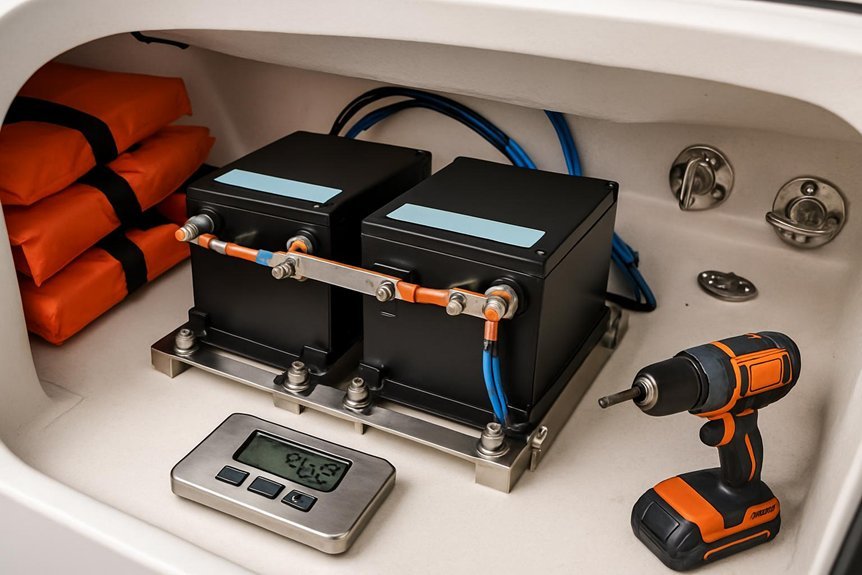
When evaluating your lithium battery needs for marine use, we start by defining required power, available space, and acceptable weight. We quantify baseline load, peak demand, and future growth to determine capacity targets. We then map enclosure dimensions, mounting constraints, and service access to establish space utilization parameters. We assess weight budgets by considering battery modules, cooling, and mounting hardware, ensuring trim and stability aren’t compromised. We identify essential auxiliary loads, redundancy needs, and charging profiles to shape voltage and current requirements. We prioritize weight optimization through compact pack layouts and efficient cooling strategies, and we verify that wiring, fuses, and protection devices fit within the planned footprint. This disciplined assessment guides a practical, space-efficient, and weight-conscious installation plan.
Choose the Marine Lithium Chemistry That Fits Your Boat
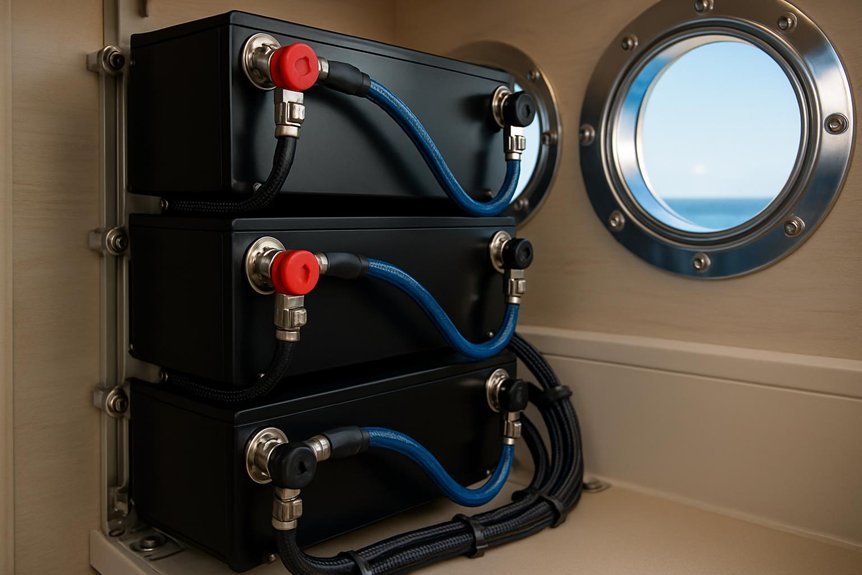
Choosing the right marine lithium chemistry hinges on how your boat uses power, tolerates weight, and manages temperature. We evaluate cycled depth, charging profiles, and thermal behavior to select the best fit. Our goal is reliable performance with minimal ballast impact and robust thermal safety.
| Chemistry option | Key advantage | Critical consideration |
|---|---|---|
| NMC | High energy density | Temperature sensitivity, BMS requirements |
| LFP | Long cycle life, stability | Slightly lower energy per kg, colder heat up |
| NCA | Strong high‑drain performance | Cost, thermal management needs |
When choosing lithium, we balance energy needs, charging speed, and system durability. For many voyages, marine chemistry in a proven, marine‑grade package provides the best overall reliability.
Size the System for Performance and Balance
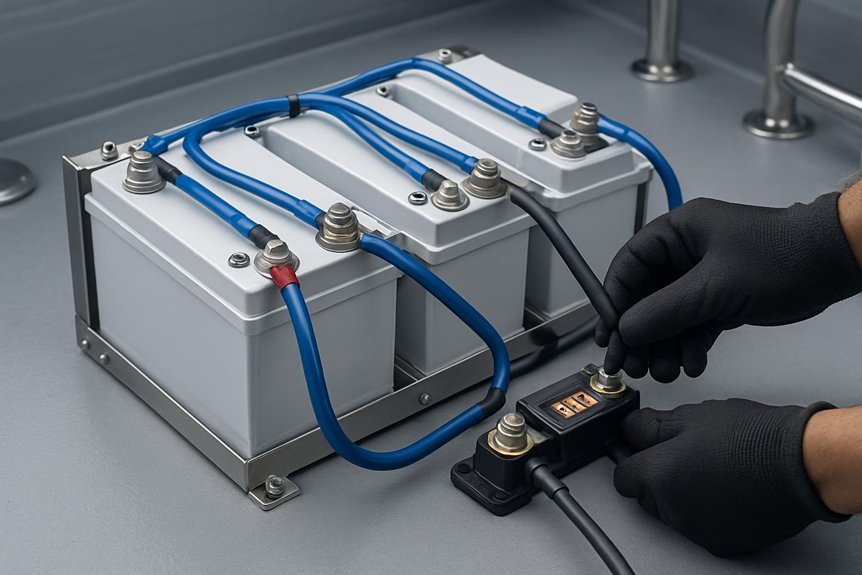
We begin by aligning system capacity with typical loads to ensure reliable operation across peak and cruising modes. We’ll size balance packs to maintain even cell aging and consistent voltage under load, matching pack chemistry to expected duty cycles. Finally, we’ll coordinate peak demand with charger and inverter limits to prevent sag, ensuring safe, resilient performance.
System Capacity Planning
How do we size a marine lithium system for reliable performance and balanced operation? We approach capacity planning by matching load profiles to usable energy, accounting for system losses, and preserving headroom for peak draws. We specify total bank capacity in amp-hours at the nominal voltage, then translate to usable energy with a conservative DoD target to extend cycle life. We model daily load curves, generator or shore power availability, and charging strategy to ensure timely replenishment without oversizing. We set reserve margins for critical loads and consider standby consumption. We integrate safety training into commissioning, verify charge termination, and document warranty coverage requirements. This planning avoids under- or over-sizing, supporting predictable runtime, repeatable performance, and long-term reliability.
Balance Pack Sizing
Balance pack sizing ensures performance and stability across operating conditions by aligning cell chemistry, pack topology, and cooling with the boat’s load profile. We sizing for peak and average demand, ensuring usable capacity remains after aging and temperature losses. Our approach pairs cells with compatible chemistry to minimize impedance and voltage sag, then defines a modular topology that simplifies cooling integration and parallel balancing. We choose pack counts that meet the required voltage and current windows while preserving margin for transients. We quantify balance economics by comparing cell counts, wiring, BMS complexity, and cooling needs against system reliability targets. We also verify compliance with marine regulations, documenting venting, temperature limits, and safety interlocks. The result is a robust, maintainable pack that respects operational envelopes and regulatory constraints.
Peak Demand Matching
Peak demand matching ties directly into the prior balance-pack sizing by ensuring the chosen architecture can sustain peak loads without compromising stability. We approach this by profiling load profiles and defining a minimum hold-up duration for critical systems, then selecting components that meet those thresholds. Our method pairs battery capacity with power electronics to deliver instantaneous current while preserving cell health. We quantify peak demand against available shore power and onboard generation, allocating headroom for startup surges and HVAC cycles. We specify charger and inverter ratings that exceed the largest anticipated draw, establishing a safe margin for contingencies. We document switching logic, fallback modes, and thermal constraints to prevent derating. This disciplined sizing ensures reliable performance, reduces electrolyte stress, and maintains balance during abrupt demand changes at sea.
Plan Venting, Enclosure, and Corrosion Protection
Plan venting, enclosure, and corrosion protection by establishing a controlled, sealed system that prevents gas buildup, protects components from moisture, and minimizes corrosion pathways. We describe a defined approach that prioritizes venting enclosure and corrosion protection safety, while maintaining serviceability and safety margins. Our plan covers enclosure integrity, seal materials, breather vent placement, and drainage to avert moisture ingress. We establish monitoring for temperature, pressure, and electrolyte leaks, with rapid isolation when thresholds are exceeded. Implementation focuses on corrosion control through compatible fasteners, coatings, and cathodic protection strategies where applicable. Table below highlights key elements for quick reference.
| Element | Rationale |
|---|---|
| Venting | Prevents gas accumulation and pressure spikes |
| Enclosure | Guards against moisture and contaminants |
Mounting and Wiring Best Practices for Boats
How can we ensure reliableMarine lithium battery installs on boats while simplifying maintenance? We approach mounting and wiring with precision, prioritizing accessible service points and vibration resilience. We select corrosion-resistant mounting hardware compatible with our battery case, using washers and isolation standoffs to accommodate thermal expansion. Mounts must align with weight distribution and require minimal tilt, while allowing tool-free inspections where feasible. Wiring routes are planned for short, straight runs, avoiding sharp bends and heat sources. Use correct gauge, fused connections, and color-coded cables for positive, negative, and communication lines. Secure fasteners with lock washers and seal any through-hull entries to prevent moisture ingress. Label all connectors and maintain accessible disconnects to streamline fault isolation during routine maintenance.
Integrate a Robust Battery Management System (BMS)
Integrating a robust Battery Management System (BMS) tightens our control over cell health, state of charge, and thermal performance once mounting and wiring are secured. We design the BMS to monitor each cell group, balance voltage across cells, and prevent overcharge or deep discharge, all while reporting real-time status to our monitoring interfaces. We select a BMS with appropriate current ratings, fault isolation, and temperature sensing to match our pack architecture and expected load profile. Integration challenges include synchronizing cell measurements, ensuring proper isolation, and validating accurate balancer operation under vibration and temperature shifts. We document communication protocols, alarm thresholds, and data logging to support traceability. Stable integration relies on clear fault logic and user-accessible diagnostics for dependable operation.
Create a Wiring Diagram and Charging Strategy
We’ll outline a concise wiring diagram and a practical charging strategy to support reliable operation. Our diagram will illustrate circuit paths, protective devices, and BMS interfaces, while our charging plan specifies source limits, charging stages, and monitoring points. This approach keeps installation traceable and ensures safe, consistent performance.
Wiring Diagram Essentials
What should your wiring diagram and charging strategy reveal at a glance, and how do you ensure it’s both correct and actionable? We present a schematic that mirrors the system topology: battery bank, busbars, alternator, DC-DC charger, inverter, loads, and fusing. We verify conductor gauges, terminal torque, and color-coding for immediate diagnostics. The diagram must show protective devices, wire routing, and isolation points, so troubleshooting is rapid and safe. We include marine cooling paths where heat sources arise and ensure clear labeling of polarity and disconnects. Fuse sizing is documented for each branch, matching component ratings and inrush considerations. Keep the diagram aligned with a written charging strategy that prioritizes proper charging profiles, temperature limits, and calm fault handling.
Charging Strategy Basics
A clear charging strategy starts with defining our target states and charging profiles across the system, so the wiring diagram can reflect correct sequencing and safety controls. We outline a disciplined cadence: charging cadence aligns with usage patterns, generator and shore power windows, and battery chemistry limits to minimize stress. We map state-of-charge thresholds, temperature checks, and fault-lock conditions to prevent overcharge or deep-discharge events. Our strategy favors modular, redundant controls: primary DC-DC chargers, secondary protection, and clear interlocks on relays and fuses. We consider solar compatibility early, ensuring panels, MPPT controllers, and battery BMS communicate the same voltage window. We specify surge handling, charger ramp rates, and isolation practices. This baseline supports predictable performance, traceable maintenance, and safe, extendable system growth.
Establish Safety Protocols and Maintenance Routines
To keep a marine lithium battery system safe and reliable, we establish clear safety protocols and routine maintenance checks from day one. We define roles, responsibilities, and escalation paths for emergencies, and we document all procedures in a centralized log. Our protocols cover battery handling, charging, disconnections, and ventilation, with explicit tic marks for permissible tools and PPE. Regular inspections verify cell temperatures, cabinet integrity, and insulation resistance, while thermal monitoring flags deviations before they become failures. We schedule preventive maintenance aligned with manufacturer specs, recording cycle counts, electrolyte status indicators, and connector torque. Safety drills train crew to isolate, ventilate, and communicate during incidents, reinforcing containment measures. Spill response plans specify absorbents, containment trays, and disposal steps to minimize environmental impact and downtime.
Navigate Regulations, Warranties, and Practical Checklists
Navigating regulations, warranties, and practical checklists starts where safety protocols leave off: ensuring compliance and clear ownership across all battery systems. We, as installers, map navigation compliance to vessel operations, confirming that national and local codes, classification society rules, and cargo or passenger limits are met before commissioning. We document exact battery types, capacities, and serials, linking them to installation drawings and maintenance logs. Warranty limits are reviewed with suppliers, noting covered components, expected lifespans, and required installation practices to preserve coverage. Practical checklists translate regulations into actionable steps: pre-install inspections, wiring verifications, communication of fault codes, and periodic revalidation after system updates. By aligning compliance and warranty details, maintenance becomes predictable, traceable, and auditable for every voyage.
Frequently Asked Questions
How Long Does a Typical Marine Lithium Battery Last at Sea?
Typical marine lithium batteries last about 5–10 years at sea, depending on usage. We monitor cycles, temperatures, and depth of discharge, ensuring safe operation. We, readers, optimize life with two word idea 1, two word idea 2.
Can Lithium Batteries Be Submerged or Exposed to Salt Spray?
Yes, lithium batteries aren’t designed to be submerged; salt spray is risky. We consult offshore use warranties, and we recommend dry, ventilated enclosures with IP ratings. Subtopic not relevant to routine marine maintenance—follow manufacturer guidelines.
What Happens if a BMS Fails During a Voyage?
If a BMS failure occurs, we stop charging, isolate the pack, and maintain ventilation to protect voyage safety; we monitor cell temps and currents, switch to redundant systems, and alert crew immediately about bms failure and voyage safety.
Are There Specific Marine Warranties for Offshore Use?
Yes, there are marine warranties tailored for offshore use. We’ll guide you through marine warranty terms, exclusions, and coverage specifics, ensuring offshore use cases are clearly defined and met, with precise, concise, technically sound language.
How Do I Dispose of or Recycle Old Lithium Marine Packs?
We dispose of old lithium marine packs through certified recycling programs, not general trash, fulfilling disposal responsibilities; we’ll help you identify recycling options, arrange pickup if needed, and guarantee Safe Handling, compliance, and environmental protection throughout the process.
Conclusion
We’ve laid out a clear path from needs assessment to maintenance, so you can install with confidence and precision. By balancing capacity, weight, and space, selecting the right chemistry, and planning venting and corrosion protection, you’ll minimize risk and maximize reliability. A robust BMS, solid wiring diagrams, and a rigorous safety routine are non-negotiables. Stick to documentation and regulations, and you’ll sail smoothly—no stone left unturned. In short, plan tight, execute clean, and sail on.