You may not know that the usable capacity of a solar lithium bank isn’t just about amp-hours, but how DoD, efficiency, and thermal effects interact across temperature ranges. We’ll break down loads, model cycle life, and align strings for both safety and cost, so you get a robust, future-proof size. There’s nuance in chemistry choices and inverter limits that can surprise you, and a practical workflow waits at the end to guide concrete decisions. Let’s start with the real constraints that shape every design choice.
Key Takeaways
- Proper sizing minimizes loss, ensures reliability, and stabilizes system dynamics during weather events by matching capacity, discharge rate, and inverter input.
- Estimate daily energy by essential loads, apply DoD targets, efficiency losses, and seasonal variation to derive usable capacity.
- Include temperature derating, thermal management, and safety margins to account for real-world performance and future growth.
- Compare chemistries (Li-ion, lead-acid, emerging options) for energy density, cost, cycle life, and safety, with data-driven tradeoffs.
- Use a step-by-step workflow: define daily use, choose system voltage, size strings, model cycle life, and document assumptions to compute final bank size.
Why You Need a Properly Sized Solar Lithium Bank (The Problem and Payoff)
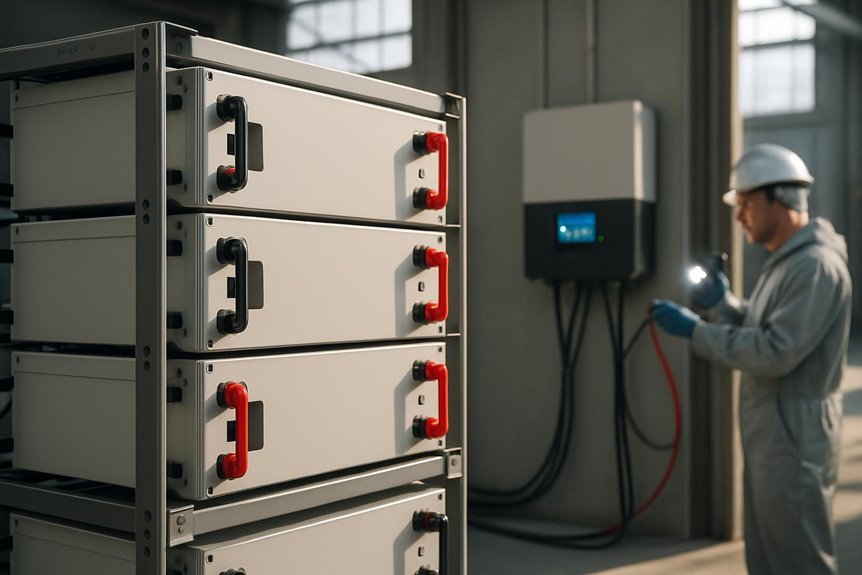
Why you need a properly sized solar lithium bank becomes clear once you understand the failure modes and the payoff. We examine how mismatches between capacity, discharge rate, and inverter input create inefficiencies, voltage sag, and shortened cycle life. When storage is undersized, peak draws trigger depth-of-discharge limits, reducing usable energy and forcing expensive, frequent replacements. Oversizing raises capital cost and idle years, diluting return on investment. In this context, precise sizing minimizes loss, ensures reliable autonomy, and stabilizes system dynamics during weather events. Misconception clarification helps readers avoid conflating total battery mass with usable energy. Budgeting tradeoffs emerge as we balance upfront capital with long-term degradation costs, maintenance, and replacement intervals. Our method emphasizes quantified margins and performance goals to deliver predictable, safe, and cost-effective solar lithium operation.
Estimate Your Daily Energy Needs and Usable Capacity
To size a solar lithium bank effectively, we start by estimating our daily energy needs and the usable capacity required to meet them. We quantify daily energy as the sum of all essential loads, using nominal watt-hours and a defined averaging period. Next, we translate that demand into usable capacity, accounting for depth of discharge targets and battery chemistry limits. We compare this to available system energy, ensuring a margin for reliability. We also assess system efficiency, including charging/discharging losses, inverter efficiency, and seasonal variation. Throughout, we emphasize battery safety by selecting appropriate BMS thresholds and ventilation considerations. This disciplined estimation yields a concrete usable capacity target, aligning daily energy requirements with practical storage, so the bank delivers consistent performance without overbuilding or underprovisioning.
Factor in Dod, Efficiency, and Temperature for Realism
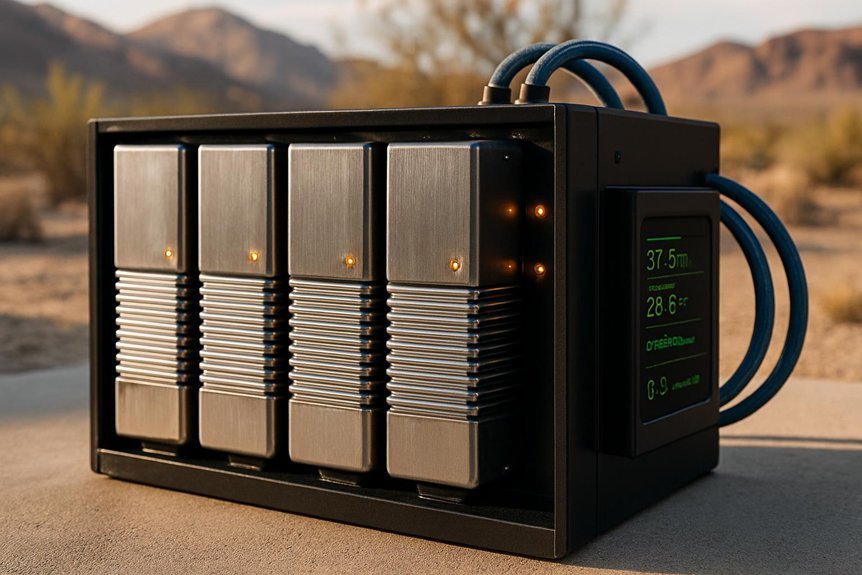
We must account for depth of discharge (DoD), system efficiency, and temperature effects to produce a realistic bank size. DoD caps usable capacity, so we size around a practical fraction to extend cycle life and performance under varying loads. We then apply system efficiency losses—converter and wiring—to determine actual usable energy from the bank, not just nominal capacity. Temperature influences both capacity and internal resistance, altering available energy and charging behavior; we adjust derating factors for ambient swings and thermal management overhead. We estimate idle room for future growth and accounting, ensuring the bank isn’t pushed to the extreme DoD on regular days. We also consider external constraints, like noisy neighbors, which can impact cooling and enclosure design, subtly shaping conservative sizing decisions. This yields a resilient, realistic battery bank.
Chemistry Options, Lifespans, and Safety Factors
Chemistry options define the fundamental tradeoffs between energy density, cost, cycle life, and safety, so we compare Li-ion variants, lead-acid, and emerging chemistries with a focus on real-world performance. We present a concise, data-driven view of chemistry options, emphasizing how each chemistry balances gravimetric and volumetric density, charge/discharge efficiency, and temperature resilience. Lifespans vary with depth of discharge, cycling rate, and thermal management; we quantify expected cycle life ranges and calendar life where available. Safety factors include thermal runaway risk, venting behavior, and fault tolerance, plus installation controls. We prioritize robust, market-relevant metrics—calendar aging, end-of-life criteria, and replacement intervals—so readers can translate chemistry options into practical battery bank planning and risk mitigation.
Step-By-Step Sizing Workflow With a Practical Example
So how do we convert a solar-plus-storage goal into a practical battery bank size, step by step, with a concrete example? We begin by defining expected daily energy use and critical-load windows, then translate these into required usable energy and depth of discharge limits. Next, we select a nominal system voltage and identify the number of series-connected strings to meet voltage targets, followed by calculating how many parallel strings are needed to meet capacity. We apply solar lithium characteristics—cycle life, C-rate, and efficiency—to model performance under typical daily profiles. We constrain the design with inverter and charger ratings, then verify with a reserve margin for autonomy days. Finally, we document assumptions, compute a final bank size, and confirm it satisfies bank sizing goals while staying cost-efficient.
Frequently Asked Questions
How Do You Compare Lithium Battery Chemistries for Long-Term Cycles?
We compare lithium chemistry using cycle life, capacity retention, and degradation rates; we prioritize long term cycle life, considering calendar aging and DOD. We quantify with NMC, LFP, and NCA data, and assess safety, cost, and performance trade-offs.
What Are Hidden Costs Beyond Initial Battery Price?
We’ll cut to the chase: hidden costs include maintenance fees, batteryBalancing, inverters, replacements, and cooling needs, plus monitoring systems and warranties—these accumulate over time, so plan for regular maintenance, calibration, and potential hardware upgrades.
How Does Aging Affect Real-World Daily Energy Availability?
Aging effects lower our actual daily energy availability as capacity fades and internal resistance rises. We’ll quantify this decline, model remaining usable energy, and adjust our system’s usable days, ensuring you understand real-world performance under aging.
Can You Scale a System After Installation Without Reconfiguring?
Yes, we can scale after installation, but with caveats. We’ll avoid reconfiguring challenges by planning upfront; scale limitations emerge if you don’t, so we carefully map load, topology, and BMS constraints before expanding.
What Safety Margins Are Recommended for Off-Grid Reliability?
We recommend specific safety margins to boost off-grid reliability, typically 20–30% extra usable capacity and 3–4 days of autonomy, with derating and temperature adjustments applied; these safety margins preserve performance under variable loads and environmental conditions.
Conclusion
We’ve shown that a bank sized for ideal energy can still fail in reality, and a conservatively oversized bank can look wasteful yet endure. Juxtaposing precision with practicality, we balance numbers against conditions—DoD, temps, and chemistry against cost and safety. In our method, exact loads meet robust margins, while modest reserves prevent surprises. The result: a lithium bank that stays reliable under stress, minimizes losses, and adapts to future needs without overbuilding.