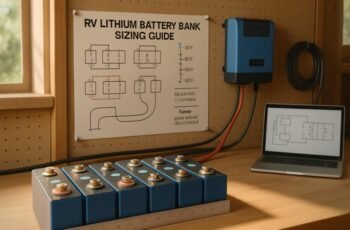
We assess cycle life, calendar life, and performance durability; we quantify capacity fade, efficiency, and reliability across projected duty cycles. We discuss how temperature, DoD, and charging strategy shape aging, and we compare chemistries with standardized tests and QA. We present data-driven criteria, warranty terms, and cost implications to guide planning. As we translate metrics into actionable maintenance, testing, and replacement strategies, a clear path emerges—but questions remain about how these factors interact in real-world deployment.
Key Takeaways
- Lifespan is the period a lithium-based solar storage system maintains usable capacity and reliable performance under specified conditions.
- Cycle life vs calendar life distinguish degradation from cycling versus time, guiding warranties and maintenance planning.
- End-of-life criteria include DoD limits, cycle count, calendar aging, temperature tolerance, and test-backed reliability.
- DoD, charging strategy, chemistry, and thermal management strongly influence degradation and overall longevity.
- Data-driven monitoring (BMS logs, SOC ranges, temperatures) and standardized testing underpin maintenance and operational decisions.
What Is Solar Lithium Battery Lifespan?
Solar lithium battery lifespan refers to the period during which a solar energy system’s lithium-based storage maintains usable capacity and reliable performance under specified operating conditions. We define it by end-of-life metrics such as depth-of-discharge limits, cycle count, calendar aging, and temperature range tolerance, aligned to industry standards. Our data-driven approach evaluates retained storage capacity, round-trip efficiency, and degradation rates under projected duty cycles, with explicit acceptance criteria for reliability. Regulatory compliance governs qualification tests, safety margins, and labeling, ensuring consistency across vendors and installations. We also consider end-of-life pathways, including responsible disposal and solar recycling processes. By anchoring expectations to verifiable test results, we provide transparent performance benchmarks that support informed system design, maintenance planning, and lifecycle cost analysis.
Cycle Life vs Calendar Life: What They Mean
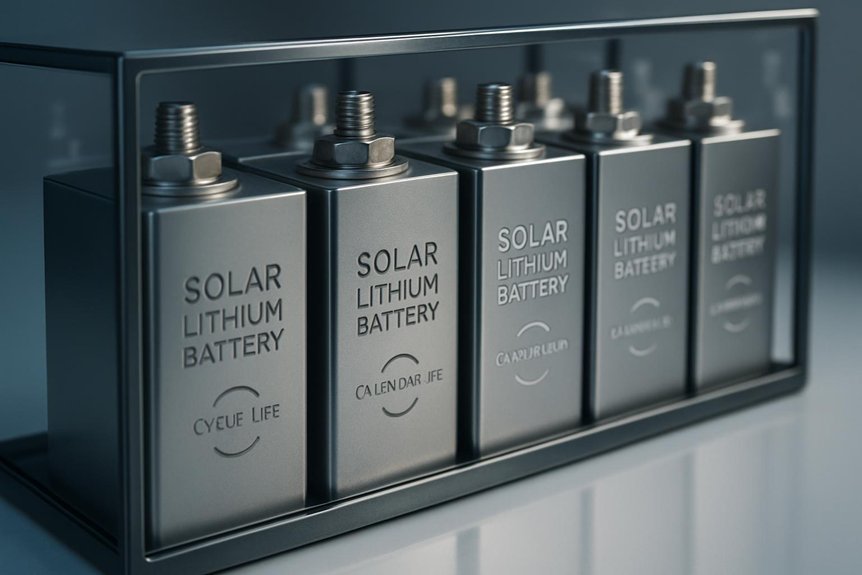
Cycle Life and Calendar Life measure different aging processes in lithium battery storage, and understanding both is key for accurate reliability planning. We compare cycle life as the system’s ability to endure defined charge–discharge events before capacity falls below a threshold, typically per ANSI and IEC test protocols. Calendar life reflects time-related degradation independent of cycling, driven by calendar aging mechanisms, temperature, and storage state. Our analysis uses standardized stress tests, reporting metrics such as capacity retention, loss per cycle, and end-of-life criteria. We emphasize that cycle life and calendar life are not interchangeable but complementary for asset planning, warranty forecasting, and maintenance scheduling. Recognizing these distinctions guides selection of chemistries, thermal management, and operating envelopes to optimize long-term performance.
Factors That Affect Longevity
Aging in lithium battery storage is driven by multiple interacting factors, including temperature, state of charge, usage patterns, and storage conditions, all of which influence both calendar and cycle aging. We assess longevity through standardized metrics, warranty terms, and life-cycle testing under representative duty cycles. Power conversion efficiency, depth of discharge, and cycle frequency directly shape degradation curves, while calendar aging remains temperature- and SOC-dependent even during idle periods. We address ageing myths with evidence from accelerated tests and field data, clarifying misperceptions about “fast charging” or “high C-rates” as universal predictors of failure. We also consider metal sourcing implications, as impurity control and supplier qualification impact long-term stability. Hazards from improper materials can undermine reliability, warranting traceability and rigorous quality assurance.
Temperature and Thermal Management
Temperature directly affects lithium battery lifespan, so we examine temperature effects on lifespan, thermal management strategies, and battery heat tolerance limits with a data-driven lens. We consider operating temperature ranges, degradation rates, and standard test protocols to guide design choices. We’ll outline how cooling, heating, and thermal monitoring impact reliability, safety, and performance across solar storage applications.
Temperature Effects on Lifespan
In solar lithium battery storage, temperature profoundly influences degradation pathways and overall lifespan; how we manage heat directly shapes cycle life and calendar life. We assess thermal exposure, rate-capacity loss, and impedance shifts with standardized test curves, ensuring data-driven decisions. Our focus remains on robust, repeatable metrics rather than conjecture, aligning with IEC/UL guidelines and industry best practices. In practice, we correlate ambient, pack, and module temperatures with capacity fade and cycle count limits, emphasizing the role of thermal inertia and platform uniformity. We also consider factory handling scenarios, including unused battery packs, and how preconditioning affects remaining energy harvesting.
| Temperature Band | Observed Degradation |
|---|---|
| 0–25°C | Low, gradual |
| 25–45°C | Accelerated |
| 45–60°C | Severe |
| 60–75°C | Rapid |
| >75°C | Catastrophic |
Thermal Management Strategies
Thermal management strategies center on maintaining temperatures within the optimal bands identified for minimal degradation, while rapidly mitigating excursions that push cells into higher-loss regions. We implement data-driven cooling and heating loops, phase-change materials, and airflow optimization to sustain uniform temperature across modules. Our approach targets a thermal resistance reduction of at least 15% and a maximum gradient of 5°C within racks, based on validated test data and standards. In practice, we couple real-time sensing with active control to avoid localized hotspots that accelerate capacity fade. We also evaluate urban design implications, ensuring facility layouts support effective venting and access for maintenance. Regulatory hurdles are navigated through documented safety margins, failure-mode analyses, and conformity with applicable codes to ensure scalable, reliable deployments.
Battery Heat Tolerance Limits
How hot is too hot for our battery systems, and how do we define acceptable bounds? We evaluate heat tolerance using C-rate dependent thermal limits, ambient-specified operating temperatures, and manufacturer-enforced safety margins. Our criteria hinge on maintaining chemical stability, cycle life, and safety hazards, quantified by maximum cell temperatures, internal resistance drift, and degradation rates under solar heat exposure. Standards bodies prescribe temperature envelopes: typically 0–40°C for continuous operation, with brief excursions to 45–60°C allowed under strict controls. Thermal management must prevent hotspots via active cooling, phase-change materials, and optimized airflow. We assess insulation performance, heat flux, and insulation thickness to minimize heat ingress. Battery insulation, paired with monitored venting and shutdown thresholds, ensures reliability across environments.
Depth of Discharge and Charging Strategy
What depth of discharge (DoD) and charging strategy most strongly shape lithium battery lifespan, and why does careful management matter? We present a data-driven view: higher DoD accelerates capacity fade and resistance growth, while frequent deep cycles stress electrode surfaces. We calibrate DoD targets to a balance between usable energy and longevity, typically limiting DoD to 60–80% for long-lived systems and tailoring to load profiles. Charging strategy matters as C-rates, termination voltage, and rest periods influence solid electrolyte interphase stability and aging mechanisms. Devices aligned with standards—IEEE, IEC, UL—favor controlled fast charging only within certified windows and temperature ranges. For going solar applications, we prioritize conservative profiles, monitoring state-of-charge, and ensuring battery chemistry remains within safe operating envelopes to extend cycle life and reliability.
Comparing Lithium Chemistries for Solar Storage
We compare lithium chemistries for solar storage with a focus on longevity and performance tradeoffs, anchoring our assessment in cycle life, temperature tolerance, and efficiency. We highlight how lithium iron phosphate, NMC, and LCO chemistries differ in degradation rates, calendar life, and safety margins under typical solar operating profiles, using data-driven benchmarks. Our discussion aligns with standards and real-world test results to guide material selection and system design decisions.
Lithium Chemistry Longevity
Lithium chemistry longevity hinges on intrinsic cell chemistry, cycle life, and calendar aging, making direct comparisons essential for solar storage design. We present data-driven benchmarks to guide system engineers toward robust decisions about long-term performance, reliability, and safety in practice. Our framing emphasizes standard testing metrics, rate capability, and degradation modes across chemistries. We compare capacity retention, calendar aging, and high-temperature resilience under realistic duty cycles to illuminate solar longevity and chemistry durability.
- Graphite/LFP vs NMC/NCA life curves under 80% DOD, 1C–2C rates
- Thermal stability and gas-generation profiles per IEC/UL standards
- EOL voltage, impedance growth, and capacity fade causes
- Safety margins and warranty implications for grid-tied deployments
Solar Storage Tradeoffs
Which lithium chemistry best suits solar storage depends on a balance of energy density, cycle life, calendar aging, thermal resilience, and safety warrants under operating duty cycles. We present a data-driven comparison of chemistries, linking performance to system design and standards. LiFePO4 offers robust cycle life and thermal stability, favoring long-horizon reliability in fixed installations, but at lower energy density. NMC variants improve energy density and round-trip efficiency, yet demand tighter thermal management and safety controls. LFP may excel under cycling-heavy duty with predictable calendar aging. High-voltage NCA/NMC chemistries deliver superior energy density for space-limited arrays, requiring rigorous safety margins and monitoring. Across all options, solar efficiency is driven by panel orientation, temperature, and charge algorithms, underscoring the need for integrated, standards-aligned system design.
Maintenance Actions to Maximize Lifespan
Maintaining solar lithium battery storage hinges on regular, data-driven actions that preserve capacity and safety. We implement disciplined maintenance to minimize degradation and ensure predictable performance for solar charging and grid integration.
- Monitor charge-discharge cycles and SOC ranges with calibrated BMS logs
- Enforce temperature control and cooling checks to prevent thermal runaway
- Verify electrolyte integrity, connections, and insulation per standards
- Schedule firmware updates and condition-based diagnostics to sustain accuracy
We base actions on measured analytics, not anecdotes, emphasizing consistency across deployments. By aligning with manufacturer guidance and test data, we reduce calendar age effects and improve cycle life. If metrics trend toward limits, we adjust charging profiles and refresh safety protocols to maintain reliability for both solar charging and grid integration requirements.
Warranty, Replacement Costs, and Total Ownership
Warranty terms, replacement costs, and total ownership are defined by documented performance guarantees, failure modes, and lifecycle assumptions rather than anecdote. We present a data-driven view anchored in standards, verified field data, and supplier reliability metrics. Our assessment accounts for warranty durations, capex amortization, O&M costs, and end-of-life recovery. Recycling economics informs post-warranty value, while reliability dashboards quantify degradation trajectories and failure probabilities. We, as readers, gain transparency on total cost of ownership, risk-adjusted returns, and contractual guarantees.
| Category | Key Metrics |
|---|---|
| Warranty Terms | Duration, coverage, exclusions, service levels |
| Replacement Costs | Module/string pricing, labor, logistics, impedance factors |
Planning for Aging: Rebalance, Replace, or Upgrade
How should we approach aging in solar lithium battery storage—rebalancing, replacing, or upgrading—as system performance shifts and economics evolve? We address aging with a planning horizon lens and rigorous risk assessment, documenting data-driven decision criteria aligned to standards. We compare degradation rates, cycle life, calendar life, and thermals to determine optimal strategy at each milestone.
How to manage aging in solar Li-battery storage: rebalancing, replacing, or upgrading with data-driven risk and horizon-based planning.
- Rebalance: optimize state of charge, channel capacity, and load sharing to extend usable life within current components
- Replace: retire failing modules or modules nearing end-of-life thresholds per manufacturer guidance
- Upgrade: adopt higher-efficiency chemistries or enhanced safety controls when cost-benefit favors modernization
- Governance: integrate monitoring, QA, and documentation to support traceable aging decisions within risk frameworks
Frequently Asked Questions
How Does Panel Orientation Affect Battery Lifespan?
Panel orientation minimally affects battery lifespan if sun exposure is optimized; we prioritize max energy throughput and balanced cycling. We monitor temperature and state-of-charge, ensuring panel orientation contributes to stable charging profiles and extends battery lifespan under standards-driven, data-backed control.
Can Solar Storage Fail Gradually or Catastrophically?
“Slow and steady wins the race,” we answer: yes, solar storage can fail gradually or catastrophically. We base this on data showing gradual degradation and potential catastrophic failure under thermal, electrical, or manufacturing faults, with standards-driven safety margins.
Do Inverters Influence Battery Aging?
We prove that inverters influence battery aging: inverter aging accelerates stress cycles and thermal variance, increasing battery degradation. Our data-driven view shows duty-cycle accuracy and soft-start behavior matter, reinforcing standards-focused maintenance and performance validation across system components.
What Maintenance Is Cost-Effective Annually?
We estimate maintenance cost effectiveness is strongest with annual checks; our data show modest, routine tasks yield stability. We partner with you to schedule preventive inspections, batteries, connections, and safety protocols, ensuring maintenance cost effectiveness over the year.
Is Replacement Timing Impacted by Seasonal Energy Usage?
We say yes: replacement timing is influenced by seasonal usage, since higher demand periods accelerate degradation and cycle counts. Our data-driven assessment shows tighter end-of-life thresholds during peak seasons, guiding proactive maintenance and compliant retirement decisions.
Conclusion
We are the gardeners tending a solar orchard, where each battery cell is a tree. Our data-guided pruning trims DoD, angles charging, and cools the grove to meet standards. Through cycle and calendar aging, we map performance like weather patterns—tracking capacity, efficiency, and failure rates. With thermal control, rigorous QA, and clear warranties, we rebalance, replace, or upgrade as the orchard ages. In disciplined stewardship, longevity becomes predictable yield under evolving duty cycles.