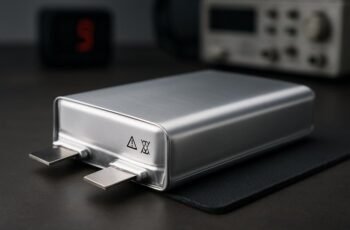
We approach LiPo battery storage with a data-driven, safety-first mindset, detailing how partial-charge states, temperature control, and venting provisions minimize risk. We’ll compare storage options, sizing, and BMS-aware charging to protect longevity and performance. Our methods emphasize regular inspections, secure labeling, and documented procedures. The stakes are high when thermal runaway is possible, yet disciplined practices reduce exposure. If you want practical, auditable guidelines, we’ll guide you step by step.
Key Takeaways
- LiPo battery storage should maintain partial charge (roughly 3.8–3.85 V per cell) in a cool, dry environment with proper containment.
- Use a robust BMS and certified enclosures to manage temperature, voltage, and venting for safe storage.
- Regularly inspect for swelling, damage, leakage, and log cell voltages to detect anomalies early.
- Balance charging, appropriate C-rates, and logging of voltages/currents to prevent thermal runaway and degradation.
- Consider alternatives (e.g., LiFePO4, flow, sealed lead-acid) for long-duration home storage; LiPo suits high-output, compact applications.
What Is LiPo Battery Storage?
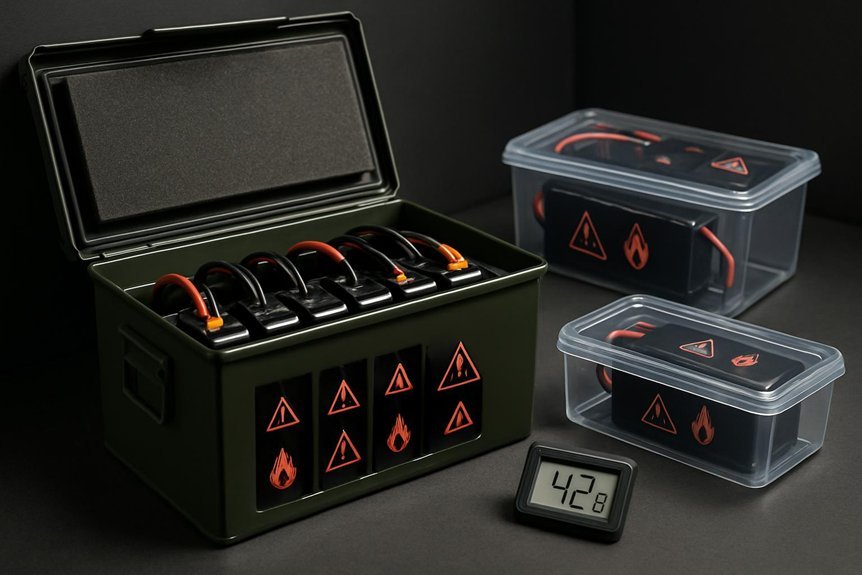
What is LiPo battery storage, and why does it matter? We frame it as a controlled system that protects cells, preserves capacity, and minimizes risk. LiPo packs store energy in thin foil and polymer layers, so temperature, voltage, and state of charge must be managed precisely. In practice, we define storage at partial charge (about 3.8–3.85 V per cell) and cool, dry conditions, with passive or active protection against heat buildup. We monitor for swelling, puncture, or electrolyte leakage, and we retire packs showing any anomaly. Addressing lipo myths and storage myths helps users avoid unsafe habits: never store fully charged, never store when damaged, and never expose to high temperatures. Proper protocol reduces degradation, extends lifespan, and lowers incident potential during non-use periods.
LiPo vs. Other Storage Options: Where It Fits
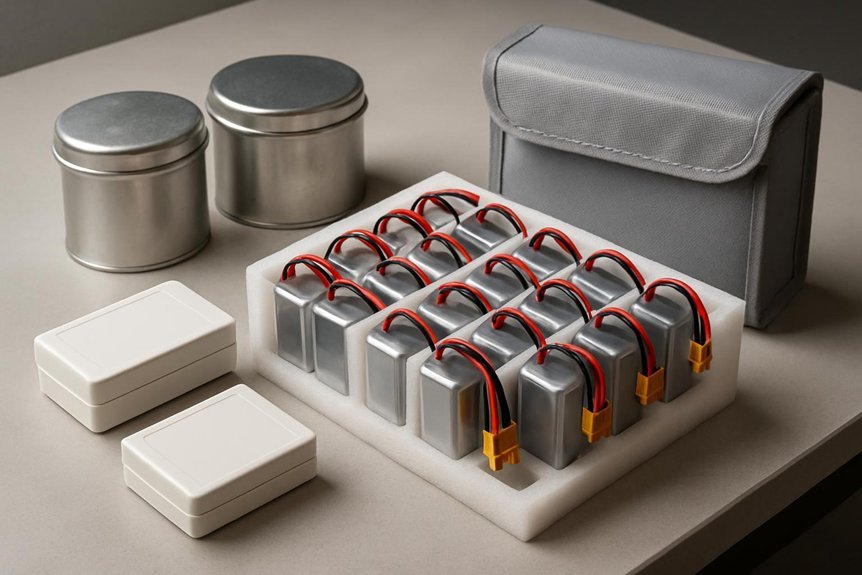
How does LiPo storage compare with other options, and where does it fit in a thorough storage strategy? We compare energy density, cycle life, power delivery, and safety with lead-acid, NiMH, and modern solid-state contenders. LiPo packs offer high specific energy and fast discharge, beneficial for brief peak loads, but require strict thermal management and robust BMS to mitigate thermal runaway risks. In home energy storage, li-po pack compatibility hinges on enclosure design, venting, and charging limits; compatibility gaps often constrain integration with standard inverter architectures. For long-duration, stationary storage, alternatives like lithium iron phosphate, flow batteries, or sealed lead-acid may deliver lower risk and longer lifecycles at different cost points. Overall, LiPo fits targeted, high-output, compact scenarios rather than primary home energy storage.
Sizing LiPo Packs for Home, Workshop, and Projects
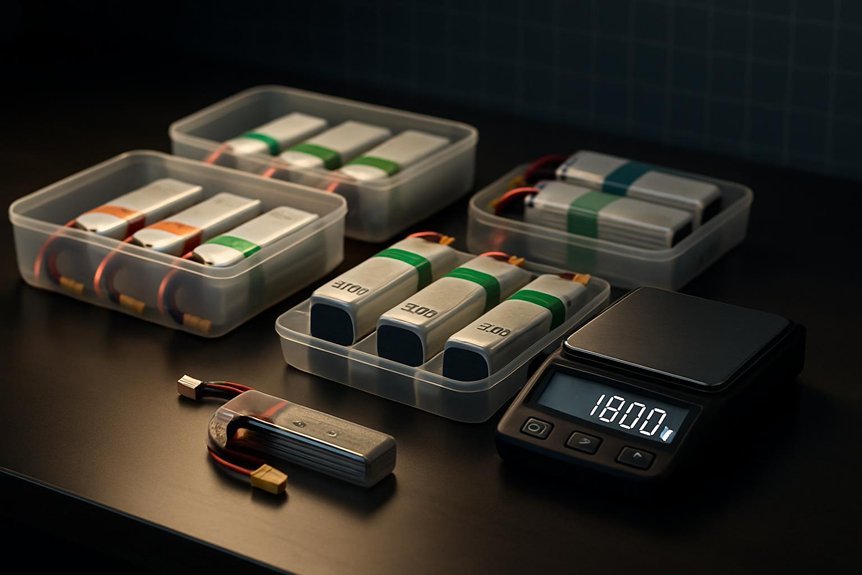
Which approach best fits your load profile and space constraints when sizing LiPo packs for home, workshop, and projects? We tailor pack selection to estimated continuous draw, peak surges, and runtime goals, then translate those needs into cell count, voltage, and capacity with margin. We quantify energy storage targets in watt-hours, not just cells, and map them to packaging form factors that fit your workspace while preserving safety margins. We prioritize thermal handling, enclosure integrity, and stacking compatibility to sustain consistent voltage delivery under load. We monitor lipo aesthetics and storage aesthetics, recognizing that organized, labeled packs reduce mishandling risks and improve traceability. By grounding choices in measured usage patterns and environmental limits, we minimize overcapacity waste and optimize overall system reliability.
Charging LiPo Safely: Chargers, C-Rates, and Balancing
Charging LiPo safely demands precise control of chargers, C-rates, and balancing to prevent runaway reactions and capacity fade. We guide readers through selecting chargers with proper voltage profiles, timing safeguards, and temperature compensation. We favor chargers that log cell voltages, currents, and impedance, enabling rapid detection of anomalies. We emphasize appropriate C-rates for pack chemistry and capacity to minimize heat, while avoiding over-discharge risk. Balancing is essential during charging to equalize cell stresses and preserve capacity. We prioritize efficient cooling strategies to maintain safe operating temperatures and extend pack life. Remote monitoring capabilities let us verify pack health remotely and trigger alarms before conditions become unsafe. In practice, follow manufacturer specs, perform periodic tests, and document deviations for continuous safety improvements.
Safe LiPo Installation and Storage
We minimize risk by selecting proper enclosures, vents, and placement that meet fire-safety standards, then verify storage conditions—temperature, humidity, and isolation—from the moment a pack arrives through routine maintenance. We approach installation with documented procedures, confirming connector integrity, gasket seals, and burn-resistance ratings before any integration. Storage practices rely on rated enclosures and monitored environments, backed by real-time telemetry for temperature, humidity, and vent status. We address safety myths by sticking to data: setpoint windows, alarm verifications, and fail-safe shutdowns on anomaly. Temperature alarms trigger immediate containment actions, including isolation and cooling, to prevent cascading failure. Regular audits verify labeling, inventory, and care schedules, ensuring consistent, traceable handling from receipt to long-term storage. Our protocol prioritizes containment, traceability, and rapid response.
LiPo Lifecycle, Longevity, and Real-World Performance
We’ll start by outlining LiPo cycle basics, including how charge/discharge depth, rate, and temperature shape cycle life. We’ll link longevity factors—cell chemistry, storage state, and handling practices—to measurable metrics like capacity retention and safety margins, with practical tips backed by data. We’ll translate real-world performance into actionable guidance for usage, monitoring, and maintenance to minimize degradation and ensure safe operation.
LiPo Cycle Basics
LiPo cycle basics hinge on understanding how capacity, impedance, and state-of-charge interact over repeated use. We operate with precise charge/discharge profiles, monitor internal resistance trends, and quantify usable energy per cycle. In practice, lipo chemistry governs how fast capacity declines under load, while impedance growth signals aging and temperature sensitivity. We track cycle aging by counting full cycles and partial cycles, recognizing that higher C-rates accelerate degradation. Storage state-of-charge also matters; mid-range SOC typically preserves health better than extremes. Safety remains paramount: balance during charging, proper venting, and fault detection reduce risk during cycle events. We emphasize reproducible measurements, compare data across cells, and use this framework to predict performance shifts under real-world duty cycles.
Longevity Factors & Tips
Longevity in LiPo systems hinges on how capacity, impedance, and state-of-charge evolve under real-world use, demanding a data-supported approach to lifecycle management. We, as engineers, track cycle life curves, calendar aging, and impedance drift to forecast usable life and failure modes. Consistent resting voltages, balanced cells, and gentle charge-discharge profiles minimize degradation rates, while avoiding deep discharges preserves capacity. Temperature monitoring is essential: elevated temps accelerate electrolyte loss and impedance growth. We implement conservative voltage windows, precise C-rate control, and periodic capacity checks to validate health forecasts. For disposal ethics, we design end-of-life plans that maximize safety and material recovery, adhering to regulatory compliance. Finally, we document performance metrics to refine models, supporting informed decisions about storage duration, replacement timing, and risk mitigation.
Real-World Performance Insights
Real-world performance reveals how LiPo packs behave under operational stress, guiding our lifecycle planning with empirical evidence. We analyze cycle counts, temperature excursions, and charge/discharge profiles to quantify capacity fade and impedance growth. Our approach blends controlled laboratory data with field telemetry, emphasizing safety margins and failure modes. We compare storage conditions, resting voltages, and SOC bands to establish realistic endurance benchmarks for various chemistries and form factors. By translating data into actionable metrics, we improve maintenance schedules and contingency planning. We also consider storage economics, balancing upfront cost, replacement cadence, and end-of-life recycling impact. For hobbyist ergonomics, we translate technical findings into practical guidelines on handling, pack bagging, and monitoring interfaces, ensuring safer, more predictable operation.
LiPo Safety Protocols, Handling, and Risk Mitigation
We’re prioritizing safe handling, strict fire risk mitigation, and rigorous battery inspection protocols to protect people and assets. Our approach is data-driven: we’ll outline accepted practices, quantify risk reductions, and require consistent inspection steps before every use. We’ll guide you with concise, actionable checks and documentation to support proactive risk management.
Safe Handling Practices
Are LiPo batteries safe when handled correctly? We, as stewards of storage integrity, apply rigorous handling protocols to minimize risk. Our practices prioritize data-backed precautions: inspect packs before use, store at partial charge, and transport in fire-safe containers. We conduct regular voltage checks, avoid puncture exposure, and maintain a clean, dry workspace. We understand that improper handling degrades cells and increases failure probability, so we emphasize containment and prompt reporting of any swelling, heat, or damage. When integrating solar logistics and wind compatibility considerations, we align charging schedules with resilient, monitored ecosystems. This table formalizes risk controls and response steps, reinforcing consistent behavior across teams.
| Control | Action | Verification |
|---|---|---|
| Inspection | Visual/voltage check | Log results |
| Storage | Partial charge, cool, dry | Temperature/voltage alerts |
| Transport | Secure, label, containerized | Pre-trip checklist |
Fire Risk Mitigation
Fire risk from LiPo packs is a real safety concern that demands disciplined mitigation measures. We approach fire risk with structured protocols: stable storage conditions, proper charging, and certified containment. Our mitigation strategies prioritize temperature control, voltage monitoring, and insulated, sealable enclosures that resist thermal runaway. We limit pack exposure time at elevated temperatures and use dedicated charging stations with equalization routines and cutoff thresholds. We verify state of charge before storage, segregate damaged or swollen packs, and maintain clear inventory logs. Fire suppression plans emphasize fire-resistant shelving, secondary containment, and appropriate extinguishing methods for lithium polymer chemistry. Training emphasizes early anomaly detection, prompt isolation, and escalation. By implementing data-driven checks and rigorous procedures, we reduce risk to personnel and facilities while preserving operational readiness.
Battery Inspection Protocols
Battery inspection protocols are essential for LiPo safety, handling, and risk mitigation, ensuring we detect degradation and defects before they compromise performance or safety. We communicate clear, data-driven checks, emphasize preventive maintenance, and document findings to guide handling decisions. Regular insulation testing verifies sleeve integrity and electrolyte containment, while thermal imaging identifies hot spots indicating internal resistance changes or cell imbalance. We pair these diagnostics with visual inspection, voltage checks, and charge/discharge observations to form a robust risk profile. Adhering to strict thresholds, we escalate anomalies promptly and isolate suspect packs. The table below summarizes steps, tools, and decision criteria to streamline audits and reduce incident likelihood.
| Step | Tool | Decision Criteria |
|---|---|---|
| Inspect visual condition | Magnification/torch | Cracks, swelling, electrolyte leakage |
| Measure voltages | Multimeter/ balance charger | Within reported cell specs |
| Temperature analysis | Infrared camera | Localized hot spots exceed threshold |
| Insulation integrity | Insulation tester | Continuity and leakage within spec |
| Documentation & action | Logbook | Track trends, quarantine if abnormal |
Maintenance and Troubleshooting Common LiPo Issues
Careful maintenance and timely troubleshooting are essential to preserve LiPo performance and safety. We approach common issues with a data-driven mindset, outlining symptoms, thresholds, and corrective actions. When cells drift, we verify balancing accuracy, temperature excursions, and state of charge—documenting any deviations that exceed our established limits. Fault indicators such as rapid voltage sag, puffing, or loss of capacity prompt immediate isolation and serial checks to identify degraded packs or damaged connectors. Our maintenance reminders emphasize regular inspection, proper storage voltage, and charger compatibility, reducing cycle wear and thermal stress. For safety, we enforce electrolyte and fire-safety protocols, including inert handling and suitable containment. Disposal considerations are part of end-of-life planning, ensuring compliant, environmentally responsible recycling of LiPo components.
LiPo Accessory Essentials and Real-World Setup
Ever wonder what tools and setups best support reliable LiPo operation in real time? We’ll cover essential storage accessories and real-world configuration with a data-driven lens. First, use a calibrated LiPo charger and a dedicated balance lead to maintain cell harmony during top-up cycles, logging voltage and temperature every 5 minutes. Store packs in fire-safe containers rated for LiPo use, and keep them away from heat sources and ignition points. Implement safety drills: establish an incident response plan, designate a supervisor, and rehearse emergency cooling and enclosure ventilation procedures. For monitoring, deploy a brick-temp and voltage monitor with alert thresholds, plus an automatic cutoff relay in extreme conditions. Keep labeling clear with batch dates, capacities, and C-rates. Consistently verify connectors, grommets, and shelf integrity to prevent mechanical stress.
Frequently Asked Questions
How Do Weather and Temperature Affect Lipo Storage Stability Long-Term?
Temperature and humidity significantly affect LiPo stability; we monitor cooling storage, humidity stability, and settled temperatures. We consistently maintain cool, dry conditions, quantify drift, and enforce safety protocols to minimize degradation and thermal runaway risk over time.
What Disposal Methods Safely Handle Damaged Lipo Packs?
Disposal safety requires isolating damaged packs, using fireproof gloves, and transporting them to a certified e-waste facility. We’ll prevent thermal runaway, suppress leaks, and document handling with strict damaged packs handling procedures for safe disposal.
Can Lipo Batteries Be Recycled in Curbside Programs?
We can’t rely on curbside programs for LiPo recycling; most municipalities don’t accept them. We’ll prioritize battery safety and data-driven methods, directing you to approved recycling programs and proper handling to maximize environmental safety and material recovery.
How Do You Verify a Lipo Pack’s Genuine Capacity and History?
We verify capacity with precision tests and log a pack’s usage history to assess history; beware counterfeit signs and avoid counterfeits, using data-driven checks. We’ll verify capacity, compare with spec sheets, and document RC/impedance stability for safety.
What Are Signs of Counterfeit Lipo Cells and How to Avoid Them?
We will identify counterfeit indicators and verify supplier vetting to reduce risk. Trust indicators include irregular labels and inconsistent markings; perform independent capacity checks, impedance testing, and history reviews. We prioritize data-driven decisions, safety, and rigorous supplier vetting.
Conclusion
We’ve laid out a rigorous framework for storing LiPo packs: safe charge states, cool dry environments, vented enclosures, and ongoing monitoring for swelling, temperature, and voltage. Regular inspections, calibrated BMS-aware chargers, and secure labeling keep incidents rare. In practice, data shows that controlled storage reduces degradation and thermal risk. As the adage goes: “An ounce of prevention is worth a pound of cure.” Follow procedures, document drills, and insist on verified safety metrics to protect personnel and assets.