We’re looking at a Battery Management System for a lithium battery as the precise control layer that protects and optimizes performance. It tracks cell voltages, temperatures, and impedance, estimates state of charge and health, and enforces current, thermal, and fault protections. Our focus is on how protection, balancing, and fault prediction work together within safe margins, and what architecture best fits a given pack. There’s more to contemplate before we decide what to implement.
Key Takeaways
- A BMS monitors and protects lithium cells to prevent overcharge, overdischarge, and excessive current, ensuring safe operation.
- It provides real-time state awareness (SOC, SOH) using cell voltages, temperatures, and impedance data.
- It performs balancing to equalize cell capacity and prevent weak cells from limiting pack performance.
- It manages thermal conditions and fault response, isolating issues to avoid cascading failures.
- It interfaces with chargers and system components via defined protocols for data, control, and safety interlocks.
What a BMS Delivers for Your Lithium Battery
A BMS delivers critical protection and management features that keep a lithium battery safe, healthy, and reliable. We outline core deliverables, focusing on electrical safety, thermal controls, and lifecycle optimization. We verify cell balance and isolation to prevent overcharge, overdischarge, and short circuits, ensuring consistent performance across packs. We enforce current limits, fault handling, and protective shutoffs to minimize damage during abuse. We enable accurate state awareness through voltage, current, and temperature sensing, supporting reliable operation under varied loads. We address battery safety through fault logging, diagnostics, and recovery strategies that extend usable life. We support chemistries compatibility by configuring protection schemes to suit different chemistries, ensuring correct thresholds and responses. Our goal is transparent, resilient operation that reduces risk and maintenance costs for end users.
How the BMS Monitors Cells and State of Charge

We examine how the BMS tracks individual cells through precise monitoring methods and sensor data fusion. We describe how cell voltages, temperatures, and impedance inform real-time condition and balance decisions. We then connect these measurements to state-of-charge estimation, highlighting the roles of voltage-based and model-based tracking techniques.
Cell Monitoring Techniques
How does the BMS keep tabs on each cell and its state of charge? We implement precise sensing and algorithms to monitor individual cells, evaluate SOC estimation, and detect anomalies. Our monitoring techniques prioritize accuracy, stability, and safety, avoiding drift and false alarms. We combine voltage, current, and temperature data to infer cell health, with calibration to compensate for aging effects. Cell balancing is applied selectively to equalize capacity differences, supporting uniform aging and predictable performance. We also track impedance changes to forewarn degradation and potential failures. Communication protocols relay data to the central controller, enabling real-time decision making. Our approach emphasizes reliability, repeatability, and clear fault signaling for safe, long-term operation.
- Accurate per-cell voltage and current sensing
- Temperature-aware SOC estimation strategies
- Impedance monitoring for aging indicators
- Targeted cell balancing to equalize capacity
- Fault signaling and diagnostic transparency
State Of Charge Tracking
State of charge tracking relies on integrated sensing and estimation to determine SOC for each cell in real time. We, the BMS team, monitor voltage, current, and temperature to feed state estimation algorithms that infer remaining capacity and health. By combining coulomb counting with open-circuit voltage trends and Kalman-filtered updates, we reduce drift and improve accuracy across operating conditions. We characterize each cell’s SOC trajectory during charge, discharge, and rest, adjusting for cell-to-cell variability and aging. Thermal management data are essential inputs, as temperature directly affects capacity and impedance, influencing SOC calculations. We maintain tight calibration, compensate for transient load events, and flag SOC boundaries to prevent overcharge or deep discharge. Continuous SOC tracking supports protection, balancing decisions, and performance optimization in real-world usage.
Core Roles: Protection, Balancing, and Fault Prediction
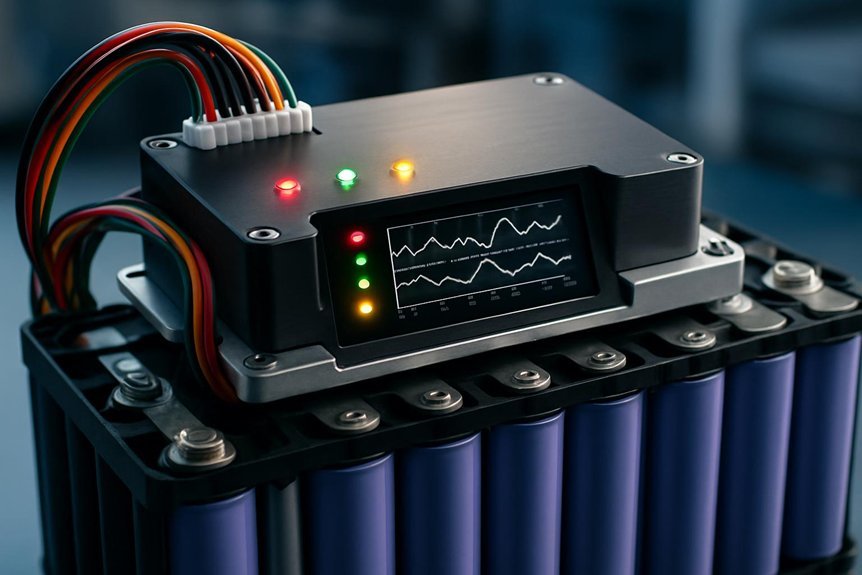
Core roles in a Battery Management System (BMS)—protection, balancing, and fault prediction—work together to ensure safe, reliable lithium battery operation. We, as engineers, implement mechanisms that detect overcurrent, overvoltage, and temperature excursions, then intervene before degradation occurs. Balancing equalizes cell states to maximize usable capacity and extend cycle life. Fault prediction uses data-driven trends to flag imminent failures, enabling proactive maintenance. These roles minimize thermal stress and impedance growth while preserving pack integrity. We avoid unnecessary activations that reduce efficiency, focusing on deterministic responses for safety margins. Our approach hinges on accurate sensing, robust filtering, and timely control actions. Together, they sustain performance, optimize energy density, and reduce risk in real-world usage.
- Safe operating boundaries and dynamic protections
- Real-time balancing strategies with minimal parasitics
- Predictive analytics and fault-admission criteria
- Thermal management integration and response
- Impedance spectroscopy-informed diagnostics
BMS Architectures: Types and When They Excel
We examine architecture variants and map each type to its core strengths, constraints, and typical use cases. We’ll highlight when a segment‑level, modular, or centralized approach excels, aligning the choice with pack chemistry, scales, and fault-tolerance needs. Finally, we offer concrete implementation tips to translate the architecture into reliable, measurable battery performance.
Architecture Variants Overview
What are the architecture variants that power a lithium battery’s BMS, and when does each excel? We categorize by communication topology, processing approach, and sensing strategy, then map to typical application constraints. Our focus is on how lithium chemistry and thermal handling shape the decision, especially around battery cooling needs and sensor fidelity. Each variant trades latency, scalability, and fault isolation for cost and power draw, so we compare implications for packaging, safety, and reliability. We avoid speculative performance claims, concentrating on architecture-driven outcomes and measurable metrics. In practice, the best fit aligns with thermal management demands, cell topology, and the control loop requirements. Clear criteria enable targeted tradeoffs and predictable behavior in real-world systems.
- Topology-driven tradeoffs
- Centralized vs. distributed processing
- Sensor fusion strategies
- Thermal feedback integration
- Scalable architecture considerations
When Each Excels Best
How do you pick the right BMS architecture for a given lithium battery application? We evaluate tradeoffs between cell topology, data bandwidth, and fault isolation. For high-power packs, centralized or modular BMSes minimize interconnect complexity and optimize fast safety responses, but demand robust thermal management to prevent hotspot formation. For large-format energy storage, distributed architectures enhance scalability and redundancy, yet require careful synchronization and communication reliability to preserve state estimation accuracy. If chemistry varies, multi-cell chemistries benefit from adaptive calibration and cell‑level balancing strategies that respect thermal limits. Battery chemistry and thermal management constraints drive sensor density, sampling rates, and fault criteria. Ultimately, selection hinges on balancing safety margins, performance targets, packaging, and maintenance practicality.
Practical Implementation Tips
Choosing the right BMS architecture hinges on matching control topology to your pack’s power, size, and safety requirements; each approach—centralized, modular, or distributed—has distinct strengths and tradeoffs. We present practical guidance, focusing on battery chemistry compatibility, sensing fidelity, and thermal management integration. We prioritize deterministic state estimation, fault handling, and scalable communication, ensuring safe operation across varying duty cycles and ambient conditions. In practice, select a topology that minimizes parasitics, simplifies harness routing, and supports robust isolation. Evaluate calibration workflows, hardware-in-the-loop testing, and firmware update strategies to reduce field failures. Align BMS features with thermal management performance to prevent cell aging and thermal runaway risk.
- Topology choice vs. pack size and duty cycle
- Sensing accuracy, fault granularity, and timing
- Calibration, testing, and OTA strategies
- Thermal management integration and cooling compatibility
- Battery chemistry-specific safety controls
How BMS Communicates: Protocols, Interfaces, and Chargers
Effective communication between a Battery Management System (BMS) and external components is essential for safe, reliable operation. We detail how bms communication occurs across protocols, interfaces, and chargers. Protocols define data structures, fault signaling, state-of-charge reporting, and command sequences, with common standards tailored to lithium systems. Interfaces specify physical layers, signaling voltages, and connector configurations, ensuring robust link integrity under vibration and temperature variation. Chargers interact through defined negotiation steps, balancing charge termination, current limits, and safety interlocks. We emphasize modular design: microcontroller networks, CAN or I2C transport, and specialized high-current bus architectures. Clarity in specification selection prevents misinterpretation and preserves data integrity. Ultimately, consistent, well-documented charging interfaces and protocol implementations enable predictable performance and diagnostics in real-world deployments.
Real-World Benefits: Safety, Longevity, and Efficiency
From the prior discussion of communication protocols and interfaces, we can see how a well-specified BMS directly shapes outcomes in safety, longevity, and efficiency. We examine real-world benefits that result from precise monitoring, fault isolation, and adaptive control strategies, while acknowledging practical limits. Our focus remains on measurable impact rather than theory, emphasizing how safety margins, thermal management, and state estimation translate to fewer faults and longer cell life. We also address transition challenges and regulatory considerations that influence implementation, certification, and interoperability. Real-world gains include consistent performance under varied loads, extended cycle life, and improved energy utilization. This clarity supports informed decisions in design, testing, and operation, minimizing risk and maximizing system reliability.
- Safety margin enhancement through accurate fault detection
- Thermal regulation enabling stable chemistry across cycles
- State-of-charge accuracy reducing over/underutilization
- Fault isolation limiting cascading failures
- Compliance and interoperability guided by regulatory considerations
How to Pick the Right BMS for Your System
How do you select a BMS that aligns with your system’s demands and constraints? We start by mapping load profiles, cell count, chemistry, and allowable voltages, then evaluate protection granularity, balance methods, and communication interfaces. We prioritize scalability and validation processes that fit your architecture, ensuring deterministic safety margins under worst-case conditions. Assess wiring complexity, thermal management compatibility, and fault response timing to avoid cascading failures. Consider battery economics—capital cost, operating expense, and end-of-life reuse—alongside firmware updates cadence, resilience, and update security. Choose a BMS with clear diagnostics, robust data logging, and open, standards-aligned APIs for integration. Finally, verify vendor support, lifecycle roadmap, and testing regimes to confirm the solution maintains performance across operating envelopes and aging.
Common BMS Issues and Troubleshooting Tips
BMS issues often arise from a mismatch between system demands and protection schemes, so we start by cataloging symptoms, logs, and fault codes, then trace them to root causes across cell balance, voltage protection, and thermals. We diagnose with a data-driven approach, isolating faulty sensors, communication glitches, and protection triggers, then map fixes to safety margins and operational envelopes. Priorities include battery safety and robust thermal management, ensuring consistent cell voltages and safe current limits under load. When symptoms persist, we test configuration parameters, firmware compatibility, and sensor calibration, applying targeted mitigations before field deployment. Continuous monitoring and iterative validation close the loop, preventing recurrence and extending pack life.
- Symptom-to-root-cause mapping
- Sensor/calibration checks
- Firmware and comms validation
- Protection threshold tuning
- Thermal management optimization
Frequently Asked Questions
How Does a BMS Handle Thermal Runaway Risk in Practice?
We mitigate thermal runaway by aggressive thermal management and rigorous fault detection; we monitor temperature gradients, slow charging, and isolate modules promptly, ensuring safe shutdowns and active cooling when thresholds are exceeded, preserving pack integrity and preventing propagation.
Can a BMS Prevent Capacity Fade Entirely?
We can’t prevent capacity fade entirely; degradation persists despite optimization, as ions shackle and slip like weathered gears. Toxic materials and supplier risk remain factors we monitor, calibrate, and mitigate through design, QA, and robust lifecycle analytics.
Do All BMSS Support Wireless Communication?
Not all BMSs support wireless communication. We prioritize Wireless monitoring, Data logging, and Firmware updates, and we assess Thermal management, Safety protocols, and Cell balancing to ensure reliable operation and system integrity for readers like you.
What Maintenance Is Required for a BMS?
We maintain the battery with scheduled checks and sensor calibration; regular maintenance includes firmware updates, connector inspections, and thermal monitoring. We’ll outline procedures clearly, focusing on battery maintenance, sensor calibration, and fault diagnosis for reliable operation.
How Scalable Is a BMS for Large Battery Packs?
We can scale BMS for large packs with modular architecture, addressing scalability challenges through shared CIMs and hierarchical control; however, interoperability, timing, and fault containment remain critical as pack size grows.
Conclusion
We’ve seen that a BMS isn’t just a watchdog—it’s the intelligent arbiter of safety, longevity, and performance for lithium packs. By coordinating protection, balancing, and state estimation, it keeps cells within safe margins and optimizes charge cycles. One striking stat: properly engineered BMS architectures can extend cycle life by up to 20–50% in demanding applications by reducing overdischarge and overheating. With the right BMS, you gain reliability, efficiency, and safer operation across your system.