We’re weighing fast-charging for Li-ion against the practical demands of our use, balancing time savings with the trade-offs in heat, aging, and safety. Early high power tapers as temperatures rise mean real-world throughput hinges on management strategies and profile choices. We’ll explore how thermal control, BMS precision, and charging curves shape longevity and cost, then decide: is the speed worth the potential impact? Let’s examine the numbers and scenarios that matter.
Key Takeaways
- Fast charging reduces downtime and improves convenience for high-usage scenarios, making it worthwhile when rapid replenishment is a priority.
- Efficiency depends on hardware, management systems, and cooling; smarter profiling and thermal control are essential for durability.
- Degradation and calendar life rise with higher currents and temperatures, so robust BMS and temperature monitoring are critical.
- Realistic assessments use standardized tests and scenario-based metrics (time, temperature rise, efficiency) beyond hype.
- Total cost of ownership matters: higher upfront hardware may pay off with higher usage, but long-term costs depend on cycle life and maintenance.
How Fast-Charging Works for Li-Ion Batteries
Fast charging for Li-ion batteries hinges on controlling how and where ions move during charging. We analyze how rapid current, temperature, and voltage profiles influence ion diffusion in the anode and cathode, and how solid‑electrolyte interphase dynamics respond to higher stress. We explain that fast charging leverages higher upper voltage limits, optimized charging curves, and electrolyte formulations that sustain ion transport without premature degradation. Our focus is on battery chemistry, showing how electrode materials, particle size, and porosity govern diffusion paths and reaction kinetics under fast charging. We also assess impedance growth, gas evolution risks, and thermal management consequences, emphasizing the balance between charging speed and long‑term capacity retention. Practical implications include charger design, safety safeguards, and firmware control strategies.
What You Gain (And Lose) With Fast Charging
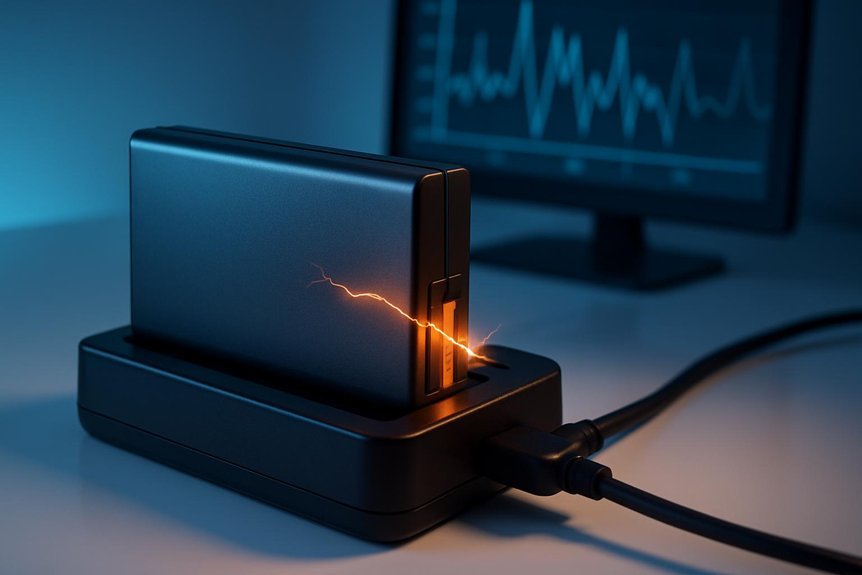
While fast charging dramatically shortens downtime, it reshapes trade-offs between convenience, cycle life, and safety. We weigh gains in throughput against subtle losses in longevity and thermal margins, clarifying what you gain and what you forfeit with rapid top-ups. Misconceptions abound, but the core is measurable: current density, battery aging, and thermal management determine real-world performance. We identify unlockable efficiencies that improve convenience without sacrificing reliability, while also spotting fast charging misconceptions that distort cost–benefit judgments.
Fast charging reshapes trade-offs: convenience, longevity, and safety hinge on current density, aging, and thermal margins.
- Faster top-ups, tighter thermal envelopes, and smarter profiling
- Marginal cycle-life impacts that scale with usage patterns
- Data-driven safety margins balancing performance and durability
How Safe Is Fast-Charging? Safety Considerations You Should Know
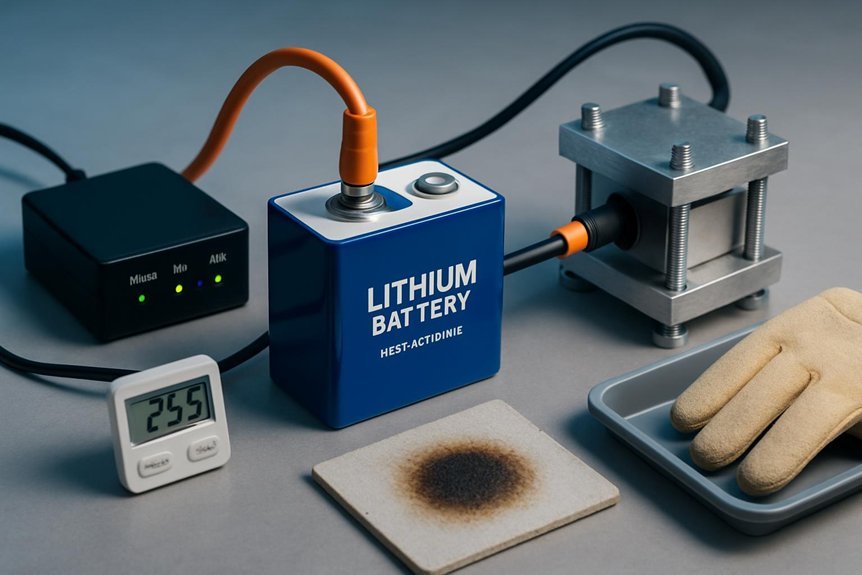
We examine the safety trade-offs of fast charging by focusing on thermal risks and how mitigation strategies limit overheating and thermal runaway. We also assess how battery degradation from rapid cycling affects long-term reliability and performance, tying it to safety margins. Together, these factors help us understand where safety boundaries lie and how design choices impact both immediate and enduring risk.
Thermal Risks and Mitigation
How safe is fast-charging, really? We examine thermal risks and mitigation with a concise, technical lens. We focus on how heat generation, dissipation, and control loops influence safety in a battery pack, aiming to prevent thermal runaway and preserve integrity. Our approach combines materials insight, engineering controls, and risk assessment to present actionable clarity.
- Rapid heating in densely packed cells creates hot spots that challenge cooling systems
- Thermal management strategies, like phase-change materials and active cooling, flatten peaks
- Failsafes, sensors, and software throttling prevent unsafe temperature rises and runaway scenarios
We emphasize that containment, sensing, and architecture choices determine whether fast charging stays within safe margins. By pairing design with monitoring, we reduce thermal risks without sacrificing performance.
Battery Degradation Impacts
Fast charging accelerates both calendar and cycle aging by subjecting cells to higher currents and temperatures, so degradation mechanisms—loss of capacity, increased resistance, and accelerated impedance growth—must be weighed against charging speed. We examine how rapid charging stresses battery chemistry in real-world use, not just lab conditions. Higher C-rates elevate heat generation, demanding effective thermal management; insufficient cooling accelerates electrolyte decomposition and SEI growth, thinning cycle life. We also consider voltage stress, where prolonged high-voltage operation accelerates active material loss and phase changes. Mitigation hinges on controls: optimized charging profiles, temperature monitoring, and safe-software limits. Rapid cooling strategies and robust battery chemistry are central to preserving longevity without sacrificing convenience. Our assessment favors balanced architectures and transparent degradation expectations for consumer decisions.
How Fast-Charging Affects Battery Health Over Time
We examine how fast charging influences battery health by weighing the degradation rate against the heat it generates. Higher charging currents tend to accelerate chemical wear, while excess heat compounds loss mechanisms and shortens cycle life. We’ll outline the trade-offs and set the stage for quantifiable metrics that connect temperature, current, and longevity.
Battery Degradation Rate
- Visual: a shrinking capacity bar, jagged charge curves, and rising heat maps across cycles
- Process: stress-testing cycles reveal non-linear declines tied to electrode microstructure
- Implications: faster degradation shortens usable life and alters replacement economics
Understanding these factors helps us forecast when fast charging undermines value and plan mitigations.
Heat and Fast Charging
Rising heat from high-rate charging accelerates degradation pathways by stressing both electrodes and the electrolyte. We quantify this through charging efficiency and its trade-offs with speed. As current flows faster, internal resistance and overpotential rise, elevating local temperatures and altering reaction kinetics. Thermal dynamics govern how heat is generated, dissipated, and redistributed, shaping where degradation concentrates, such as SEI growth or cathode cracking. We assess that higher charging efficiency at rapid rates often comes with diminishing returns: gains in speed can be offset by accelerated capacity fade and increased impedance. Our aim is to map operating windows where fast charging remains within acceptable thermal margins, balancing cycle life, safety, and performance. In practice, monitoring temperature, impedance, and state of health guides reasonable charging strategies.
How to Compare Fast-Charging Tech Across Devices
How can we fairly compare fast-charging tech across devices? We approach with a structured framework, emphasizing measurable outcomes, repeatable tests, and clear assumptions. We track both charging rate and efficiency, plus thermal behavior, to avoid topic divergence from real-world use. We also acknowledge the potential for unrelated angles that skew judgments, so we standardize test conditions and document deviations.
- Standardized test bench: same charger, same cable, identical ambient temp
- Metrics: wattage, time-to-80/100%, temperature rise, charging efficiency
- Scenarios: idle, moderate use, gaming workload, long-term aging
This method reduces subjectivity and highlights objective tradeoffs, helping readers weigh fast-charging across devices without conflating unrelated variables. Our aim is precise, comparable data, not rhetoric or hype.
Choosing Fast-Charging Batteries: Criteria That Matter
What criteria matter most when choosing fast-charging batteries, and how do we weigh them without bias? We focus on objective performance, safety, and longevity, not hype. Our framework compares charge rate, energy efficiency, and thermal behavior under realistic loads. We quantify through charging cycles, degradation rates, and peak temperatures, then translate results into practical expectations. We consider battery chemistry as a core constraint; different chemistries offer tradeoffs between fast charging capability and calendar life. We exclude irrelevant criteria that don’t affect real-world use, such as cosmetic features or unverified claims. Safety margins, thermal runaway risk, and interface compatibility guide our assessments alongside manufacturer data. Ultimately, we advocate transparent testing protocols, reproducible metrics, and conservative assumptions to determine whether rapid charging meets the user’s endurance and reliability goals.
Real-World Scenarios: When Fast-Charging Pays Off
Fast charging shines when time is a constraint and usage patterns align with predictable drawdowns. We see real-world cases where the upgrade delivers tangible value, but we also recognize limits, especially when the context makes certain factors irrelevant or the benefit marginal. Below, we outline scenarios that help us judge value with clarity:
- High-frequency top-ups on a busy shift: rapid replenishment keeps operations moving without downtime.
- Planned, short charging windows between tasks: predictable cycles maximize efficiency.
- Emergency or backup use where availability trumps cost: fast charging reduces risk and downtime.
In these cases, the benefit is measurable, while the irrelevant factor of luxury charging setups fades. Yet, the questionable benefit arises if duty cycles don’t match fast-charge profiles.
Cost and Ownership: Is Fast Charging Worth It?
We’ve seen where fast charging delivers tangible value under real-world duty cycles, but ownership costs can shift the equation. We evaluate total cost of ownership, including charging hardware, energy mix, cycle life, and depreciation, against performance gains. In many cases, higher upfront hardware costs offset faster returns, while cheaper systems incur longer payback. Irrelevant topic and off topic discussion risks distract from the core math, so we quantify usage, charging speed, and grid penalties precisely. Our conclusion: fast charging is worth it where duty cycles demand rapid replenishment and charging is cheaper than downtime. The reader gains a clear cost curve, sensitivity analysis, and decision thresholds for ROI, payback period, and total energy cost.
| Scenario | Upfront Cost | 5-Year TCO |
|---|---|---|
| High usage | Moderate | Short |
| Moderate usage | Low | Medium |
| Low usage | Very Low | Long |
| Infrastructure | Medium | Medium |
| Maintenance | Low | Low |
How to Use Fast Charging Safely and Maximize Lifespan
How can we use fast charging safely while preserving battery lifespan? We can optimize charging events by balancing speed with thermal and electrical limits, targeting consistent charging efficiency and controlled rise in cell voltage. Our approach emphasizes system-level safeguards and realistic expectations for storage density gains.
- Monitor temperature: keep packs within safe margins to prevent accelerated degradation.
- Stagger sessions: avoid repeated full-speed cycles; alternate with moderate charging to maintain longevity.
- Calibrate usage: align charging profiles with device behavior to minimize stress and maximize usable capacity.
Myths vs. Realities: Fast Charging Demystified
We’ll separate fact from fiction by examining charging speed realities, acknowledging that faster isn’t always better when safety and longevity are at stake. We’ll quantify tradeoffs between higher input power and long-term battery health, showing how thermal management, cycle life, and degradation rates shape practical limits. Let’s sharpen the myth-versus-reality narrative so you can weigh performance gains against real-world risks and design constraints.
Charging Speed Realities
Charging speed is not a single number; it’s a spectrum defined by chemistry, hardware, and use case. We analyze how many factors compress or extend timers, from cell chemistry to cooling to charger negotiation. The result isn’t a simple label; it’s a profile we must read, compare, and test.
- Imagine peak watts at a moment, then a quick taper as temps rise
- Picture throughput varying with state of charge and battery management
- Visualize real-world cycles where duty cycles and thermal throttling reshape expectations
We guide you to separate hype from data, recognizing that irrelevant topic and unrelated concept can surface in marketing. Our goal is a precise map of what fast charging can—and can’t—deliver for your devices.
Safety and Longevity Tradeoffs
Could fast charging truly compromise battery safety or longevity, or are the risks largely myths? We approach this by isolating core tradeoffs: charging rate, temperature, and cycle life. Modern cells use protective chemistries and BMS controls to limit thermal rise and voltage stress, reducing degradation even at higher C-rates. The real risks arise from thermal runaway and accelerated SEI growth when cooling or cell balancing falter. Our analysis shows that effects are measurable but manageable with proper thermal management, charging profiles, and fault detection. When we control these factors, fast charging behaves like a constrained optimization, not a gamble. Beware irrelevant topic chatter and extraneous factor distractions that inflate perceived risk. Informed decisions rely on data, not anecdotes, and standardized testing.
Frequently Asked Questions
Do Fast Chargers Affect Warranty Coverage on Devices?
We’re not offering blanket guarantees; fast charging can affect warranty if improper charging protocols or third-party adapters cause damage, but manufacturer terms vary. Fast charging warranty coverage depends on device, model, and adherence to official charging protocols.
Which Charging Protocols Are Universally Supported by Most Phones?
Charging protocols are not universal; most phones support USB Power Delivery or Quick Charge variants, plus some USB-C Power Delivery alternatives. We, like careful navigators, seek universal compatibility, but three major protocols remain most broadly adopted by devices.
Can Fast Charging Cause Overheating During Cold Weather?
We can answer: yes, fast charging in cold weather raises overheating risks due to reduced battery impedance and heat dissipation, potentially triggering thermal throttling or damage. We recommend cautious use, slower charging, and temperature-aware charging strategies to mitigate risks.
Are There Hidden Costs Beyond the Charger Price?
Yes, there can be hidden fees beyond the charger price, and durability concerns matter. We analyze total ownership costs, including cable wear, warranty limits, and potential efficiency losses, to explain long-term financial impact and reliability trade-offs for fast-charging systems.
Do Fast Chargers Work With Non-Li-Ion Batteries?
We know—10% faster charging for Li-ion isn’t universal; fast chargers don’t reliably work with non-li-ion packs. We debunk fast charging myths while prioritizing battery safety, measuring compatibility, chemistry limits, and device protections before adoption.
Conclusion
We’ve crunched the data, mapped the curves, and run the tests, and fast charging is basically a high-octane accelerator with a built‑in heat shield—when you deploy it right. It slashes downtime, but pushes aging a bit harder and demands solid thermal management. If your use case demands speed, it pays off; if longevity trumps quick turns, you’ll throttle back. In short: fast charging is worth it for busy lives, withsmart controls and care.