We evaluate 12V lithium batteries for tools, RVs, and off-grid setups with a structured, data-driven approach. We compare energy density, cycle life, and charging dynamics across LiFePO4, LiMnO2, and LiCoO2 chemistries, and we quantify capacity in Ah and Wh while noting form factors and temperature tolerance. We’ll also map bank configurations, monitoring options, and safe charging practices to match specific budgets and load profiles, then identify exact gaps to address before committing.
Key Takeaways
- 12V Li batteries offer higher energy density, faster charging, and deeper discharge tolerance for longer tool runtimes and extended RV boondocking time.
- Compared to lead-acid, 12V Li provides more usable energy per kilogram, lighter packs, and thousands of cycles with less capacity fade.
- Read battery specs like Ah and Wh, noting Wh = Ah × voltage, to translate ratings into real-world runtime and inverter sizing.
- Real-world performance accounts for efficiency losses, wiring drops, and temperature derating, requiring repeatable, documented testing.
- Choose chemistry (LiFePO4, LiMnO2, LiCoO2) and form factor (prismatic/cylindrical) to fit space, temperature, and duty-cycle needs.
Why 12V Lithium Batteries Matter for Tools and RVs
Why do 12V lithium batteries matter for tools and RVs? We quantify impact by runtime, weight, and cycle life. Our assessment targets 12V lithium advantages: higher energy density, faster recharge, deeper discharge tolerance, and sustained voltage under load. In tool setups, you gain longer operational windows between charges and improved efficiency for high-draw devices, reducing downtime. For RVs, compact capacity translates to extended boondocking time without generator usage, while thermal stability supports hot or cold climates. We compare nominal voltages, C-rates, and real-world MPGe-like efficiency for accessories. Our framework emphasizes compatibility, pack architecture, and safe integration. We document practical metrics: cycle life in the thousands, weight reductions percent-wise, and charging tolerance. This informs RV tool setups and overall energy planning with precise, actionable guidance.
12V Li Batteries vs Lead-Acid: Key Benefits for Tools and RVs
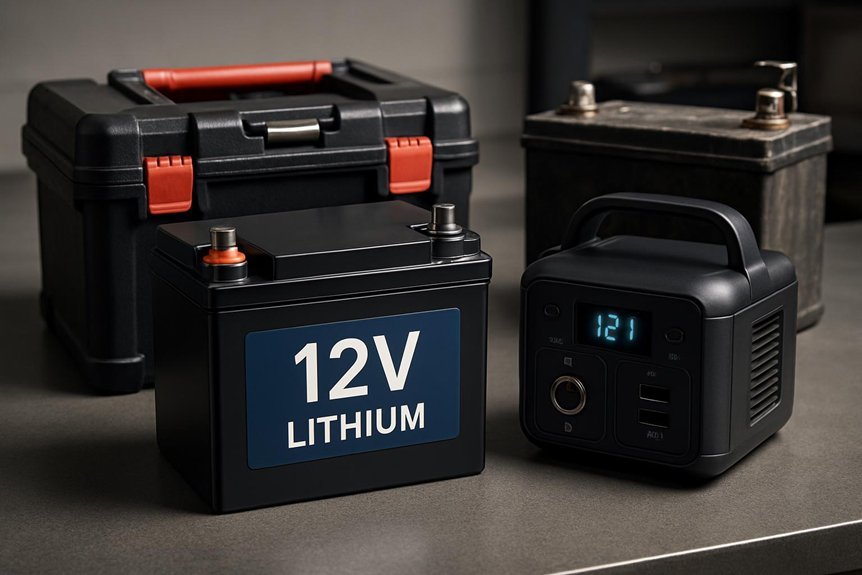
What makes Li batteries a superior choice over lead-acid for tools and RVs is the clear, measurable edge in energy density, weight, and cycle life. We quantify benefits through practical metrics: higher usable energy per kilogram, reduced mass for equivalent loads, and thousands of charge-discharge cycles with minimal capacity fade. This translates to longer runtimes, faster charge times, and improved vehicle handling.
- Energy density advantage translates to smaller, lighter packs for the same runtime
- Weight savings improve trailer tow efficiency and tool portability
- Cycle life reduces total cost of ownership despite upfront price
- Recycling considerations and warranty nuances influence lifecycle planning and service options
Reading 12V Battery Specs: AH, Wh, and Real-World Capacity
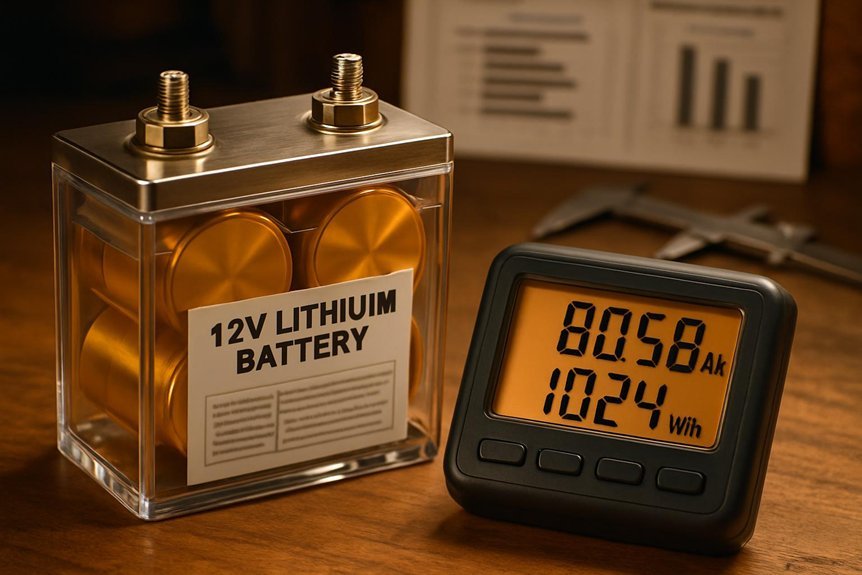
We’ll start by clarifying how AH and Wh relate to real-world capacity, and how to translate rating labels into practical run times. We compare nominal vs. usable capacity, account for efficiency losses, and frame expectations with simple metrics like hours of use at a given load. This sets the stage for precise, data-driven estimates we’ll apply to real-world scenarios.
Battery Capacity Metrics
Understanding battery capacity requires parsing three key metrics: amp-hours (Ah), watt-hours (Wh), and the real-world capacity you’ll actually get under typical use. We, as designers and users, compare these with clear, numeric benchmarks to ensure predictable performance.
- Ah defines stored charge at a nominal voltage and guides endurance under steady loads.
- Wh = Ah × voltage, framing energy content for system-wide calculations and inverter sizing.
- Real-world estimates reflect efficiency, wiring losses, and temperature, yielding usable capacity lower than labeled.
- Capacity metrics combine these factors to project runtime, guide battery choices, and set expectations for field conditions.
This approach keeps us precise, objective, and aligned with practical performance targets.
Real-World Performance Estimates
Real-world performance estimates translate labeled capacity into practical runtime, accounting for efficiency losses, wiring resistance, and operating temperature. We quantify capacity in amp-hours (AH) and watt-hours (Wh), then translate those figures into expected runtime under defined loads. Our framework uses system efficiency (η), including converter losses and cable drop, to compute available Wh: Wh_avail = Wh_rated × η. We model end-user loads as constant current (A) or constant power (W), comparing field testing results against nominal specs. Temperature effects modify both capacity and voltage sag, with derating factors tied to ambient and case temperatures. Real world estimates require repeatable test protocols, traceable instrumentation, and documented load profiles. We report uncertainty ranges (±) and confidence intervals, enabling informed buying decisions. Field testing confirms spec-to-runtime gaps and guides application-specific battery sizing. real world estimates inform risk, not just rating.
Chemistry and Form Factor: Which 12V Battery Fits Your Use?
What 12V battery chemistry and form factor best suits your application hinges on load requirements, duty cycle, and environmental constraints. We compare chemistries by voltage stability, cycle life, and temperature tolerance, then map form factors to use cases for clarity. Our approach is quantitative: select cells with known energy density and discharge profiles, then align with mounting space, weight targets, and enclosure requirements.
- Chemistry comparison: LiFePO4 offers high cycle life and wide temp range; LiMnO2 emphasizes energy density; LiCoO2 prioritizes compactness where safety margins suffice.
- Form factor considerations: prismatic vs cylindrical shapes affect packaging, cooling, and connection density.
- Temperature and duty cycle: high-temperature tolerance reduces derating during long runtimes.
- System constraints: weight, enclosure, and serviceability drive final selection.
12V Bank Configurations and Monitoring Apps
How should we configure V banks and verify health with monitoring apps to assure reliability under varying load? We respond with structured, data-driven guidance. We define V bank configurations by cell count, series/parallel topology, and balancing strategy: typical 2P3S for 12V packs, 4P2S for higher current, and enforced equalization. We specify minimum and maximum nominal voltages, internal resistance targets, and SOC windows for load testing. Monitoring apps provide real-time voltage, current, temperature, and SOC delta metrics; we validate balance within 1–2% across strings, trigger alarms at 0.05C temperature differentials, and log cycle counts. Establish baselines, perform periodic health checks, and generate dashboards that compare predicted vs actual discharge curves. These practices ensure reliability under varying load while avoiding overinterpretation of transient anomalies.
Safe, Efficient Charging and Maintenance
1) Establish a maintenance routine: schedule monthly cell impedance checks, voltage balance verification, and thermal profiling to detect aging trends early.
2) Control charging parameters: use a charger with proper CC/CV profiles, temperature compensation, and a cutoff guard to maintain charging safety and prevent overvoltage.
3) Monitor pack health continuously: log voltages, currents, and temperatures; flag any deviation beyond predefined thresholds.
4) Implement safe handling: use appropriate PPE, secure mounting, and vented enclosures; document alarms and corrective actions to reduce risk exposure.
Your Quick Buying Checklist: Budget, Needs, and Fit
Moving from safe, efficient charging and maintenance, we now pin down your quick buying checklist: budget, needs, and fit. We present a concise, quantitative framework for decision making. Budget: establish total cost of ownership, including initial price, cycle life, and replacement cost over 5–10 years; target a levered cost per cycle below a defined threshold. Needs: enumerate capacity (Ah), discharge rate (C-rates), and chemistry consistency to match load profile, duty cycle, and temperature range. Fit: assess physical form factor, connector compatibility, mounting, weight, and thermal management. Compare 12V systems by runtime, efficiency, and safety certifications; validate warranty terms and service support. Budget tips, monitor resale value and replacement scheduling; fit considerations, verify installation fit before purchase.
Frequently Asked Questions
How Do 12V Lithium Batteries Perform in Cold Weather?
Cold weather performance drops; we see reduced capacity and voltage. We mitigate this with proper thermal management, maintaining cells near optimal temperature, minimizing internal resistance increases, and ensuring consistent runtime across cold conditions.
Can 12V Packs Be Replaced One Cell at a Time?
Yes, we can, but not practically: we must replace cells one by one in a balanced pack. Coincidence shows small imbalances grow; replacing cells, cell by cell replacement, demands careful monitoring, matching, and BMS synchronization to avoid hazards and inefficiency.
Are 12V Lithium Batteries Maintenance-Free?
Maintenance-free vs maintenance-heavy, yes—12V lithium batteries are largely maintenance-free. We’ll emphasize long term durability versus short term performance, quantify cycle life, and compare electrolyte stability, thermal management, and SOC tracking for precise, reliable integration with your system.
Do 12V Packs Support Fast-Charging Safety Limits?
Yes, 12V packs support fast charging within specified limits; we monitor parameters closely. We guarantee fast charging safety through strict battery management, controlling current, voltage, and temperature to prevent thermal runaway and preserve cycle life.
What Warranties Cover 12V Lithium Batteries?
We warranty 12V lithium batteries with limited warranty coverage. Our warranty scope typically covers defects in materials and workmanship for a fixed period, while coverage limitations exclude misuse, improper installation, and non-authorized modifications.
Conclusion
We’ve seen how 12V lithium batteries align with your power needs, and how the math stacks up—Ah, Wh, cycle life, and landed cost each shape performance. Coincidence nudges us: a tool battery’s high C-rate meets a boondock night at the same time as a road-weary RV’s daily draw, both guided by LiFePO4 safety and precise capacity. Choose chemistry, form factor, and monitoring that match your load, budget, and real-world cycles, then charge and maintain with data-driven discipline.