We compare Lithium-Ion and LiFePO4 on energy density, safety, and longevity, evaluating how each chemistry handles real-world duties. Our analysis traverses density, thermal behavior, cycle life, and charging dynamics, grounding recommendations in data-driven criteria. While Li-Ion offers higher energy and faster response, LiFePO4 provides safer operation and steadier voltage. The choice hinges on duty cycle and thermal management. We’ll outline practical implications and a framework to guide your selection as we uncover the nuanced tradeoffs.
Key Takeaways
- Li-ion delivers higher energy density (150–200 Wh/kg, 400–600 Wh/L) vs LiFePO4 (90–120 Wh/kg, 180–320 Wh/L), boosting runtime in portable devices and EVs.
- LiFePO4 offers better thermal stability and safety, with lower peak temperatures under faults, though its charging can be slower at high C-rates.
- Li-ion generally supports faster charging and dynamic response, but efficiency and performance vary with SOC and temperature; LiFePO4 is steadier and more predictable.
- LiFePO4 typically outcycles Li-ion (often 2,000–3,000+ cycles at 80% DoD) with less capacity fade, especially under high DoD and temperature stress.
- Practical choice depends on use case: Li-ion for high energy density needs; LiFePO4 for safety, longevity, and cost-effectiveness in stationary or grid applications.
Li-Ion vs LiFePO4: Key Differences You Need to Know
Are Li-ion and LiFePO4 batteries fundamentally different, or are their distinctions mostly situational? We present a concise, data-driven comparison to guide readers through practical implications. Li-ion typically offers higher energy density and lighter weight, improving runtime in portable devices and EVs, while LiFePO4 emphasizes stability, thermal safety, and cycle life in demanding environments. Our two word discussion ideas revolve around performance framing and safety considerations, and we note that the subtopic not relevant to other h2s. In battery comparison terms, LiFePO4 trades some energy density for greater energy efficiency in energy-limited systems with frequent cycling. For users prioritizing longevity and consistent behavior under thermal stress, LiFePO4 can outperform standard Li-ion chemistries, despite tighter form factor or higher upfront cost.
Energy Density: How Much Power Do They Really Hold?
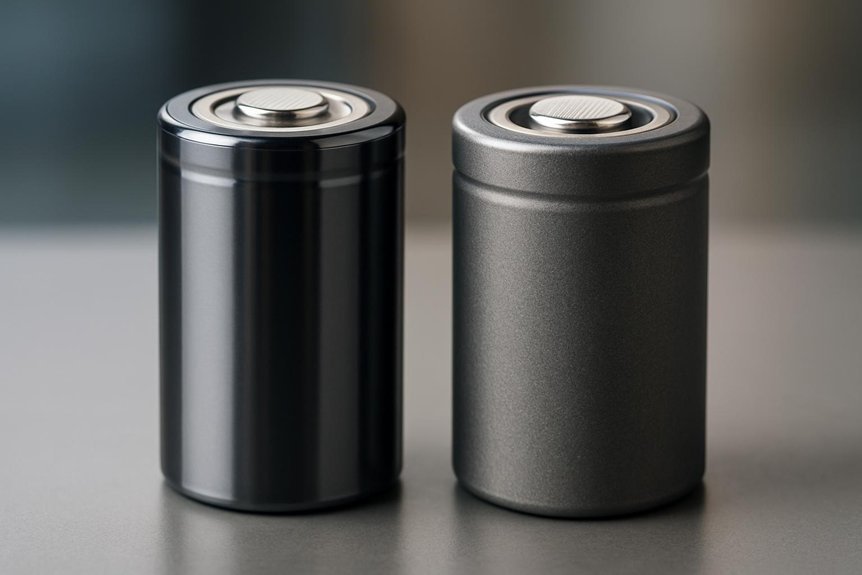
When we compare energy density, Li-ion and LiFePO4 chemistries reveal a clear trade-off: Li-ion cells typically store more energy per unit mass and volume, boosting runtime for portable devices and EVs, while LiFePO4 cells deliver lower energy density but steadier performance under cycling and thermal stress. In practice, gravimetric values for Li-ion often exceed 150–200 Wh/kg, with volumetric figures above 400–600 Wh/L, whereas LiFePO4 typically lands around 90–120 Wh/kg and 180–320 Wh/L. Beyond raw numbers, chemical stability drives long-term capacity retention, yet irreversible capacity loss can accumulate with high-temperature or high-rate cycling. Weighing factors like operating temperature, safety margins, and thermal management clarifies why energy density isn’t the sole determinant of suitability across applications.
Charging Speed and Efficiency: What to Expect in Real Life
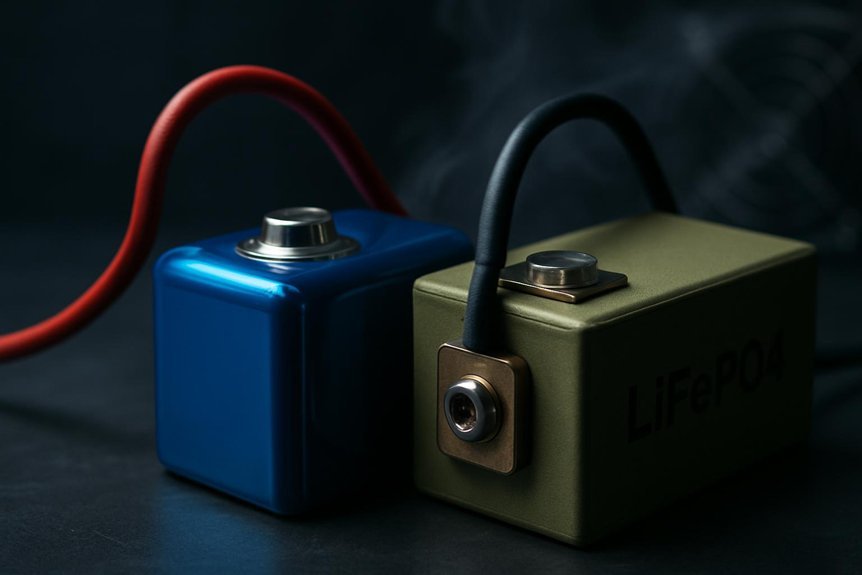
Charging speed and efficiency differ notably between Li-ion and LiFePO4 chemistries in real-world use. We assess charging speed by looking at C-rate behavior, impedance growth, and the impact of temperature. Li-ion typically sustains higher acceptance currents, but efficiency variability rises with higher states of charge and thermal fluctuations. LiFePO4 shows steadier voltage plateaus and more predictable current limits, yet it often delivers slower practical charging, especially at elevated C-rates, due to higher internal resistance at cold starts. We quantify efficiency by examining coulombic and energy efficiencies under representative load profiles. In real life, charging speed is constrained by BMS safety margins, aging, and cooling availability, while efficiency variability reflects chemistry-specific polarization and cell balancing needs. Readers should consider application duty cycles and ambient conditions when comparing overall performance.
Safety and Thermal Stability: Which Chemistry Feels Safer?
Li-ion and LiFePO4 chemistries present distinct safety and thermal profiles that influence risk assessment in real-world use. We compare their inherent failure modes, focusing on containment, heat generation, and mitigation effectiveness. Li-ion cells typically exhibit higher energy density, which can amplify consequences during abuse if protective measures fail, whereas LiFePO4 chemistry generally demonstrates more favorable thermal stability and lower peak temperatures under similar faults. Safety signaling, such as built-in venting, current interruption devices, and cell design cues, often responds differently across chemistries, shaping alarm thresholds and response protocols. In practice, thermal runaway risk remains a function of cell design, packaging, and thermal management, not chemistry alone. We emphasize robust monitoring, effective cooling, and proper charging to reduce vulnerability in both systems.
Longevity and Cycle Life: How Long Will They Last?
We compare cycle life and calendar aging across Li-ion and LiFePO4 chemistries, focusing on how performance declines over repeated use versus time. We’ll quantify End-of-Life longevity and how calendar wear interacts with cycle wear, highlighting practical implications for expected life under various duty cycles. This discussion sets the stage for interpreting the Points: Cycle Life Comparison, Calendar vs. Wear, and End-of-Life Longevity.
Cycle Life Comparison
How long a battery lasts hinges on cycle life, which quantifies how many complete charge–discharge cycles each chemistry can endure before capacity falls to a specified threshold. We compare lithium-ion and LiFePO4 by how they resist degradation under real use, noting the distinct drivers of calendar aging and cycling stress.
1) Cycle life endpoints differ: LiFePO4 often exceeds 2,000–3,000 cycles at 80% DoD, while typical lithium-ion ranges ~500–1,500 cycles under similar conditions.
2) Depth of discharge materially shifts outcomes; shallower cycles preserve capacity longer for both chemistries.
3) Temperature accelerates aging; higher temps amplify calendar aging and cycle wear, reducing usable life.
4) Chemical stability governs long-term retention, with LiFePO4 offering steadier resistance to voltage fade.
Understanding these nuances guides design choices and maintenance schedules.
Calendar vs. Wear
Could calendar aging and cycle wear be disentangled when predicting battery longevity? We examine how calendar aging reflects time-driven capacity loss, while wear captures cycle-induced degradation from charge/discharge events. In lithium ion systems, calendar effects arise from chemical aging and continued SEI growth, independent of usage, whereas wear scales with depth of discharge, C-rate, and temperature during operation. We compare Li-ion chemistries against LiFePO4 variants, noting that LiFePO4 typically exhibits slower calendar decay yet distinct cycle stability. Our analysis emphasizes that total longevity results from the interaction of calendar and wear, not their sum alone, since operating history shapes both processes. We emphasize controlled storage, moderated temperatures, and managed cycling as methods to extend life without sacrificing performance. calendar vs. wear remains a practical dual-parameter framework for lithium ion diagnostics.
End-of-Life Longevity
- Cycle durability: LiFePO4 typically sustains more cycles at high depth of discharge, extending end of life in energy storage contexts.
- Calendar aging: Capacity fade from storage time matters; Li-ion variants convert aging differently across temperature bands.
- Operational bounds: Real-world duty cycles determine usable life more than nominal specs.
- End-of-life criteria: Capacity threshold and safety limits define retirement points and recycling considerations.
Total Cost of Ownership: Price, Maintenance, and Replacements
Evaluating total cost of ownership requires a clear view of price, maintenance, and replacements across lithium-ion and LiFePO4 options. We present a structured comparison that captures upfront price, cycle life, and replacement timing. Lithium-ion cells generally offer higher energy density but incur higher replacement costs and potential degradation-related penalties. LiFePO4 provides longer calendar life and steadier performance, reducing replacement frequency, though unit costs per kWh can be higher in some configurations. Maintenance scheduling emerges as a decisive factor: LiFePO4 systems typically require less frequent conditioning and balancing, while lithium-ion packs demand tighter monitoring and timely balancing to prevent efficiency loss. Overall, total cost hinges on usable energy, duty cycle, and retrofit needs, with careful cost comparison guiding procurement decisions and lifecycle planning.
Temperature Sensitivity: How Weather and Heat Affect Performance
Temperature and ambient conditions profoundly shape battery performance and reliability. We examine how temperature sensitivity and weather impact manifest in Li-ion and LiFePO4 chemistries, focusing on efficiency and safety margins.
- Temperature sensitivity shifts charge/discharge efficiency, elevating internal resistance at low temperatures and accelerating aging at high temperatures.
- Weather impact alters rate capability, where heat waves reduce cycle life while cold spells depress available capacity.
- Thermal management becomes critical, with active cooling or heating needed to maintain optimal operating windows.
- Performance trade-offs emerge between energy density, safety margins, and longevity under fluctuating environmental conditions.
Understanding these effects helps us tailor usage, protective measures, and monitoring to preserve reliable operation across climates.
Ideal Use Cases: When Li-Ion Shines
Li-ion batteries excel in applications demanding high energy density and fast dynamic response, where compact form factors and lightweight design matter most. We target scenarios requiring prolonged runtime with minimal weight penalties, such as portable electronics, drones, and plug-in hybrids, where performance margins matter more than raw endurance alone. In these use cases, the energy-to-weight ratio often drives usability, and Li-ion chemistry supports rapid discharge and efficient charging profiles. While evaluating options, we perform a useful comparison against competing chemistries to quantify density, cycle life, and thermal behavior under typical duty cycles. Readers should weigh safety tradeoffs alongside performance, recognizing that high energy density introduces more stringent thermal management and fault containment requirements. Our assessment emphasizes data-driven criteria, avoiding overgeneralizations while guiding design choices toward optimized functionality.
Ideal Use Cases: When LiFePO4 Shines
Where LiFePO4 shines is in applications that prioritize safety, longevity, and cost-effectiveness over maximum energy density. We analyze its practical use cases with a focus on reliability, lifecycle cost, and predictable performance under varied conditions. Our assessment centers on how battery safety and thermal management influence long-term outcomes and maintenance needs.
Where LiFePO4 excels in safety, longevity, and cost-effectiveness over peak energy density, guiding reliable, low-maintenance long-term performance.
- Stationary energy storage systems requiring stable long-term cycles and low risk of thermal runaway.
- Off-grid or remote deployments where rugged safety margins reduce monitoring complexity.
- Electric fleets prioritizing total cost of ownership and predictable degradation curves.
- Grid-tollow or backup applications that favor longevity over peak power demands.
Which Chemistry Should You Choose for Your Project? A Practical Framework
We start from a concise framework that maps Battery Chemistry Tradeoffs to our Project Requirements. We’ll align performance, safety, cost, and lifecycle goals with a Practical Decision Framework to guide selection. This discussion invites you to evaluate how Li-ion and LiFePO4 meet your specific needs, with a clear path to a justified choice.
Battery Chemistry Tradeoffs
So how do we choose the best battery chemistry for a given project? We frame tradeoffs in concrete terms, balancing performance, safety, and lifecycle cost. Our assessment weighs chemistry-specific limits, such as energy density, rate capability, and thermal stability, against project constraints. We also account for compatibility constraints and manufacturing tradeoffs, ensuring feasibility from design to production. The goal is a transparent decision that minimizes risk while meeting targets.
- Evaluate energy density versus runtime requirements, noting weight and volume implications.
- Assess thermal management, safety margins, and fault tolerance for the intended environment.
- Compare cycle life, calendar life, and degradation profiles under expected usage.
- Align supply chain, manufacturing processes, and cost curves with project timelines.
Together, we translate chemistry properties into actionable project criteria for a robust choice.
Project Requirements Mapping
To map project requirements to a suitable chemistry, we start from the tradeoffs discussed earlier and translate them into concrete criteria. We define target energy density, cycle life, calendar life, safety margins, cost envelope, and thermal tolerance. We then map these criteria to battery chemistry options, assessing how Li-ion variants and LiFePO4 meet each criterion under expected operating conditions. We establish acceptance thresholds for metrics such as specific energy, depth of discharge, and calendar aging, and we quantify performance degrades with temperature and load. We consider supply chain reliability, environmental impact, and testability within project milestones. The result is a defensible selection framework that prioritizes energy storage performance, safety, and total cost of ownership for the given use case.
Practical Decision Framework
Which chemistry should you choose for your project? We present a practical decision framework that weighs performance, constraints, and lifecycle implications in a disciplined way. Our approach balances cycle life and energy density to align with project goals, budgets, and safety requirements.
- Define target duty cycle and required energy density to set baseline metrics.
- Map cycle life expectations against reuse, maintenance, and replacement timing.
- Evaluate total cost of ownership, considering upfront, operating, and end-of-life costs.
- Assess safety, thermal management, and supply stability alongside environmental impact.
We then synthesize results into a recommendation, acknowledging trade-offs between chemistries and emphasizing data-driven choices. This framework supports disciplined, repeatable decision-making, not prescriptive zeal.
Frequently Asked Questions
Can Recycling Options Differ Between Li-Ion and Lifepo4?
Yes, recycling options differ: we tailor processes to chemistry, with Li-ion and LiFePO4 requiring distinct recycling processes, and we navigate varying end of life regulations to maximize material recovery and safety. We analyze, optimize, and report results.
Do Both Chemistries Require the Same BMS?
Sure: no, not the same BMS; different protections are required. We’re analyzing chemistries and conclude that a BMS must be tailored, addressing cell chemistry, voltage, and balancing needs, while maintaining universal safety safeguards for both.
How Do Temperature Swings Affect Charging Cycles?
Temperature swings affect charging cycles by accelerating capacity fade and increasing internal resistance during extremes; we mitigate with tailored charging profiles, and tighter temperature control. We monitor deltaV and impedance changes to preserve cycle life, optimizing charging cycles accordingly.
Are There Compatibility Issues With Existing Battery Packs?
Like gears in a precision clock, we see compatibility concerns with existing packs. We’ll assess pack swapability, connector standards, BMS signals, and chemistries to ensure safe integration and consistent performance across systems.
Which Chemistry Has Higher Heat Generation Under Load?
Higher heat under load: Li-ion tends to generate more heat than LiFePO4 due to higher energy density and internal resistance, though real-world conditions matter. We assess operating temps, C-rates, and thermal management to minimize thermal buildup.
Conclusion
We’ve shown how Li‑ion and LiFePO4 each serve distinct roles, not one superior across the board. Consider that LiFePO4’s cycle life can exceed 2,000–5,000 cycles with minimal capacity fade, versus typical Li‑ion around 500–1,500 cycles in real use. This statistic highlights a practical priority: longevity and safety for stationary or high-cycle applications often trump energy density. In our framework, choose based on duty cycle, thermal management, and cost, not just capacity.
