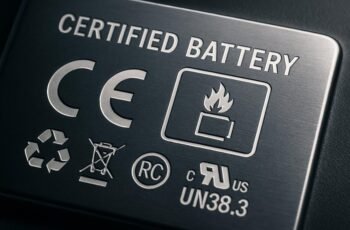
We scan the risk landscape as if we’re watching a stack of batteries glow in the dark, measuring exposure drivers, containment capacity, and regulatory pressure with a probabilistic lens. We quantify units on site, aggregate energy, charging throughput, and density to project loss potential and cascading risk. We’ll map how location, use, and standards shape underwriting, weigh traceability and fire behavior tests, and frame the controls that reduce probability and severity. The next step reveals how to structure coverage and mitigate losses.
Key Takeaways
- Lithium battery risk is driven by exposure magnitude (units and energy) and density, affecting potential loss size and propagation risk.
- Location, use, and regulatory context shape exposure, containment capability, and underwriting decisions for battery-related losses.
- Regulatory standards (BS ISO 3941:2026, UN reforms) and compliance programs influence loss inputs, premiums, and coverage eligibility.
- Evidence, forensics, and data quality impact attribution of fires, requiring robust documentation and chain-of-custody in claims.
- Risk mitigation, incident response, and endorsed controls (storage, charging practices, and detection) enable premium credits and faster remediation.
Lithium Battery Risk in Insurance: Why It Matters Now
Could lithium battery risks be the next dominant driver of insurance loss? We quantify exposure by mapping growing incident frequency, scale, and loss concentration across sectors. Reported fires rise ~10% annually, with EV/PHEV fires numbering in the thousands and large energy storage incidents capable of multi-million-dollar losses. We model rapid thermal runaway, high heat release, and cascade failure as non-linear risk amplifiers, increasing probability of deductible-relevant events and extended business-interruption durations. Chemistry incompatibilities and consumer behaviors emerge as critical interaction terms: improper charging, damaged handling, and storage practices elevate fault likelihood and severity. Underwriting now requires exposure mapping, BMS/thermal management verification, and supervised charging controls. We project higher premiums and exclusions to reflect persistent uncertainty, with contingent liabilities arising from toxic byproducts and environmental cleanup. The LIB fire data landscape underscores substantial gaps in reporting and the need for integrated, multi-source analysis to produce discipline-wide risk assessment and pricing precision.
Core Exposure Drivers for Underwriters: Volume, Location, and Use
What, exactly, drives exposure for lithium battery risk underwriters? We quantify volume as total on-site units and cumulative energy (kWh), noting loss size scales with aggregate energy. Density—units per location—drives escalation risk via thermal propagation and suppression complexity. Mixed chemistries and form factors increase heterogeneity in runaway behavior and gas emissions, raising model variance. Throughput frequency elevates handling and charging incident likelihood. Large fleets create aggregation concentration risk that can exceed sublimits without aggregation modeling. Location factors matter: occupancy type, storage/charging placement, and proximity to high-value assets amplify conditional loss exposure and business interruption. Local fire service capabilities and hazmat resources constrain containment. Regulatory constraints alter insurability. Unrelated topic, unrelated theme. Operational controls—procedures, segregation, and compartmentation—mitigate human-factor and ignition probabilities.
How Regulators Are Shaping Underwriting and Pricing
Regulatory frameworks now directly reshape underwriting and pricing by anchoring loss inputs to verifiable standards, incident data, and mandatory controls. We quantify impact through standardized fire-behavior tests, labeling, and supply-chain traceability, then translate them into risk tiers and premium ladders. Adoption of BS ISO 3941:2026 and UN transport reforms narrows uncertainty about transit exposure, while stationary-storage codes tighten entry criteria for coverage. Mandatory incident reporting—with standardized formats—and regulator-led post-incident investigations enrich cause, failure mode, and loss magnitude data, reducing model error. Data sharing gaps persist, but improved datasets lower pricing dispersion and enable probabilistic adjustments for regional exposure. Compliance-driven controls—fire-rated enclosures, detection, and suppression—translate into measurable loss-reduction credits, calibrated by audit frequency and documented maintenance. Insurers increasingly anchor loss inputs to verifiable standards and incident data, guiding underwriting and pricing decisions.
Evidence Challenges in Battery-Caused Losses: Causation, Traceability, Forensics
Causation, traceability, and forensic analysis in battery-caused losses are inherently uncertain, yet we can quantify that uncertainty by mapping it to data quality, material signatures, and scene dynamics. We present a probabilistic framework: forensic traceability relies on preserved fragments, chain-of-custody, and the likelihood of origin cues surviving high heat and suppression activities. Incident documentation must capture temporal sequencing, discoloration patterns, and residue distribution to support proximal-cause arguments. We acknowledge that microstructural, electrochemical, and chemical forensics face constraints from volatilization, migration, and non-unique signatures, reducing discriminative power. Our approach weights evidence sources by preservation probability, sampling coverage, and contamination risk, yielding confidence intervals for attribution. While complete certainty is rare, structured documentation and layered analyses improve decision quality for insurers and investigators alike.
Risk-Mitigation That Insurers Reward: Policies, Programs, Audits
We quantify how compliance through audits, mitigation-oriented endorsements, and third-party certifications shift risk by reducing high-severity probabilities and stabilizing loss distributions. Our review shows that structured policies, targeted programs, and independent verifications yield measurable improvements in control effectiveness, traceability, and incident response, with audited sites reporting lower claim frequencies and faster remediation. We invite readers to evaluate specific metrics—compliance rates, endorsement uptake, and certification attainment—as predictors of premium stability and coverage reliability.
Compliance Through Audits
- We verify battery compliance across standards (BS ISO 3941:2026, UN 38.3, NFPA provisions) and capture results.
- We document governance cadence, owner roles, and escalation paths to demonstrate active risk oversight.
- We retain audit artifacts (inspections, test certificates, corrective actions) for claims defense and underwriter review.
- We integrate BMS, SOC/SoH trends, and emergency drills into repeatable audit scope for ongoing assurance.
Mitigation-Oriented Endorsements
Mitigation-oriented endorsements translate risk controls into measurable insurance terms, tying coverage to verifiable charging and storage practices. We quantify risk reduction as tiered premium adjustments tied to verified infrastructure, with 5–20% discounts for medium risk and higher for high-value risks, scaled by battery quantity and energy capacity. Evidence of fire-suppression upgrades, segregated charging zones, and enforced maximum simultaneous charging counts yield measurable loss-expectancy improvements and experience-rating credits after multi-year audits. Conditional savings depend on periodic compliance checks and maintenance logs; noncompliance penalties and premium recapture are triggered when requirements lapse. Endorsements constrain ad-hoc charging, mandate engineered controls, and define acceptable chemistries, while monitoring dashboards translate ongoing adherence into automatic premium adjustments and clear, auditable risk signals.
Third-Party Certification Programs
Independent third-party certification programs are a core lever insurers use to quantify and reduce lithium‑battery risk. We quantify risk reductions through defined audit scopes and certified results, translating them into measurable premium impacts and exclusions.
- Third party certification: IEC 62133, UN 38.3 baseline tests; regional marks (UL/CE/UKCA) shape market-coverage judgments and premium loadings.
- Audit scope: system-level fire/abuse validation (UL 9540A, IEC 62619) informs cascade risk estimates and loss expectancy.
- Site/maintenance audits: factory, commissioning, and periodic reviews tighten controls, lowering modelled failure rates.
- BMS/thermals: audits of design controls, cybersecurity, and software updates reduce probability of thermal events and recovery costs.
These audit scopes and third-party certifications directly influence risk modeling and terms.
Storage and Charging Controls That Cut the Risk
What concrete controls reduce lithium battery fire risk in storage and charging areas? We quantify risk reduction by pairing design, monitoring, and procedure. Dedicated charging rooms with controlled access lower exposure probability, while 0.5–1.0 m spacing and non-combustible surfaces curb thermal propagation. 90-minute fire doors and fire-resistant cabinets contain incidents; ventilation and temperature sensors limit ambient rise and enable early shutdown. Supervised charging, smart chargers with end-of-charge cutoffs, and staggered windows reduce concurrent heat load and circuit stress. Segregated storage for different battery states lowers cross-contamination risk; vented, fire-retardant enclosures trap flames when needed. Regular inspections, labeled quarantine steps, and defined disposal timelines improve containment outcomes. Storage temperature and fire doors emerge as measurable levers in loss-probability curves.
Coverage Structures for Battery Risks: Limits, Endorsements, and Exclusions
How should we structure coverage for battery risks to balance exposure control with cost? We assess limits, endorsements, and exclusions across policy lines to quantify risk and manage cascade potential. Key metrics: per-occurrence vs. aggregate limits, sub-limits, declared values, and contingent BI exposure from grid dependencies. Our approach yields actionable controls, not guesswork.
- Align per-occurrence and aggregate limits to potential thermal-event cascades across modules and sites.
- Apply sub-limits for BI, environmental remediation, and debris to prevent underfunding of critical losses.
- Include draught testing and ballast placement endorsements to verify mitigation remains enforceable under coverage.
- Require explicit endorsements for thermal runaway, latent defects, or specific chemistries to reduce coverage gaps.
Endorsements, warranties, and conditions precedents then calibrate risk transfer and attest to proactive loss mitigation.
Claims Playbooks and Subrogation: From Incident Response to Recovery
We start with a disciplined, numbers-driven view of our playbooks, mapping incident response to measurable recovery outcomes and subrogation potential. We quantify detection windows, evidence integrity metrics, and loss-reserving sensitivities to forecast recovery probabilities and time-to-recovery ranges. We’ll discuss how traced causation paths—manufacturing defects, misuse, or improper charging—shape coverage positions, subrogation gambits, and cost-to-recover estimates, with an emphasis on reducing uncertainty through standardized procedures.
Incident Response to Recovery
In incident response for lithium battery events, we begin with a structured, data-driven sequence that translates on-scene findings into actionable recovery steps for claims and subrogation. We apply a quantitative lens to identify irreversible combustion risks, enforce municipal fire codes, and map evidence to recovery strategies with probabilistic reasoning.
1) Detect, isolate, and document: capture logs, CCTV, and BMS histories to establish a robust timeline and state of charge.
2) Preserve evidence: secure power, charging equipment, and debris with chain-of-custody protocols to support claims and future subrogation.
3) Assess containment: implement environmental sampling and specialist interpretation to bound contamination and remediation scope.
4) Stabilize and recover: evaluate salvage vs disposal, quantify temporary housing costs, and plan hazardous-waste handling for compliant recovery.
Subrogation and Tracing Challenges
Subrogation and tracing in lithium battery incidents is a high-stakes, data-driven process where evidence integrity, provenance gaps, and causal uncertainty shape recovery chances. We quantify recovery likelihoods by aggregating probabilistic inputs from fragmented forensic data, chain-of-custody risk, and incident timelines. Forensic data gaps limit attribution to cell-level failures, increasing reliance on external indicators and Bayesian updating. Chain-of-custody risk amplifies uncertainty around sample provenance, lowering evidentiary weight in subrogation claims. We model scenarios with probabilistic trees: distinguishing user abuse, charging misuse, and manufacturing defect remains contingent on damaged components and missing chargers. Global standards variance further reduces consensus reliability. Ultimately, elevated uncertainty translates into longer timelines and heightened settlement pressure, demanding rigorous documentation, conservative estimates, and transparent reporting to optimize recovery probabilities.
The Road Ahead: BESS, Micromobility, and Evolving Standards
Regulatory and standards evolution is accelerating practical risk management for BESS, micromobility, and related deployments, with a clear shift toward measurable requirements and verifiable compliance. We quantify exposure by enforcing design, spacing, and suppression mandates, plus compartmentation and ventilation rules, while pilots test minimum distances. Our roadmap hinges on evolving blueprints for governance and urban zoning that translate into tighter controls and clearer policy boundaries.
- Establish targeted compliance milestones tied to independent verification, factory acceptance tests, and site acceptance tests.
- Mandate fire suppression, monitoring, and segmentation as policy conditions precedent.
- Implement blueprinted governance with lifecycle tracing from end-of-life handling to remediation.
- Align urban zoning with safe-retail/return programs and charging-area segregation for micromobility.
These steps enable probabilistic risk reduction and transparent insurer decisioning.
Frequently Asked Questions
How Do Insurers Quantify Aggregate Battery Exposure Across Portfolios?
We quantify aggregate battery exposure via exposure modeling, aggregating portfolio Wh, applying loss distributions, and weighting by regulatory compliance and storage practices; we compute insurance valuation, density metrics, and concentration indices to support probabilistic risk decisions.
What Triggers Mandatory Third-Party Audits in Battery Risk Policies?
Audits trigger when insurer thresholds are exceeded, and targeted third-party audits become mandatory. We assess probabilistic risk, origin cells, counterfeit cells, jurisdiction storage, coverage treatment, fire rated barriers, subrogation unidentified risks, and related controls.
How Are Counterfeit or Refabricated Cells Treated in Coverage?
Counterfeit materials and refabricated cells trigger tighter coverage; we treat them as non-conforming, increasing risk scores and exclusions. We quantify impact via probabilistic risk scoring, flagging cost containment implications and potential subrogation exposure for insurers and insureds alike.
Which Jurisdictions Mandate Specific Fire-Rated Storage for Batteries?
Fire-safety maps pin down who demands a fire-rated storage, and several states/cities mandate it. We quantify risk with thresholds (often 20 kWh) and probabilities; jurisdictions like NY, CA, FL, MA/NJ enforce fire-rated enclosures, off topic.
How Does Subrogation Work When Origin Cells Are Unidentified?
Subrogation works, but with unidentified origin cells our subrogation complexities rise; we rely on probabilistic inference, circumstantial evidence, and defect-pattern odds. We quantify likelihoods, allocate costs accordingly, and pursue third-party fault where evidence supports plausible causation.
Conclusion
We conclude with a quantitative view: risk is probabilistic, not absolute. On-site lithium battery losses rise with energy density and charging throughput, yet effective controls cut incident probability by up to 40% when implemented as a system. Consider a facility stacking 100 MWh and 500 charging ports; even modest adherence to separation, fire-rated enclosures, and continuous detection halves containment losses. Our takeaway: structured programs reduce expected losses, shaping pricing and coverage with disciplined standards.