We ask if fire safety can redefine BESS success by proving that chemistry, containment, and monitoring together actually slow heat spread. We’ve seen data suggesting LFP chemistries, modular enclosures, and multi-layer venting can limit fires long enough for responders. If we align sensing, zoning, and NFPA-aligned practices with real-time telemetry, we’ll know where gaps remain and how to close them before a spark becomes a crisis. There’s more to uncover, and our next steps matter.
Key Takeaways
- Prioritize fire-safe enclosure design using fire-rated compartments, intumescent coatings, and non-combustible fixtures to slow heat transfer and limit propagation.
- Use LFP chemistries where feasible to reduce fire intensity and improve thermal margins, with robust segregation for higher energy cells.
- Integrate venting as a controlled safety feature with pressure-relief panels and isolation inserts to manage off-gassing during events.
- Implement continuous monitoring, early-warning sensors, and multi-agency drills to enable rapid detection and containment.
- Align siting, setbacks, and zoning per NFPA 855 and UL/IEC standards, with redundancy in suppression and water/foam containment inventories.
Why Battery Storage Fire Safety Matters
Why does battery storage fire safety matter? We see fragmented incident reporting across NFIRS, CPSC, industry databases, and media, which undercounts events and erodes trust. Our view is data-driven: hidden fires in LIBs, megawatt-scale BESS heat, and prolonged, high-temperature events demand stronger safety culture and more rigorous incident reporting. Regulatory gaps and inconsistent inspections magnify risk, while incomplete post-incident data blocks root-cause learning. Scale amplifies consequences: larger fires release toxic products, challenge responders, and threaten grid reliability. We must treat safety as a strategic asset, integrate early warning, and normalize transparent reporting to close the gaps. By prioritizing safety culture and thorough incident reporting, we reduce uncertainty, accelerate learning, and drive fire-resistant design and operations. main factual point [broad and systemic
Choosing Chemistry to Minimize Fire Risk
When we choose chemistry, we’re picking the fundamental driver of fire risk for a storage system, and the data clearly favor LFP in many scenarios. We see higher T2 and T1 for LFP, meaning a wider safety margin under heat and modest overheating. LFP releases less free oxygen and lower Qtotal, reducing fire intensity and propagation likelihood. NMC/NCA offer higher energy density but harsher fire behavior, demanding stricter spacing, containment, and venting strategies. Battery chemistry tradeoffs become about balancing performance with risk tolerance, enclosure venting, and passive protection. Our approach favors LFP where simplicity, reliability, and safer enclosures matter most, while still engineering around higher energy cells with robust segregation. Informed choices optimize safety, predictability, and lifecycle resilience across environments. Main factual point about higher safety margins in LFP This emphasis reflects the broader assessment that LFP affords greater tolerance to heat and delays in runaway progression, contributing to safer indoor and outdoor deployments.
Foundational Risk Drivers in BESS Installations
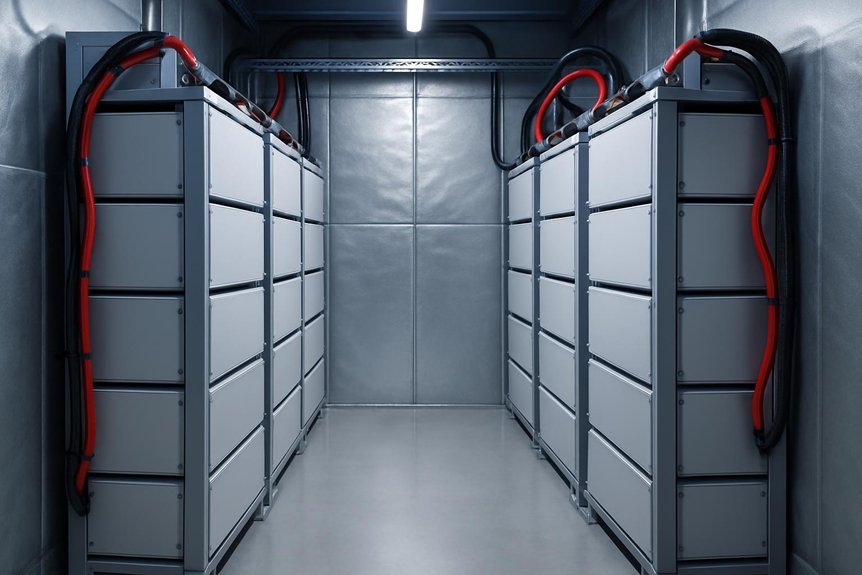
We see that foundational risks in BESS installations hinge on how thermal runaway is triggered, how state of charge and depth of discharge shape cell stress, and how aging alters heat and resistance over time. Thermal runaway is the primary severe failure mode that can lead to fire or explosion if unchecked, so robust design and monitoring are essential to interrupt escalation. Our approach is data-driven and risk-aware: by mapping triggers, SOC/DoD effects, and degradation pathways, we can prioritize design and operations that interrupt escalation. We’ll explore how these drivers interact across manufacturing, integration, and maintenance to build inherently safer storage at scale.
Thermal Runaway Triggers
Thermal runaway is not a distant risk but a concrete consequence of how we design, assemble, and operate BESS installations; recognizing the trigger points—mechanical abuse, electrical faults, and thermal environment factors—lets us prioritize mitigation where it matters most. We see mechanical abuse like punctures, crushes, and impacts igniting internal shorts within seconds to minutes, with propagation accelerating in dense packs. Electrical abuse—overcharges, overdischarges, high-rate currents, reversed cells, and faulty systems—creates hotspots and accelerated exothermic events. Thermal environment factors, including elevated ambient heat, poor airflow, external fire exposure, radiant transfer, and cyclic temperature swings, push margins toward runaway. Our pathway blends robust packaging, resilient BMS, and optimized cooling to suppress trigger paths, delivering safer, dependable energy storage at scale. subtopic irrelevant, unrelated content
SOC and DoD Impacts
What if our risk posture could be anchored to how we manage State of Charge (SoC) and Depth of Discharge (DoD) across every module? We see SoC nuances shaping propagation risk, as high SoC increases energy for exothermic events and top‑end charging raises thermal runaway potential. DoD implications reveal deeper cycling eroding safety margins, while frequent high-DoD profiles accelerate resistance growth and heat. We must harmonize DoD strategies with service profiles—partial cycling extends life and reduces peak stress. DoC patterns affect gas generation, venting, and explosion risk, especially in confined enclosures with elevated SoC. Our BMS must enforce nuanced SoC ranges and constrained DoD windows, balancing grid needs with safety margins, discovering opportunities to decouple high-SoC clusters and minimize cascading failures. SoC nuances and DoD implications drive smarter, safer architectures.
Aging Degradation Effects
Aging degradation is the quiet driver behind risk growth in BESS installations, linking our earlier focus on SoC/DoD to the real-world stressors that erode safety margins. We see three intertwined vectors: thermal stress accelerates SEI growth and electrolyte decomposition, calendar fade during storage, and mechanical shifts that disrupt contacts. Electrolyte aging and calendar fade drive capacity loss, impedance rise, and gas generation that elevates internal pressure. Elevated temperatures magnify parasitic reactions, accelerate LLI, and promote cathode instability, while nonuniform aging concentrates hotspots. Mechanical degradation from cycling or vibration compounds these effects, loosening connections and creating nonuniform current paths. Together, these degradation pathways inform risk-aware design and proactive monitoring—prioritizing thermal management, store conditions, and rigorous sequence checks to sustain safety margins.
Designing Safe Enclosures for Fire Containment
We design fire-resistant enclosures that isolate thermal events, using double-walled steel, fire-rated insulations, and reinforced seals to slow propagation and meet performance targets. Our approach emphasizes controlled venting, heat isolation, and automatic damper responses that limit oxygen and direct flames away from personnel and adjacent equipment. By integrating multi-parameter sensing, redundant controls, and data-driven performance metrics, we frame containment as a dynamic, verifiable system rather than a static barrier.
Fire-Resistant Enclosures Design
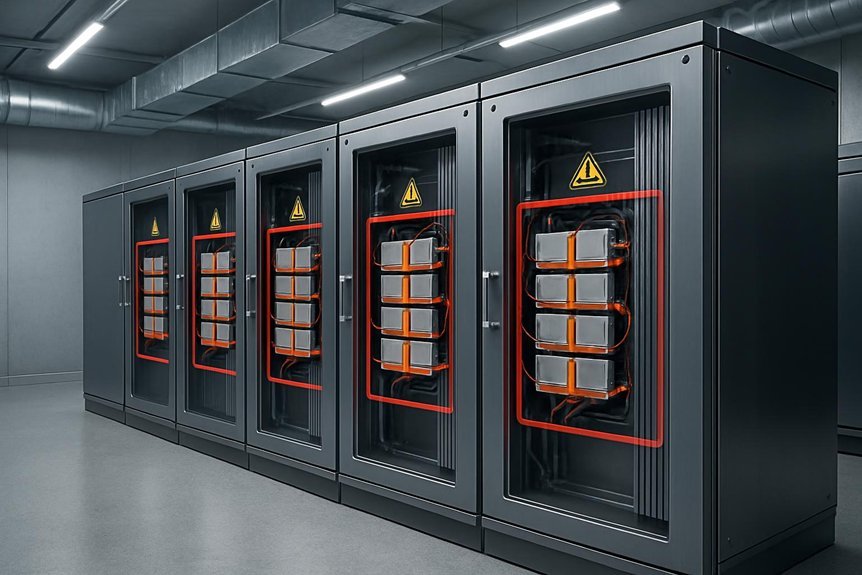
Envisioning safe, scalable fire-resistant enclosures starts with a robust, data-driven approach to materials, structure, and compartmentation. We combine double-walled steel with mineral wool or calcium-silicate cores to achieve 60–90+ minute fire resistance, reinforcing integrity under thermal stress. Intumescent coatings or ceramic blankets slow heat transfer, delaying exterior rise by 30–60 minutes in tests. Non-combustible internal fixtures limit secondary fuel load and resist off-gassing attack. Reinforced door frames, continuous welds, and fire-rated gasketing preserve containment during overpressure events. Modular partitions create fire zones, while sealed trays and dedicated barriers lower propagation. Pressure-relief panels control venting, and removable isolation inserts simplify post-event repairs, limiting cost. We integrate fire curtain and ceramic veil concepts as protective barriers, enhancing overall resilience.
Venting And Heat Isolation
Could we design venting and heat isolation as an integrated safety system that scales with risk? We can treat venting dynamics as a controllable failure mechanism, sizing vents to relieve peak pressures and direct blasts away from people and equipment. Roof or upper-wall placement reduces lateral debris, while controlled blow-out panels predictably open to prevent random ruptures. Heat isolation divides large arrays into smaller zones, containing energy release and limiting fire spread. We balance continuous dilution, active ventilation, and rapid shutoffs to keep gas concentrations well below ignition thresholds. Localized extraction curbs dilution needs and supports faster cooling. Fail-safe controls ensure oxygen is limited during events, preserving integrity and safety margins. Sensor redundancy and immediate responses close the loop.
- Venting dynamics guide risk-tuned enclosure design
- Localized extraction minimizes dilution requirements
- Predictable blow-out panels reduce debris ejection
- Heat isolation confines energy per zone
- Redundant sensors trigger rapid ventilation and shutdown
Compartmentalization and Barriers for Fire Limitation
Compartmentalization and fire barriers are essential to limit propagation in energy storage systems, combining cell-to-system hierarchy with proven barrier constructions to confine incidents and preserve critical function. We unite cell-level, module, rack, and room strategies to slow or halt spread, leveraging fire-rated assemblies, intumescent seals, and segmented enclosures. Passive barriers block heat transfer, while active vents and water-mist aids provide rapid cooling when needed. We design with perimeter fencing and exterior lighting as a security and detection layer that complements containment. The following table distills relationships among levels, materials, and outcomes for readers seeking actionable insight.
| Level | Barrier Material/Strategy | Expected Impact |
|---|---|---|
| Cell/Module | Fire-rated casings, separations | Delays propagation, reduces cascade |
| Rack/Room | Fire walls, venting, sealing | Localizes incidents, supports suppression |
| System | Segmentation, airflow control | Prevents system-wide failure, enables staged shutdown |
Per-Cell Monitoring and BMS Integration
What if we could see trouble the moment it begins? We can, through per-cell monitoring and seamless BMS integration that anchors safety to insight. Our approach combines millivolt-level voltage resolution with per-cell impedance and DCR trends to catch early degradation, plating, or shorts before they cascade. High-resolution thermal mapping reveals hotspots and delta-T across the pack, guiding selective derating and cooling actions. Continuous logging at 1 Hz–1 kHz captures transient events that slower systems miss, while threshold-based alerts refine intervention timing. Integrated data fuels predictive maintenance, reducing catastrophic failures and extending life. We fuse gas, pressure, voltage, and temperature signals for confident decisions and rapid isolation when needed.
Early warning through per-cell sensing, thermal mapping, and integrated BMS for safe, predictive, and rapid fault isolation.
- Early warning precision through per cell impedance and high-resolution thermal mapping
- Targeted isolation to prevent propagation
- Data-driven derating and cooling optimization
- Rapid, confident fault containment
- Predictive maintenance that lowers risk and cost
Detection and Early Warning Systems for Pre-Fire Events
Our prior focus on per-cell monitoring and BMS integration sets the baseline for proactive recognition of pre-fire events. We fuse gas sensing and acoustic emissions with strain, pressure, and voltage analytics to form a converged early-warning fabric. Hydrogen and hydrocarbon sensors capture electrolyte breakdown, with multi-gas arrays sharpening specificity and reducing false alarms. Gas trends, particularly rate-of-rise, offer earlier alerts than static thresholds, while humidity and temperature compensation maintain reliability. Strain gauges and fiber-optic sensors reveal deformation and venting precursors, and internal pack pressure signals map swelling progression. Rising impedance and cell-to-cell voltage divergence illuminate internal shorts before thermal escalation. By correlating mechanical, chemical, and electrical signals, we localize risk modules, enabling targeted intervention and safer, smarter storage. Gas sensing, acoustic emissions, proactive protection.
Suppression and Cooling Strategies for BESS Fires
- Visualize containment timelines that hinge on heat transfer dynamics
- Prioritize material compatibility to avoid corrosive surprises
- Balance aggressive cooling with vapor management for safe environments
- Integrate drainage and neutralization early to limit contamination
- Embrace data-driven, iterative refinement over static plans
Siting, Separation, and Emergency Planning
We’re guiding siting with risk-informed distances and clear barriers that shield communities, utilities, and responders while maximizing redundancy and access. Data on setbacks, flood/seismic/wildfire hazards, and zoning feeds our decisions, and we’ll translate those metrics into practical layouts, guardrails, and emergency routes. Our aim is proactive planning that constrains propagation, accelerates response, and minimizes regulatory friction through disciplined, verifiable design.
Siting Distances And Barriers
What distances and barriers are truly needed to protect people and assets when siting BESS? We balance risk, code, and real-world heat models to define practical buffers. Setbacks hinge on capacity, wildfire exposure, and community receptors, with 3 feet minimums indoors or near doors and vents, and larger separations per NFPA 855 for big deployments. Internal layouts enforce thermal separation between modules, while perimeter barriers reduce external ignition and vehicle risk. Enclosure aesthetics matter too: robust, noncombustible facades that still allow access for suppression. We optimize space for visibility and maintenance, not just density.
- We design with data-driven defensible space and risk-aware buffer zoning
- Thermal separation informs row spacing and access routes
- Enclosure aesthetics meet safety without sacrificing functionality
- Firebreaks and vehicle barriers are deliberate, not decorative
- Stormwater and runoff controls integrate with site geometry
Emergency Planning Coordination
How can we guarantee emergency planning aligns with siting and separation decisions to protect people and assets from the outset? We pursue integrated ERP design, grounded in NFPA 855, UL 9540/9540A, IEC series, and local codes, with AHJ coordination guiding suppression, access, and separation. Our approach links battery economics to practical protections: robust site access, labeled staging areas, and dedicated emergency gates become non-negotiable. We embed continuous telemetry, on-site water, foam, and containment inventories into pre-incident plans, elevating multi-agency drills from quarterly to data-informed routines. We address consumer packaging and waste handling post-incident, ensuring environmental reporting flows through defined channels. Clear communications, after-action reviews, and mutual aids refine ERP, enhancing resilience without increasing complexity.
Standards, Certification, and Practical Compliance
- Hazard mitigation as design discipline, not afterthought
- Testing standards driving installation parameters
- Verification through UL 9540/9540A data
- Documentation fueling insurance and financing
- Proactive risk assessment shaping continuous improvement
Frequently Asked Questions
How Do Fire Risks Differ Between Cylindrical, Pouch, and Prismatic Cells?
We observe cylindrical differences: they’re typically safer containment, cooler spread, and built-in vents, reducing propagation risk. Pouch cells pose higher swelling, rapid gas release, and unpredictable venting. Pouch vs. prismatic shows higher thermal coupling and risk.
What Operational Practices Reduce Soc-Related Fire Hazards Most?
We reduce fire hazards through strict operational practices that limit SOC exposure, enforce temperature-aware charging, and trigger rapid fault isolation, while continuously validating data-driven SOH models to anticipate risks and prevent SOC-driven incidents.
Can Aging Accelerate Thermal Runaway in Mixed-Module Packs?
Yes, aging accelerates thermal runaway in mixed pack interactions. We see faster propagation, hotspots, and higher peak temps with aged cells, guiding risk-aware, data-driven mitigations for safer, visionary storage design. aging acceleration, mixed pack interactions.
Do Venting Designs Influence Post-Failure Gas Exposure Risk?
Venting designs directly influence post-failure gas exposure risks; they shape venting reactions and dilution, moderating aging acceleration effects. We evaluate data-driven parameters, optimize paths, and anticipate risk to minimize ignition chances and occupant exposure.
What Metrics Indicate Imminent Thermal Events Beyond Temperature Rise?
We see imminent thermal events via SOC events patterns and impedance spikes; we monitor AE trends, pressure derivatives, and surface hot spots, using data-driven risk awareness to anticipate, alert, and mitigate before runaway initiates.
Conclusion
We’re building a safer grid by aligning chemistry, containment, and intelligent ops. Our data shows that modular, fire-resilient designs can slow propagation by 60–90 minutes, buying essential time for responders. By coupling real-time per-cell monitoring with robust venting and compartmentalization, we cut escalation risk while preserving reliability. If we commit to proactive siting, multi-layer detection, and NFPA-aligned standards, we don’t just store energy—we safeguard communities and the future of reliable power.
