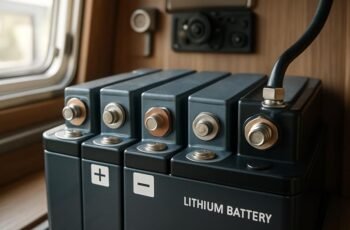
Did you know that improper cabling and poor cooling are the leading causes of early failure in golf cart lithium packs? We’ll walk you through careful planning, from matching voltage and chemistry to secure mounting and proper BMS integration, so you can minimize thermal stress and voltage sag. We’ll also cover venting, cable routing, and fault logging to keep systems safe and reliable, but there are critical checks you’ll want to perform before you proceed.
Key Takeaways
- Assess your golf cart’s range, duty cycle, and temperatures to determine appropriate voltage, AH, and discharge requirements before installation.
- Verify compatibility with OEM specs, controller, charger, and fitment dimensions to ensure proper mounting and clearance.
- Use secure, vibration-resistant mounting, correct polarity, appropriately gauged wiring, and a dedicated BMS with temperature sensing.
- Design cooling and cable routing with airflow channels, vents, color-coded cables, and modular isolation of battery packs for serviceability.
- Follow consistent charging windows, avoid over/under charging, monitor temperatures and voltages, and perform periodic inspections for longevity.
Define Your Golf Cart Battery Needs
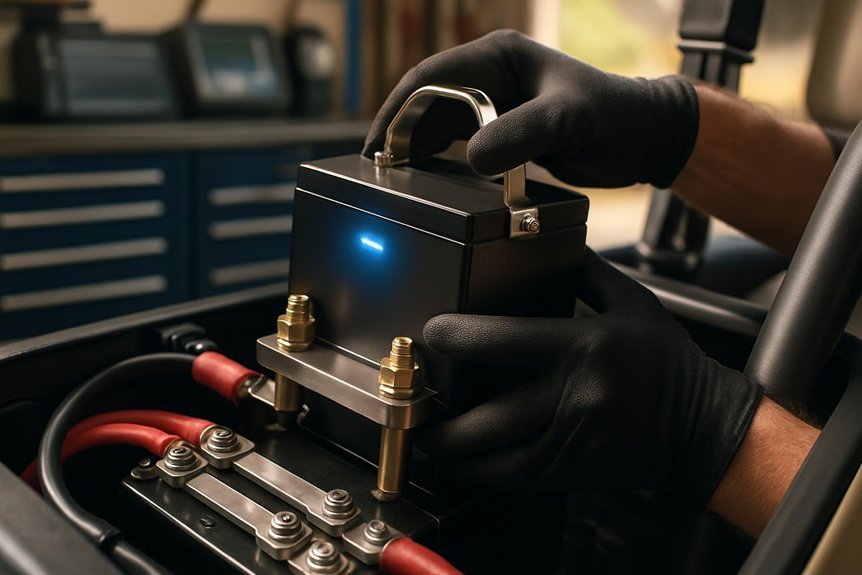
When choosing a golf cart battery, start by defining your performance and safety requirements. We assess range, acceleration, cycle life, charging efficiency, and temperature tolerance to set metrics. We quantify daily use patterns, load profiles, and duty cycles to estimate energy demand. We then translate needs into specific specs: voltage, amp-hour rating, and discharge rate, with safety margins for peak draws. To optimize reliability, we consider optimize capacity across typical on-course and terrain conditions, and weight distribution to preserve handling and braking. Battery chemistry options guide thermal management, lifecycle cost, and replacement intervals, informing cost planning. We document tolerance for corrosion, venting, and MTBF targets, plus warranty coverage. Our methodical definition reduces surprises and aligns performance with safety expectations.
Check Compatibility and Fitment Before Buying
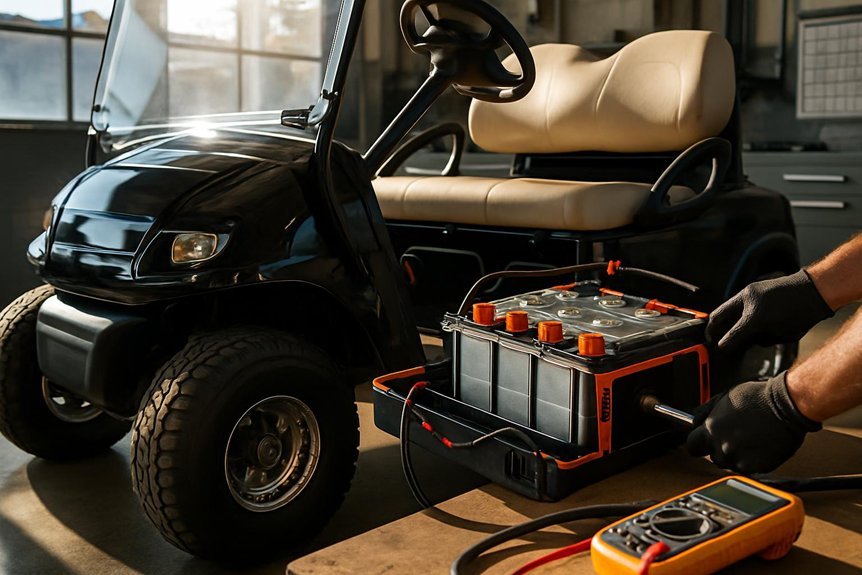
We’ve established your performance and safety targets; now we verify that the chosen battery actually fits and functions in your cart. To check compatibility, we assess voltage, amp-hour rating, and cell chemistry against OEM specifications, then confirm controller and charger compatibility. Fitment planning considers dimensions, mounting points, and enclosure clearances, plus access for maintenance. We also review storage considerations—cooling, humidity, and temperature limits—to prevent degradation. Weight distribution is evaluated to maintain balance, axle load, and tire wear. Table highlights quick checks:
| Dimension OK | Mounting Points | Access for Maintenance |
|---|---|---|
| Weight within spec | Enclosure clearance | Cooling airflow adequate |
| Voltage/Cap compatibility | Cable routing | Safety interlocks verified |
| Battery vendor support | Warranty terms | Aftermarket accessories |
| Storage temperature range | Impact on range | Transport handling |
Safe Mounting, Wiring, and Battery Management
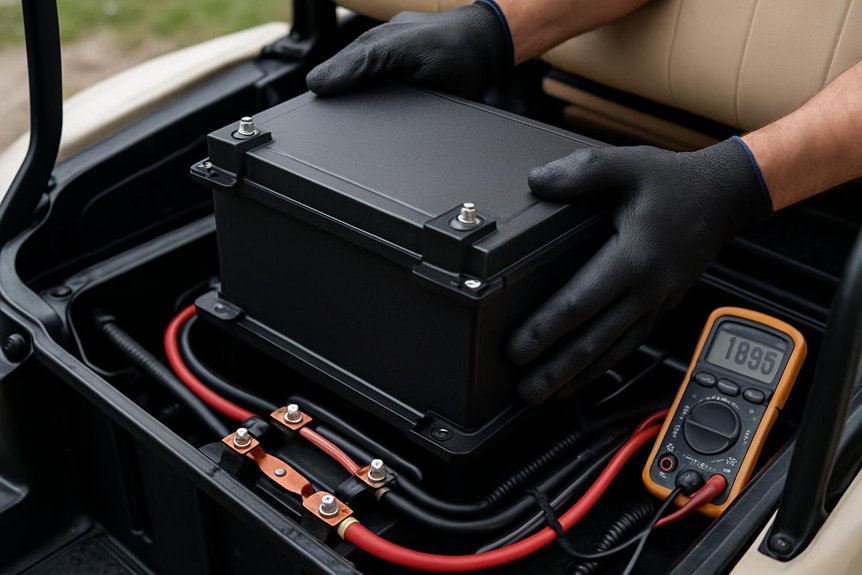
Are you confident your cart’s mounting, wiring, and battery management meet strict safety and performance benchmarks? We approach safe mounting by securing battery packs with vibration-resistant hardware and compliant isolation to prevent chassis contact. Wiring procedures emphasize polarity integrity, correct gauge selection, and protective sheathing to minimize abrasion and heat buildup. We document all connections using labeled terminals, torque specs, and crimp quality checks, ensuring low-resistance paths and reliable fault tracing. Battery management relies on a dedicated BMS, monitored cell balance, and temperature sensing to prevent overcharge, deep discharge, or thermal runaway. We enforce standardized routing, strain relief, and enclosure ventilation to reduce exposure risk. Data logs verify ongoing conformity to manufacturer limits, fleet cycles, and safety audits.
Optimize Cooling, Ventilation, and Cable Management
To optimize cooling, ventilation, and cable management, we prioritize uninterrupted heat dissipation, strategic airflow paths, and tidy, protected cabling that minimize thermal buildup and abrasion. Our approach relies on data-driven placement, optical cooling integration, and real-time monitoring with thermal sensors to verify performance under load. Effective airflow optimization reduces hotspot formation, while battery pack isolation prevents cross-channel heating from spreading. We also emphasize fixture rigidity and abrasion-resistant sleeves to sustain long-term reliability.
- Implement optical cooling channels that align with heat sources and maximize convective removal.
- Map airflow paths to avoid stagnation, using vents and baffles for balanced distribution.
- Isolate battery modules to contain heat and simplify cooling subsystem servicing.
- Secure cables with color-coded routing and protective sheathing to maintain integrity.
Charging, Maintenance, and Troubleshooting for Longevity
From our prior focus on cooling, ventilation, and cable management, we pivot to how to keep a golf cart lithium battery system performing reliably over time. We outline precise charging, routine maintenance, and targeted troubleshooting to maximize longevity. Practice consistent charging windows aligned with manufacturer guidance; avoid overcharging and deep discharges to minimize capacity fade. Monitor cell temperatures and voltage imbalances with calibrated tools, and document deviations promptly. Schedule periodic insulation and terminal checks, plus electrolyte or coolant verifications if applicable. When issues arise, diagnose with data: look for abnormal heat, voltage drift, or remodeling corrosion. Consider finding substitutes only after rigorous verification of safety and compatibility; don’t rely on unverified claims. Debunk safety myths with evidence, and reinforce proper PPE, ventilation, and fault isolation during service.
Frequently Asked Questions
How Long Does a Typical Golf Cart Lithium Battery Last per Charge?
Typically, a golf cart lithium battery lasts 4–8 years or 1,500–3,000 cycles per charge, depending on usage. We monitor lithium longevity metrics and follow charging etiquette to maximize lifespan and guarantee safe, reliable performance for you.
Can I Mix Lithium With Lead-Acid Batteries in One Cart?
We don’t recommend mixing lithium with lead-acid in one cart due to safety and compatibility concerns. Mixing compatibility and battery safety data show risks; use a single chemistry, proper BMS, and follow manufacturer guidelines for optimal performance.
Do Lithium Batteries Require a Dedicated Charger or BMS Upgrades?
Yes, lithium charging and BMS upgrades are usually required. We insist on proper BMS upgrades for cell balancing and safety, and a charger compatible with lithium chemistry to prevent voltage spikes and thermal issues. We prioritize data-driven, safe procedures.
What Are Signs of an Impending Lithium Battery Failure?
We see signs of impending lithium failure: capacity loss, voltage sag, sudden temp spikes, and abnormal impedance. We recommend bms upgrades and a dedicated charger, plus continuous monitoring, data-driven checks, and strict safety protocols before any replacement or service.
Are Warranties Transferable With Cart Modifications or Upgrades?
We can confirm warranty transferability is limited by cart modification impact; upgrades may void coverage. We’ll review terms, ensure documentation, and advise you on safety-critical implications before proceeding with any modification affecting the warranty.
Conclusion
We’ve covered precise steps to match voltage, capacity, and chemistry, secure mounts, and implement a dedicated BMS for balance and temperature, with proper cooling, venting, and strain-relief wiring. A data-driven note: lithium packs last 2–3× longer than lead-acid under proper cycling, reducing total cost of ownership when managed with timely SOC checks and fault logs. If we follow charging windows and preventive maintenance, our golf carts stay safer, more reliable, and ready for steady performance.